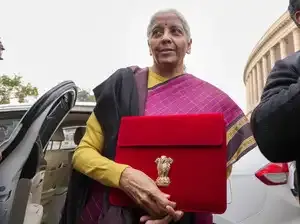
Finance Minister Nirmala Sitharaman used her Budget 2026-27 speech on Sunday to lay out an unusually broad industrial playbook, targeting six priority areas to steady India’s growth at a time when the global economic pitch looks increasingly uneven. From semiconductors and biopharma to textiles, MSMEs and urban economic clusters, the budget signalled a clear intent to deepen domestic manufacturing while insulating the economy from external shocks. The thrust comes amid slowing global trade, persistent geopolitical risks, and renewed tariff pressures in major markets that have complicated export-led growth strategies. Against this backdrop, Sitharaman’s proposals seek to convert supply-chain disruptions into an opportunity to scale up Indian production and jobs. The emphasis also marks an evolution from Budget 2025-26, which focused more narrowly on capex and PLI-style incentives, towards a more ecosystem-driven industrial strategy.
A similar logic underpins the expansion of the India Semiconductor Mission. ISM 1.0 helped India enter chip fabrication and assembly conversations; ISM 2.0 goes further by targeting equipment and materials manufacturing, full-stack Indian intellectual property, and more resilient domestic supply chains. This shift reflects global realities: US-China technology decoupling, export controls, and supply bottlenecks have made chip sovereignty a strategic priority. In January, analysts quoted by Reuters and The Economic Times noted that countries able to localise even parts of the semiconductor toolchain would enjoy outsized geopolitical leverage—something India is now clearly aiming for.
Critical minerals form another pillar. After launching a rare earth permanent magnet scheme in November 2025, the budget proposes dedicated rare earth corridors across mineral-rich states such as Odisha, Kerala, Andhra Pradesh and Tamil Nadu. With rare earths increasingly weaponised in global trade disputes, this move aims to anchor India’s electric mobility, electronics and defence ambitions in secure domestic supply.
MSMEs, often described as the economy’s shock absorbers, received a targeted push through a ?10,000-crore SME Growth Fund to create “champion” enterprises and future jobs. This is a notable upgrade from Budget 2025-26, which relied more on credit guarantees and compliance easing. The new fund’s performance-linked design reflects growing recognition that scale, not just survival, will determine MSMEs’ role in global value chains.
Industrial rejuvenation extends to 200 legacy industrial clusters, reflecting concerns flagged in pre-budget commentary that ageing clusters were losing competitiveness even as new industrial corridors came up. Complementing this are plans for three dedicated chemical parks, a sector long viewed as a downstream multiplier for pharmaceuticals, agrochemicals and specialty materials.
Infrastructure-linked manufacturing also features prominently. Schemes for container manufacturing, backed by ?10,000 crore over five years, and for construction and infrastructure equipment (CIE) aim to reduce import dependence in capital-intensive segments. The outlay for the Electronic Components Manufacturing Scheme, raised to ?40,000 crore, reinforces the electronics push that began in earlier budgets but now seeks deeper localisation beyond assembly.
Finally, Sitharaman’s proposal to develop city economic regions ties industrial policy to urban planning—an acknowledgement that competitive manufacturing ecosystems require logistics, skilled labour, housing and services to co-evolve. This marks a conceptual shift from Budget 2025-26’s corridor-centric thinking towards more integrated urban-industrial clusters.
The six-part strategy reflects a bet that India can play an aggressive industrial innings even as global conditions worsen. Whether it delivers a sixer or edges to the boundary will depend on execution—but the intent to reshape India’s manufacturing and urban economy is unmistakably bold.
Budget 2026 Live
Budget 2026: Catch all the live action here
Income Tax Slabs Live Updates
Stock Market Live Updates
Manufacturing muscle and MSME champions in a fragmented world
A central theme of the budget is scaling up manufacturing in strategic and frontier sectors where India sees both vulnerability and opportunity. The proposed BioPharma Strategy for Health Advancement through Knowledge, Technology and Innovation builds on lessons from the pandemic era and rising global demand for diversified pharma supply chains. While Budget 2025-26 focused largely on API self-reliance and incremental R&D incentives, this year’s approach widens the lens to innovation, technology and knowledge ecosystems—an attempt to move India up the value chain rather than remain a volume producer.Budget 2026 Highlights: Here's the fine print
A similar logic underpins the expansion of the India Semiconductor Mission. ISM 1.0 helped India enter chip fabrication and assembly conversations; ISM 2.0 goes further by targeting equipment and materials manufacturing, full-stack Indian intellectual property, and more resilient domestic supply chains. This shift reflects global realities: US-China technology decoupling, export controls, and supply bottlenecks have made chip sovereignty a strategic priority. In January, analysts quoted by Reuters and The Economic Times noted that countries able to localise even parts of the semiconductor toolchain would enjoy outsized geopolitical leverage—something India is now clearly aiming for.
Critical minerals form another pillar. After launching a rare earth permanent magnet scheme in November 2025, the budget proposes dedicated rare earth corridors across mineral-rich states such as Odisha, Kerala, Andhra Pradesh and Tamil Nadu. With rare earths increasingly weaponised in global trade disputes, this move aims to anchor India’s electric mobility, electronics and defence ambitions in secure domestic supply.
MSMEs, often described as the economy’s shock absorbers, received a targeted push through a ?10,000-crore SME Growth Fund to create “champion” enterprises and future jobs. This is a notable upgrade from Budget 2025-26, which relied more on credit guarantees and compliance easing. The new fund’s performance-linked design reflects growing recognition that scale, not just survival, will determine MSMEs’ role in global value chains.
Old clusters, new cities and the infrastructure-industrial link
The second leg of Sitharaman’s strategy focuses on rejuvenating legacy sectors while anchoring growth in infrastructure and urban regions. The labour-intensive textile sector gets an integrated programme combining a National Fibre Scheme, a Textile Expansion and Employment Scheme, and a consolidated National Handloom and Handicraft Programme. The announcement of mega textile parks signals continuity with earlier plans, but with sharper emphasis on modernisation, testing infrastructure and employment generation—areas where Budget 2025-26 had limited fiscal backing.Industrial rejuvenation extends to 200 legacy industrial clusters, reflecting concerns flagged in pre-budget commentary that ageing clusters were losing competitiveness even as new industrial corridors came up. Complementing this are plans for three dedicated chemical parks, a sector long viewed as a downstream multiplier for pharmaceuticals, agrochemicals and specialty materials.
Infrastructure-linked manufacturing also features prominently. Schemes for container manufacturing, backed by ?10,000 crore over five years, and for construction and infrastructure equipment (CIE) aim to reduce import dependence in capital-intensive segments. The outlay for the Electronic Components Manufacturing Scheme, raised to ?40,000 crore, reinforces the electronics push that began in earlier budgets but now seeks deeper localisation beyond assembly.
Finally, Sitharaman’s proposal to develop city economic regions ties industrial policy to urban planning—an acknowledgement that competitive manufacturing ecosystems require logistics, skilled labour, housing and services to co-evolve. This marks a conceptual shift from Budget 2025-26’s corridor-centric thinking towards more integrated urban-industrial clusters.
The six-part strategy reflects a bet that India can play an aggressive industrial innings even as global conditions worsen. Whether it delivers a sixer or edges to the boundary will depend on execution—but the intent to reshape India’s manufacturing and urban economy is unmistakably bold.