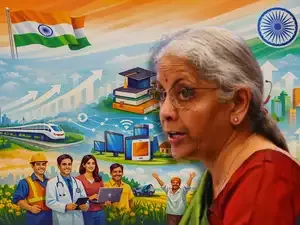
Budget 2026: Union Finance Minister Nirmala Sitharaman on Sunday positioned India’s creative industries as a new engine of jobs and services-led growth, announcing fresh support for the “Orange Economy” while presenting the Union Budget for 2026–27.
“Orange economy. India's animation, visual effects, gaming and comics (AVCG) sector is a growing industry projected to require 2 million professionals by 2030. I propose to support the Indian Institute of creative Technologies Mumbai in setting up AVCG content creator labs in 15,000 secondary schools all over the country and 500 colleges,” Sitharaman said in her Budget speech.
The proposal builds on themes flagged prominently in the Economic Survey 2025–26, which argues that creativity-led sectors — spanning culture, media, entertainment and intellectual property -- can emerge as significant drivers of employment, urban services and tourism. Termed the “Orange Economy”, these activities derive value primarily from ideas, artistic expression and cultural capital rather than physical goods.
Also read: Budget 2026 makes fresh bet on manufacturing as it seeks to sustain growth
Within this broader framework, the Survey identifies the concert economy as a particularly high-impact but underdeveloped segment in India’s services landscape. Live entertainment, it notes, generates economic value far beyond ticket sales, creating demand across hospitality, transport, logistics, advertising, security and local services.
Global experience cited in the Survey shows that live music accounts for roughly one-third of global music revenues. In the United States, live music generated over USD 130 billion in economic output and supported more than 900,000 jobs in 2019. In the UK, music tourism contributed £6.6 billion -- around 0.3 per cent of GDP -- in 2022. More broadly, UNCTAD estimates referenced in the Survey suggest creative industries contribute between 0.5 per cent and over 7 per cent of GDP across countries.
The Survey highlights that concerts act as short-duration tourism multipliers, intensifying spending on accommodation, food, transport and city services over brief periods. It also underscores their labour-intensive nature, with employment generated across event operations, stage management, logistics, hospitality, security and media -- sectors that tend to absorb younger workers and creative professionals.
Budget 2026: Sitharaman proposes high-level committee to review banking sector under Viksit Bharat
In India, the concert economy remains nascent but is expanding, supported by a young population, rising discretionary spending, digital ticketing platforms and improving urban infrastructure. However, the Economic Survey cautions that scale alone will not unlock economic gains. It points to the importance of urban readiness and facilitative governance, including predictable regulations, crowd management systems, efficient transport links and streamlined approvals.
Structural bottlenecks persist, including a shortage of large live-event venues and constraints around payments to foreign performers. The Survey suggests that opening up heritage monuments for select events and easing visa and foreign exchange permissions for international artists could significantly enhance India’s appeal as a global concert destination.
At present, event organisers often require between 10 and 15 separate clearances. The Ministry of Information and Broadcasting is working towards a single-window mechanism for live entertainment permissions, including approvals from state governments — a reform the Survey implicitly frames as critical to unlocking the sector’s potential.
Budget 2026: Nirmala Sitharaman announces Rs 10,000 crore MSME growth fund to tariff-proof sector
Taken together, the Economic Survey argues that the Orange Economy should be viewed not as niche entertainment, but as part of a broader urban growth and tourism strategy. With targeted policy support, regulatory simplification and skills development -- including initiatives such as the AVCG creator labs announced in the Budget -- India could convert creativity and culture into a durable source of jobs and economic value.
Budget 2026 Live
Budget 2026: Catch all the live action here
Income Tax Slabs Live Updates
Stock Market Live Updates
Budget 2026 Highlights: Here's the fine print
The proposal builds on themes flagged prominently in the Economic Survey 2025–26, which argues that creativity-led sectors — spanning culture, media, entertainment and intellectual property -- can emerge as significant drivers of employment, urban services and tourism. Termed the “Orange Economy”, these activities derive value primarily from ideas, artistic expression and cultural capital rather than physical goods.
Also read: Budget 2026 makes fresh bet on manufacturing as it seeks to sustain growth
Within this broader framework, the Survey identifies the concert economy as a particularly high-impact but underdeveloped segment in India’s services landscape. Live entertainment, it notes, generates economic value far beyond ticket sales, creating demand across hospitality, transport, logistics, advertising, security and local services.
Global experience cited in the Survey shows that live music accounts for roughly one-third of global music revenues. In the United States, live music generated over USD 130 billion in economic output and supported more than 900,000 jobs in 2019. In the UK, music tourism contributed £6.6 billion -- around 0.3 per cent of GDP -- in 2022. More broadly, UNCTAD estimates referenced in the Survey suggest creative industries contribute between 0.5 per cent and over 7 per cent of GDP across countries.
The Survey highlights that concerts act as short-duration tourism multipliers, intensifying spending on accommodation, food, transport and city services over brief periods. It also underscores their labour-intensive nature, with employment generated across event operations, stage management, logistics, hospitality, security and media -- sectors that tend to absorb younger workers and creative professionals.
Budget 2026: Sitharaman proposes high-level committee to review banking sector under Viksit Bharat
In India, the concert economy remains nascent but is expanding, supported by a young population, rising discretionary spending, digital ticketing platforms and improving urban infrastructure. However, the Economic Survey cautions that scale alone will not unlock economic gains. It points to the importance of urban readiness and facilitative governance, including predictable regulations, crowd management systems, efficient transport links and streamlined approvals.
Structural bottlenecks persist, including a shortage of large live-event venues and constraints around payments to foreign performers. The Survey suggests that opening up heritage monuments for select events and easing visa and foreign exchange permissions for international artists could significantly enhance India’s appeal as a global concert destination.
At present, event organisers often require between 10 and 15 separate clearances. The Ministry of Information and Broadcasting is working towards a single-window mechanism for live entertainment permissions, including approvals from state governments — a reform the Survey implicitly frames as critical to unlocking the sector’s potential.
Budget 2026: Nirmala Sitharaman announces Rs 10,000 crore MSME growth fund to tariff-proof sector
Taken together, the Economic Survey argues that the Orange Economy should be viewed not as niche entertainment, but as part of a broader urban growth and tourism strategy. With targeted policy support, regulatory simplification and skills development -- including initiatives such as the AVCG creator labs announced in the Budget -- India could convert creativity and culture into a durable source of jobs and economic value.