What is the Orange Economy? The internet is abuzz with the term 'Orange Economy' after Union Finance Minister Nirmala Sitharaman used the term as she presented the Budget 2026 on Sunday. In her budget speech, the finance minister announced a major push for India's creative industries or the so-called "orange economy", outlining budgetary measures aimed at creating future-ready jobs and strengthening skills in animation, design and emerging technologies. So, what is 'Orange Economy' and how is it linked to content creators?
In simple language, the 'Orange Economy, also known as the 'creative economy,' is a concept that includes sectors related to creativity and cultural industries. The 'orange economy' refers to sectors driven by ideas, technology, culture, and intellectual property rather than traditional manufacturing. It encompasses industries like animation, gaming, film, music, design, and digital content, aiming to foster job creation, urban development, and cultural value.
The concept of orange economy has been promoted to highlight how cultural heritage and creativity can fuel sustainable economic growth. It spans sectors such as advertising, animation, software, video games, film, fashion, publishing, and content creation. Recent government initiatives include setting up content creator labs in educational institutions and establishing a National Institute of Design.
Prime Minister Narendra Modi also highlighted India’s rising role in the global creative economy at the WAVES 2025 (World Audio Visual and Entertainment Summit), focusing on the concept of an "orange economy" that emphasizes creativity, culture, and intellectual property.
ALSO READ: STT and F&O explained: Why has FM Nirmala Sitharaman’s proposed hike on Securities Transaction Tax in her Budget speech left traders worried? All FAQs explained
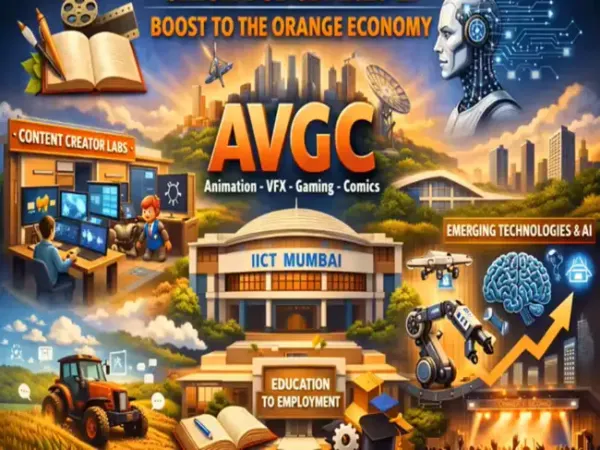
“India's animation, visual effects, gaming and comics sector is a growing industry, projected to require 2 million professionals by 2030,” Sitharaman said in her Budget speech. “I propose to support the Indian Institute of Creative Technologies, Mumbai, in setting up AVGC content creator labs in 15,000 secondary schools all over the country and 500 colleges.”
According to the government, the initiative aims to strengthen India’s next-generation creator workforce and support jobs, startups and innovation in the creative economy. The proposal draws on observations in the Economic Survey 2025–26, which noted that creativity-led sectors—such as culture, media, entertainment, and intellectual property—can drive employment, urban services, and tourism. Referred to as the “Orange Economy,” these activities generate value mainly from ideas, artistic expression, and cultural capital rather than physical goods.
ALSO READ: '4 guna lagaan dena hoga': STT hike budget memes storm internet as Niramala Sitharaman moots changes for F&O. Check hilarious reactions
A special emphasis was placed on the live entertainment or concert economy, described as a high-multiplier activity. India’s live entertainment industry crossed ₹10,000 crore in 2024, and beyond ticket sales, it fuels demand for hospitality, transport, logistics, and other local services. The survey also noted that creative industries contribute between 0.5% and 7% of GDP globally. In the United States, live music alone supported more than 900,000 jobs and generated over $130 billion in 2019.
It underlined the concert economy’s potential to boost tourism, urban services, and employment, while noting challenges such as venue shortages and regulatory hurdles.
In her speech, Nirmala Sitharaman highlighted the design sector’s rapid growth and the shortage of trained professionals.
Proposal to set up a new National Institute of Design (NID) in eastern India to strengthen design education and regional development.
ALSO READ: Budget 2026-27 memes: As Nirmala Sitharaman presents her 9th budget, netizens use iconic Panchayat dialogue, 'Apke fund se thoda paise mil jaata toh...'
The Budget emphasised that AI and emerging technologies are central to building citizen capacity and enabling inclusive growth.
Key initiatives supporting this push include the AI Mission, National Quantum Mission, Anusandhan National Research Fund, and the Research, Development and Innovation Fund.
Technology’s role was highlighted in benefiting farmers, women in STEM, youth seeking upskilling, and persons with disabilities.
Emerging technologies were positioned as crucial to expanding India’s orange economy.
Announcement of ‘Bharat-VISTAAR’ — a multilingual AI-based platform integrating AgriStack portals with ICAR practices to improve farm productivity and decision-making.
Proposal to create a high-powered ‘Education to Employment and Enterprise’ Standing Committee to assess how AI and emerging technologies will impact jobs and skills.
Budget 2026 Live
Your 2-minute guide to becoming a Budget pro
Check what gets cheaper and costlier in Budget this year
How far has India come since the last money manual
Budget 2026 Highlights: Here's the fine print
The concept of orange economy has been promoted to highlight how cultural heritage and creativity can fuel sustainable economic growth. It spans sectors such as advertising, animation, software, video games, film, fashion, publishing, and content creation. Recent government initiatives include setting up content creator labs in educational institutions and establishing a National Institute of Design.
Prime Minister Narendra Modi also highlighted India’s rising role in the global creative economy at the WAVES 2025 (World Audio Visual and Entertainment Summit), focusing on the concept of an "orange economy" that emphasizes creativity, culture, and intellectual property.
ALSO READ: STT and F&O explained: Why has FM Nirmala Sitharaman’s proposed hike on Securities Transaction Tax in her Budget speech left traders worried? All FAQs explained
Orange Economy and Union Budget 2026-27
Nirmala Sitharaman has announced fresh support for the “Orange Economy” in the Union Budget 2026. Presenting her ninth consecutive Budget, Sitharaman said the government would support the Indian Institute of Creative Technologies (IICT), Mumbai, to set up animation, visual effects, gaming and comics (AVGC) and content creator labs across 15,000 secondary schools and 500 colleges nationwide.“India's animation, visual effects, gaming and comics sector is a growing industry, projected to require 2 million professionals by 2030,” Sitharaman said in her Budget speech. “I propose to support the Indian Institute of Creative Technologies, Mumbai, in setting up AVGC content creator labs in 15,000 secondary schools all over the country and 500 colleges.”
According to the government, the initiative aims to strengthen India’s next-generation creator workforce and support jobs, startups and innovation in the creative economy. The proposal draws on observations in the Economic Survey 2025–26, which noted that creativity-led sectors—such as culture, media, entertainment, and intellectual property—can drive employment, urban services, and tourism. Referred to as the “Orange Economy,” these activities generate value mainly from ideas, artistic expression, and cultural capital rather than physical goods.
ALSO READ: '4 guna lagaan dena hoga': STT hike budget memes storm internet as Niramala Sitharaman moots changes for F&O. Check hilarious reactions
What does Economic Survey say about the Orange Economy?
The Economic Survey 2025–26 highlighted the ‘orange economy’ as an emerging engine for India’s employment generation, urban services, and tourism growth. It positioned the creative economy as a key pillar of India’s services-led growth model, with the potential to absorb a large workforce that traditional manufacturing may struggle to accommodate.A special emphasis was placed on the live entertainment or concert economy, described as a high-multiplier activity. India’s live entertainment industry crossed ₹10,000 crore in 2024, and beyond ticket sales, it fuels demand for hospitality, transport, logistics, and other local services. The survey also noted that creative industries contribute between 0.5% and 7% of GDP globally. In the United States, live music alone supported more than 900,000 jobs and generated over $130 billion in 2019.
Key takeaways about Orange Economy
The Economic Survey defined the “orange economy” as activities that derive value mainly from ideas, artistic expression, and cultural capital.It underlined the concert economy’s potential to boost tourism, urban services, and employment, while noting challenges such as venue shortages and regulatory hurdles.
In her speech, Nirmala Sitharaman highlighted the design sector’s rapid growth and the shortage of trained professionals.
Proposal to set up a new National Institute of Design (NID) in eastern India to strengthen design education and regional development.
ALSO READ: Budget 2026-27 memes: As Nirmala Sitharaman presents her 9th budget, netizens use iconic Panchayat dialogue, 'Apke fund se thoda paise mil jaata toh...'
The Budget emphasised that AI and emerging technologies are central to building citizen capacity and enabling inclusive growth.
Key initiatives supporting this push include the AI Mission, National Quantum Mission, Anusandhan National Research Fund, and the Research, Development and Innovation Fund.
Technology’s role was highlighted in benefiting farmers, women in STEM, youth seeking upskilling, and persons with disabilities.
Emerging technologies were positioned as crucial to expanding India’s orange economy.
Announcement of ‘Bharat-VISTAAR’ — a multilingual AI-based platform integrating AgriStack portals with ICAR practices to improve farm productivity and decision-making.
Proposal to create a high-powered ‘Education to Employment and Enterprise’ Standing Committee to assess how AI and emerging technologies will impact jobs and skills.