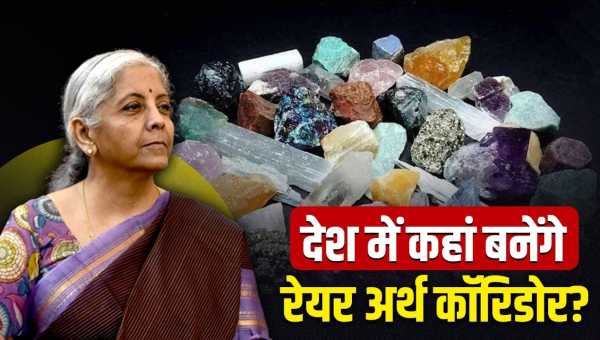
In the General Budget 2026, Finance Minister Nirmala Sitharaman has announced the creation of Rare Earth Corridor.
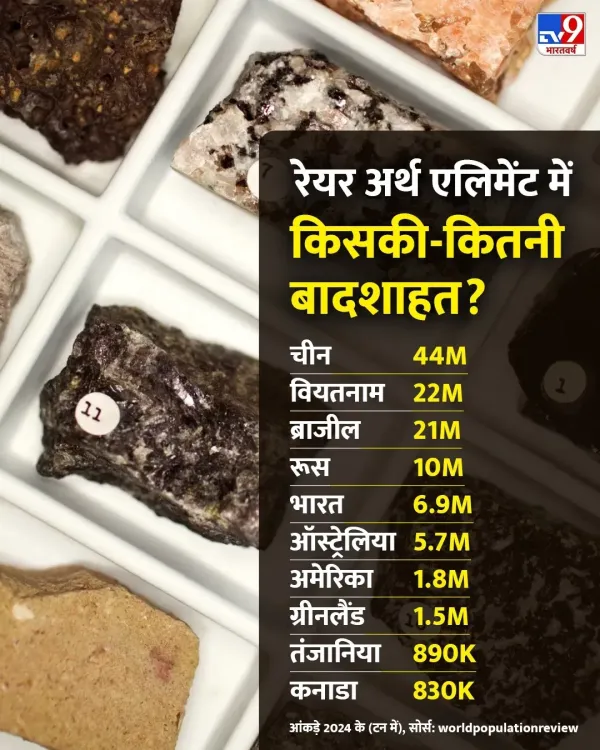
India is moving towards becoming a supplier and not just a consumer in the technology race of the 21st century. In this context, the government's special focus is visible on rare earth minerals i.e. rare earth elements (REEs). In the General Budget 2026, Finance Minister Nirmala Sitharaman announced the creation of Rare Earth Corridor, which can pave the way for a new industrial revolution in India's coastal and mining-rich areas. Not only this, by focusing on this, India is also trying to defeat China, because in the case of rare earth elements, China is at the top and India is at 5th position.
Let us try to solve some questions related to this in the name of announcement made in the Union Budget. Like, where are the reserves of rare earth minerals in India? In which states is the government's focus? Where will rare earth corridors be built?
What are rare earth minerals, why are they important?
Rare earth minerals are a group of 17 elements. 15 Lanthanides, plus scandium and yttrium. These remain hidden inside seemingly ordinary minerals like monazite etc., but the backbone of modern technology rests on them. They are mainly used in smartphones, laptops, high-end electronics, electric vehicle (EV) motors and batteries, wind turbines and other green energy technologies, satellites, radar, missile and defense systems and high-performance permanent magnets, lasers, medical imaging etc.
Currently, China's share in the world's supply chain is very high. This is why control over rare earths is not only considered an economic but also a strategic power.
Which rare earth minerals are found where in India?
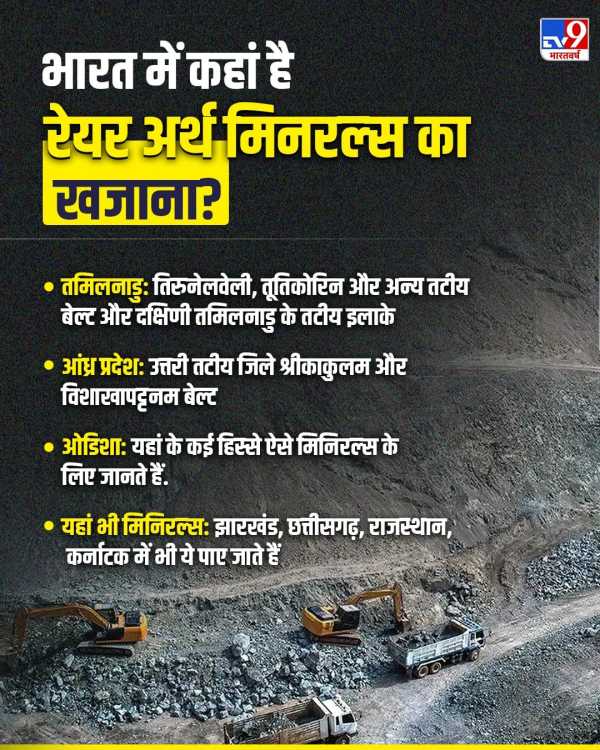
India's rare earth resources are mainly concentrated in beach sand and some internal mineral deposits. There are possibilities of rare earth mineral reserves in many other states including Kerala, Tamil Nadu, Andhra Pradesh, Odisha.
- Chavara and surrounding areas of Kollam district in Kerala is the main hub of sand minerals. Heavy minerals like monazite, ilmenite, rutile, zircon are found here, which contain good amount of rare earth elements. Major activities of Indian Rare Earths Limited are concentrated here.
- Tirunelveli, Tuticorin and other coastal belts in Tamil Nadu, coastal areas of southern Tamil Nadu are known for beach sand minerals. Here, minerals including monazite are found, from which elements like neodymium, praseodymium, dysprosium can be extracted, which are necessary for high-performance magnets.
- The northern coastal districts in Andhra Pradesh between the Srikakulam and Visakhapatnam belts are important for placer deposits. Monazite-rich sand and other heavy minerals are also present here, which can become raw materials for the future rare earth value chain.
- Odisha has long been known for minerals like iron, bauxite and chromite. In recent years, the possibilities of minerals related to rare earth have been highlighted in its coastal and some internal areas. In Budget 2026, it has been specifically said to support Odisha under the Rare Earth Corridor Scheme.
- Other potential states also include Jharkhand, Chhattisgarh, Rajasthan, Karnataka etc., where there are signs of rare earth minerals in some parts. However, the focus of the government's main corridor is on the coastal states with beach sand monazite. In future, with the development of geological survey and technology, the role of these states may increase.
On which states is the government's current focus?
The main states which have been clearly identified by the government for Rare Earth Corridor in the Union Budget 2026 are Odisha, Kerala, Andhra Pradesh, Tamil Nadu. The government proposes that these mineral rich states will be provided assistance to develop Rare Earth Mineral Corridor, which will include mining, processing (separation and purification of rare earths from ore), research and development, manufacturing, especially permanent magnets and other high-value products etc.
Where will rare earth corridors be built?
According to the announcement of Budget 2026, the focus of the corridor is mainly on sand monazite deposits between the coastal states. In broad terms, the outline of the corridor can be understood like this.
- Kerala Rare Earth Corridor: Chavaravijinjamkochi belt. Beach sand mining and primary processing at Chavara, export and logistics support from deep sea ports like Vizhinjam and Kochi. According to available reports, Kerala alone is looking at investment potential of around Rs 42 thousand crore, which could span from mining to value-added manufacturing.
- Tamil Nadu Rare Earth Corridor: Probable areas here: Tirunelveli, Tuticorin, Nagapattinam and other coastal parts, where there are beach sand deposits. Tamil Nadu is already strong in terms of ports, roads and industrial corridors, hence manufacturing clusters of rare earth based magnets and electronic components can be developed.
- Andhra Pradesh Rare Earth Corridor: Srikakulam to Visakhapatnam Rail-Road-Port Connectivity Belt in North Coastal Andhra. Visakhapatnam can form the backbone of the corridor as a port and industrial hub, where rare earth processing plants, magnet factories, and units of electronics/EV supply chain can be established.
- Odisha Rare Earth Corridor: The mineral belt and coastal areas here may include Paradip Port and areas related to internal mining. Steel, aluminum and other heavy industries are already present here. With the addition of rare earth value chain, a new pillar can be added to the industrial economy of the state.
The exact geographical boundaries of the corridor, location of clusters, and finer details of the project will become clear from future government notifications, detailed project reports, and state policies. Now it has come out in the form of a framework and policy information.
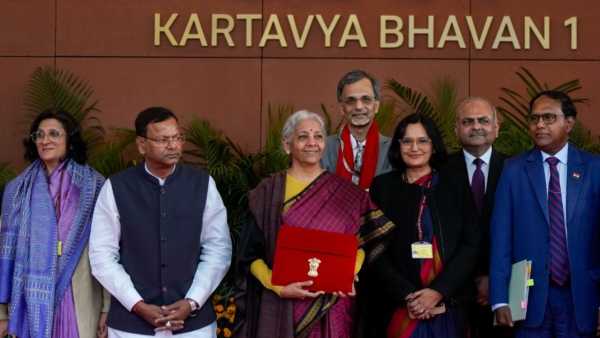
budget 2026
Why is the government focusing?
- India and China-Plus-One Strategy: The world today is highly dependent on China for rare earth supply. India wants to secure supplies for itself through the Rare Earth Corridor and also wants to become an alternative source for those countries which are adopting China Plus One strategy.
- Green Energy and EV Mission: There is a huge demand for rare earth based magnets in electric vehicles, battery storage and wind turbines. India has set net zero and big EV targets by 2070. Domestic rare earth supply will reduce both costs and geo-political risks.
- Needs of Space and Defense Sector: The need for high-performance magnets, sensors and advanced materials in India's space missions (e.g. Chandrayaan, Gaganyaan) and defense platforms is continuously increasing. By creating a domestic rare earth value chain, ISRO, DRDO and other agencies can get safe and stable supply.
- Employment and Export Potential: According to the estimates of policy analysts, the Rare Earth Corridor can create more than 50 thousand direct and indirect jobs and there is a possibility of exports worth up to 10 billion dollars by 2030. The emphasis on value-added manufacturing rather than mining will also create high-skilled jobs.

Challenges and emerging questions
As attractive as the Rare Earth Corridor looks, serious questions also arise. Beach sand mining can impact coastal ecosystems, fishing communities and coastal biodiversity. Chemical use and safe disposal of radioactive by-products (such as thorium-containing waste) are critical in rare earth processing.
Issues such as land acquisition, use of coastal areas, and impact on traditional livelihoods (fisheries etc.) will come to the fore. Transparent consultation, fair compensation, and ensuring jobs for local people on priority will be necessary. Creating the entire value chain from mining to high-end magnets and electronic components is not easy. This will require foreign technology partnerships, huge investment in R&D and skill development, otherwise India may remain only a raw material supplier.
From time to time, there are sharp fluctuations in the prices of rare earths around the world. If projects are planned only keeping in mind the period of high prices, then economic pressure may increase when prices fall. Therefore, policy stability and long-term thinking are important.
At the juncture where India stands today, rare earth minerals are not just another mineral resource, but a strategic opportunity standing at the intersection of technology, security, green energy and geopolitics. The proposed rare earth corridor in Odisha, Kerala, Andhra Pradesh and Tamil Nadu can empower India at many levels. Chinese dependence will reduce, India's bargaining power in the global supply chain will increase. New industries will be created from beach sand to high-tech magnets, EV components, satellite-missile parts.
A new wave of investment, infrastructure and skill development may arise in coastal and mining rich states. But this opportunity will be realized only if transparent and responsible policies are implemented on environmental standards, rights of local communities, and long-term technology potential.
-
Horror as woman raped in motorway service station toilet

-
Video Alleging Rashmika Mandanna & Vijay Deverakonda's Wedding Prep At Udaipur Palace Goes Viral; Internet Reacts

-
Union Budget will benefit Bihar: Nitish Kumar
-
Celebrating Unity: Assam Tea Employees' Association Conference Highlights Cultural Diversity
-
Aus Open: Alcaraz ends Djokovic's perfect finals record to win first Australian Open title in Melbourne