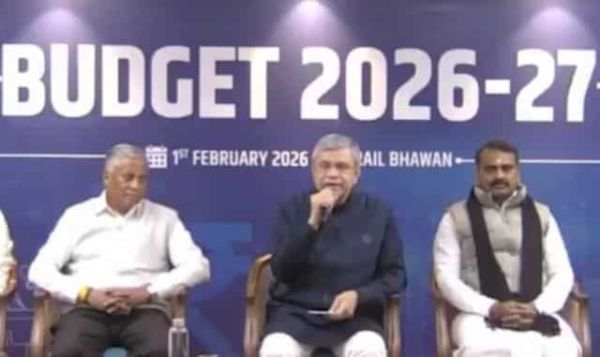
In a landmark push for infrastructure and economic growth, the Indian government has allocated a record capital expenditure (CapEx) of Rs 2.93 lakh crore for Indian Railways in the Union Budget 2026-27.
This unprecedented funding, the highest ever for the sector, aims to revolutionise rail connectivity, enhance freight efficiency, and prioritise passenger safety, aligning with Prime Minister Narendra Modi’s vision of a Viksit Bharat (Developed India).
Union Minister for Railways, Ashwini Vaishnaw, highlighted the budget’s focus during a press conference at Rail Bhawan, emphasising how it will accelerate modernisation, safety measures, and passenger amenities. “This historic budget of Rs 2.78 lakh crore will give momentum to railway safety, modernisation, and passenger facilities,” Minister Vaishnaw posted on X (formerly Twitter), expressing gratitude to PM Modi and Finance Minister Nirmala Sitharaman.
High-Speed Rail Corridors to Transform Inter-City Travel
A major highlight is the announcement of seven new high-speed rail corridors spanning nearly 4,000 kilometers, expected to attract investments worth Rs 16 lakh crore. These corridors will connect key cities, reducing travel times dramatically and fostering economic integration across regions.
The proposed routes include:
- Mumbai to Pune (travel time: ~48 minutes)
- Pune to Hyderabad (~1 hour 55 minutes)
- Hyderabad to Bengaluru (~2 hours)
- Hyderabad to Chennai (~2 hours 55 minutes)
- Chennai to Bengaluru (~1 hour 13 minutes)
- Delhi to Varanasi (~3 hours 50 minutes)
- Varanasi to Siliguri (~2 hours 55 minutes)
In South India, the Chennai-Bengaluru-Hyderabad network will form a “South High-Speed Diamond,” benefiting states like Karnataka, Telangana, Andhra Pradesh, Tamil Nadu, Kerala, and Puducherry. Minister Vaishnaw described this as a “big boon” for regional development, transforming the transportation sector and boosting IT and economic hubs.
Northern and eastern corridors, such as Delhi-Varanasi and Varanasi-Siliguri (via Patna), will create new economic belts across Delhi, Uttar Pradesh, Bihar, and West Bengal, promoting seamless multimodal passenger movement and sustainable transport.
New Dedicated Freight Corridor to Bolster East-West Trade
To enhance logistics and decongest networks, a 2,052 km Dedicated Freight Corridor (DFC) from Dankuni in West Bengal to Surat in Gujarat has been announced. Passing through Odisha, Chhattisgarh, Madhya Pradesh, and Maharashtra, it will integrate with the existing Western DFC, enabling efficient goods movement to western ports.
Minister Vaishnaw noted that the existing Eastern and Western DFCs are already handling around 400 freight trains daily and operating near saturation. This new East-West corridor will strengthen trade flows, support industrial growth, and reduce logistics costs, positioning railways as a key driver of supply chain efficiency.
Safety at the Forefront with Rs 1.20 Lakh Crore Allocation
Safety continues to be paramount, with nearly Rs 1.20 lakh crore dedicated to initiatives. This includes advanced track maintenance, rapid deployment of the Kavach automatic train protection system, CCTV installations, overhead electrical upgrades, and station redevelopment.
The minister pointed out a 95% reduction in railway accidents due to past investments, underscoring the government’s commitment to further improvements. Enhanced locomotive, wagon, and coach maintenance, along with better customer care, will elevate the overall passenger experience.
Technological and Sustainability Milestones
Indian Railways is also making strides in indigenous technology. Propulsion systems designed and manufactured in India are now being exported to leading nations like the USA, Germany, France, Switzerland, and Spain, marking a significant achievement in self-reliance.
On the sustainability front, rail transport is highlighted as 95% less polluting than road alternatives, supporting India’s environmental goals. Record infrastructure feats include 35,000 km of new tracks, 47,000 km of electrification (covering over 99.5% of the broad-gauge network), and accelerated production of Vande Bharat, Amrit Bharat, and Namo Bharat trains.
This budget reinforces Indian Railways’ role as the backbone of national development, promising faster connectivity, efficient logistics, and resilient infrastructure to propel India towards a developed future.
-
How much salary do Agniveers get in the Air Force? Find out here.

-
Don't want financial worries in retirement? Find out which of EPF, PPF, and NPS is best for you.

-
AI Users Alert: OpenAI Makes Big Decision - These ChatGPT AI Models Will Be Shut Down Next Month

-
No respite for cyber fraudsters, data theft to be curbed, new data framework announced in Budget 2026

-
Girls' Hostels to Open in Every District of the Country: How and Who Will Get Accommodation?
