
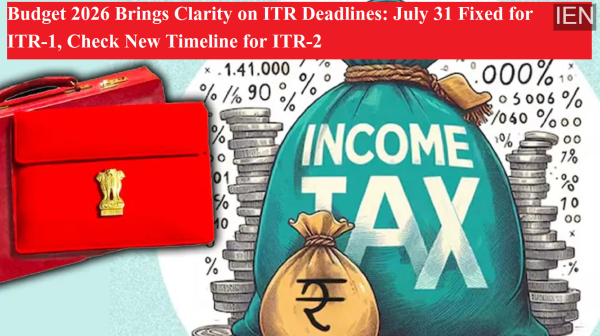
The Union Budget 2026 has delivered long-awaited clarity for millions of taxpayers by removing confusion around income tax return (ITR) filing deadlines. In her budget speech on February 1, 2026, Finance Minister Nirmala Sitharaman confirmed a fixed and predictable timeline for filing different categories of tax returns, a move that is expected to ease compliance stress for salaried individuals, professionals, and small taxpayers.
For years, frequent deadline extensions had created uncertainty among taxpayers, making tax planning difficult. The latest announcement aims to bring discipline, transparency, and convenience into the income tax filing process.
July 31 Confirmed as Final Date for ITR-1 and ITR-2Under the new framework announced in Budget 2026, salaried individuals and taxpayers without business income can continue to file their income tax returns using ITR-1 and ITR-2 forms up to July 31 of the assessment year. This confirmation ends speculation about potential changes to the deadline and provides a stable filing window for the majority of individual taxpayers.
The government clarified that individuals earning salary income, pension income, or income from house property (without audit requirements) will not be required to rush or wait for last-minute extensions. This predictability is expected to improve timely compliance and reduce last-minute filing pressure.
Extended Deadline for Small Businesses and Non-Audit CasesBudget 2026 also introduced relief for small businesses and non-audit taxpayers. Individuals and entities falling under non-audit business categories will now get time until August 31 to complete their return filing.
This extension acknowledges the complexity involved in compiling business accounts, especially for small traders and self-employed professionals who operate with limited resources. By offering additional time, the government aims to reduce filing errors and improve accuracy in tax reporting.
Revised Return Filing Window Extended Till March 31One of the most taxpayer-friendly announcements in Budget 2026 relates to revised returns. Taxpayers will now be allowed to file revised income tax returns until March 31, subject to a nominal fee.
Previously, the revised return window closed on December 31, leaving many taxpayers exposed to penalties if errors were discovered later. The extended timeline provides breathing room for correcting genuine mistakes such as calculation errors, missed deductions, or omitted income entries—without the fear of heavy fines or scrutiny.
Tax experts believe this change will encourage voluntary compliance and reduce litigation.
Simplification in Property Transactions and TDS RulesThe budget also introduced simplification measures in real estate-related tax compliance. When purchasing property from non-resident sellers, the responsibility of deducting TDS will now rest with the resident buyer.
To make the process smoother, a PAN-based challan system will replace the need for a TAN, significantly reducing paperwork and administrative hurdles. This reform is expected to benefit homebuyers, real estate developers, and tax consultants alike.
Special Disclosure Window for Overseas AssetsAnother notable measure is the introduction of a six-month special disclosure window for reporting overseas assets. This initiative is particularly relevant for young professionals, students, and non-resident individuals who may have unintentionally failed to disclose foreign investments or accounts.
During this window, eligible taxpayers can report overseas assets without facing penalties, provided the omission was unintentional. This move aligns with the government’s broader objective of encouraging transparency while offering reasonable relief for genuine errors.
Impact on Taxpayers and the EconomyExperts believe that the clarified timelines and procedural simplifications will improve compliance, enhance transparency, and strengthen trust between taxpayers and the tax administration. The clear warning that penalties and interest will apply for missed deadlines underscores the importance of timely filing.
For middle-class salaried taxpayers, the July 31 deadline offers certainty, as most individuals complete documentation such as Form 16, investment proofs, and bank statements by that time. A fixed annual deadline also helps financial planners and tax professionals manage workloads more efficiently.
A Step Towards a Simpler Tax SystemBudget 2026 reinforces the government’s commitment to simplifying the tax ecosystem. With greater reliance on digital platforms, online filing, and paperless compliance, the focus remains on reducing friction while improving accountability.
Overall, the announcement brings much-needed structure to income tax filing in the country. By setting clear deadlines and expanding correction windows, the government has taken a practical step toward making tax compliance easier, more predictable, and less stressful for ordinary taxpayers.
-
Rakul Preet keeps weekend style chic with monochrome cowl top and skirt

-
Parenting Tips: Is your child also weak in studies? With these 5 easy tricks your memory will become as sharp as a computer.

-
Great choice for home decor

-
The transit of Venus in Ardra Nakshatra can brighten the luck, financial gain and progress of these 3 zodiac signs.

-
Don’t keep appe pan limited only to appe, learn its 5 magical uses from chef Pankaj Bhadauria:
