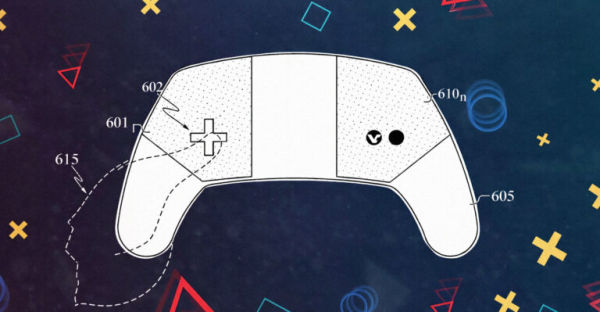
Sony Interactive Entertainment has been granted a U.S. patent for an innovative PlayStation controller design that replaces traditional physical buttons and sticks with a largely touchscreen-based interface. The concept detailed in a patent published in January 2026 but originally filed in 2023 imagines a radically configurable controller where players can choose where the buttons go, resize them, or remove them entirely, potentially redefining how gamers interact with consoles.
This patent doesn’t guarantee a commercial product, but it does highlight Sony’s exploration of bold ideas that could influence controllers for future platforms like PlayStation 6 or enhanced DualSense variants.
The most distinctive aspect of Sony’s patent is its replacement of fixed physical inputs with touch-sensitive surfaces. Instead of a fixed D-pad, face buttons and analog sticks, the controller would use a large touchscreen covering most or all of the top face, where all traditional inputs would normally reside. Users could place virtual controls anywhere on this surface according to their personal preference, game type, or accessibility needs.
For example, a player might put the D-pad on the right side instead of the left, enlarge buttons for better reach, or strip down inputs for simpler game genres with layouts tailored to individuals rather than one universal design.
Comfort, Accessibility, and Personalization
Sony’s patent explicitly addresses limitations of traditional controller layouts. In the document, the company notes that fixed configurations may be too small, too large, or uncomfortable for certain players, and that a one-size-fits-all approach fails to accommodate varied hand sizes and playstyles.
By allowing players to adjust button placement and size, the design could improve ergonomics and accessibility, lowering barriers for gamers with physical challenges or unique preferences. Such adaptability goes beyond mapping buttons, it changes where they appear relative to a player’s grip and movements.
Sony’s existing accessibility efforts, like the specialized PS5 Access Controller which already lets users remap inputs show a clear trajectory toward inclusivity, and this patent suggests a hardware-level progression of that idea.
Touch and Sensors: Beyond Simple Tap Inputs
The patent doesn’t just describe a static touchscreen, it details advanced input recognition that could interpret taps, swipes, pinches, and even “pretouch” proximity of fingers. This means the controller might sense a finger approaching before it touches the surface, potentially preparing or highlighting virtual controls in anticipation.
Sony’s documentation also mentions the addition of pressure and heat sensors beneath the touch surface to distinguish between deliberate input and casual contact (such as a resting thumb) a common challenge for touchscreen game controls. This could help reduce accidental presses and improve reliability in fast-paced gameplay.
In some illustrations, lighting feedback and haptic elements are described as visual or tactile cues to help users locate and confirm controls without constantly looking down at the controller.
Another intriguing feature in the patent is the possibility of dynamic controller layouts that adjust based on how a player holds the device. If the system detects a certain grip, it could automatically shift button regions closer to where thumbs naturally rest, reducing strain.
Players might also be able to save custom configurations, letting multiple users have distinct control schemes stored and loaded instantly. Some patent interpretations suggest the controller could even recognize a specific user and load their preferred layout automatically.
This flexibility would let players seamlessly «switch» control schemes between genres from racing to fighting to platforming without digging into menus or awkward software remapping each time.
From a conceptual standpoint, the benefits are significant: greater accessibility, personalized ergonomics, and adaptability to different game genres could broaden the appeal of PlayStation hardware. Such a controller could be especially valuable for players with motor disabilities who struggle with standard layouts.
However, obstacles remain. Touchscreens lack tactile feedbackwhich is crucial for muscle memory and fast, instinctive play. Many gamers rely on physical feel to know exactly where a thumbstick or button is without looking. This concern is echoed in community discussions and may limit touchscreen-only designs from replacing traditional gamepads entirely.
Even with haptic improvements, the transition from physical buttons to flat, virtual ones could present a steep learning curve especially for competitive titles where instant, error-free input matters.
How This Fits Into Sony’s Controller Evolution
Sony has a long history of evolving controller design. From early innovations with motion sensing (Sixaxis) to the advanced haptics and adaptive triggers of the DualSense, the company continually experiments with new ways to enhance gameplay.
This new touchscreen patent represents a potential leap that pushes even further prioritizing software-defined controls over fixed physical hardware. Whether this leads to a production product remains uncertain, as most patents never make it to market.
No Guarantee of Commercial Release, But a Window Into the Future
It’s important to emphasize that patents don’t promise products. Companies file many ideas to protect intellectual property long before (or even without) commercial rollout. Yet, when a patent shows such thoughtful integration of adaptive controls, it can hint at broader design directions.
Sony’s touchscreen controller concept may influence future PlayStation peripherals, accessibility hardware, or modular controller designs that blend physical and virtual inputs. Even if not released as shown, elements like customizable layouts, dynamic touch recognition, and adaptive ergonomics could appear in later iterations of DualSense or bespoke controllers targeted at niche audiences.
Sony’s touchscreen PlayStation controller patent imagines a flexible, player-centric input device that breaks away from traditional fixed buttons. With its touch surfaces, dynamic layouts, and potential for personalized gaming experiences, the idea points toward a future where controls adapt to the player not the other way around. While commercial implementation is uncertain, the patent stands as a compelling insight into how Sony might rethink the fundamental interface between players and games in the years ahead.
-
Troubled by itching and burning sensation in white discharge? These home remedies will give immediate relief

-
Why blush has become most essential step in today’s makeup routine

-
Loss of appetite is not normal! This deficiency may be hidden in the body, increase your diet with these 5 things kept in the kitchen.

-
Valentine’s Week 2026: Know the importance of every day to celebrate love

-
Motion of thanks passed in Lok Sabha without PM Modi’s reply, Prime Minister will reply in Rajya Sabha today