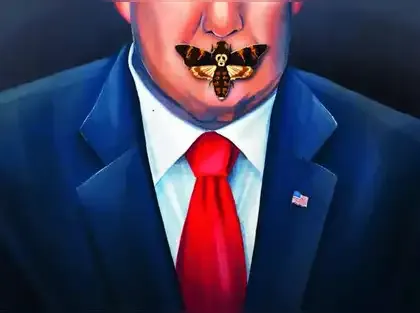
Sooner or Lecter
Exhale! India and the US have finally agreed to a trade deal, removing the biggest hurdle in bilateral relations. The punishing 50% tariff on India - including the additional 25% tariff placed in August to persuade India to stop purchasing Russian oil - is expected to come down to 18%. This is a welcome development - provided no wrinkles appear as they have in other trade deals. With that caveat in mind, the relief is unmistakable after months of uncertainty and rancour.
The good news came without a nomination for a certain peace prize. Or, Delhi showing up with a briefcase filled with goodies. Or, going officially ballistic. (Surrogates were let loose to do that.) Strategic patience was key, as was silence in the face of provocation. US ambassador Sergio Gor proved to be a catalyst. He seemed to understand that a reset with India was a necessary, if not sufficient, condition for rebuilding relations.
The Monday Trump-Modi phone call, apparently initiated by the White House, produced an outcome that friends of both countries had been waiting for. The US agreed to reduce reciprocal tariffs on India from 25% to 18% 'effective immediately', and India has apparently agreed to bring down its tariff and non-tariff barriers to zero. In addition, India has agreed to spend more than $500 bn on US goods, according to Trump's social media post.
While he didn't mention the punitive 25% oil tariff, Trump did say that Modi had 'agreed to stop buying Russian oil' and buy much more from the US, and potentially Venezuela. Modi said nothing on the subject in his message and, instead, described Trump's leadership as 'vital for global peace, stability and prosperity'. It was high praise given the pain gone by.
The 18% rate puts India in a slightly better position vis-a-vis other South Asian countries (Bangladesh at 20%, Pakistan at 19%) and those in Southeast Asia (China at 47%, Malaysia and Indonesia at 19%, and Vietnam at 20%). While that's welcome, it's unclear whether 18% is the final figure, or whether it'll come on top of existing tariffs on certain products - meaning: will 18% be 'stacked' or 'unstacked'?
Also Read | India didn’t blink: Key strategy that swung the US trade deal
Tariff-stacking means multiple tariffs, such as anti-dumping duties, sectoral tariff, and Sections 301 and 232 tariffs under the two trade Acts, being levied on the same product. It can be onerous. India's competitors for the US market are all under stacked tariffs. Unstacked tariffs would mean 18% is the final effective figure for India. Only Europe, Japan, South Korea and Taiwan have been given the luxury of unstacked tariffs.
There's also some ambiguity around when the 25% oil tariff would go. Gor said on Indian TV channels that a few technical details remained to be sorted out, meaning nirvana won't be immediate. But he stressed the oil tariff would be removed in due course. A White House official said the oil tariff 'will be dropped' as part of India's agreement to end oil purchases from Russia.
Use of future tense is significant. The understanding appears to be that moving forward, India won't buy Russian oil. Data has to reflect the tapering before the sword dangling overhead is removed. As baseball legend Yogi Berra famously said: It ain't over till it's over. Also, the 'deal-maker' prez will keep leverage alive, possibly change his mind, and remain focused on his rate of success. Best to wait for the executive order and notice in the Federal Register to see the dates, times and applicable tariff codes.
Also Read | Baap of all trade deals! What Modi-Trump announcement means for your stocks
According to Trump, Modi 'committed to BUY AMERICAN', including energy, coal, agricultural products and tech worth more than $500 bn. How and what would add up to that huge figure is unclear. Fortunately, there's no timeframe, even if the maths is dramatically in America's favour - India must buy more US goods, pay 18% tariff on exports, and give up Russian oil. A White House official told me the tariffs were levied 'by design to rectify the trade deficit in our favour'. In 2024, the US had a trade deficit of $45.7 bn with India.
Finally, what changed Trump's mind after a year of acrimony? How did a 'dead economy' come alive to merit a trade deal? A few possible reasons:
The good news came without a nomination for a certain peace prize. Or, Delhi showing up with a briefcase filled with goodies. Or, going officially ballistic. (Surrogates were let loose to do that.) Strategic patience was key, as was silence in the face of provocation. US ambassador Sergio Gor proved to be a catalyst. He seemed to understand that a reset with India was a necessary, if not sufficient, condition for rebuilding relations.
The Monday Trump-Modi phone call, apparently initiated by the White House, produced an outcome that friends of both countries had been waiting for. The US agreed to reduce reciprocal tariffs on India from 25% to 18% 'effective immediately', and India has apparently agreed to bring down its tariff and non-tariff barriers to zero. In addition, India has agreed to spend more than $500 bn on US goods, according to Trump's social media post.
While he didn't mention the punitive 25% oil tariff, Trump did say that Modi had 'agreed to stop buying Russian oil' and buy much more from the US, and potentially Venezuela. Modi said nothing on the subject in his message and, instead, described Trump's leadership as 'vital for global peace, stability and prosperity'. It was high praise given the pain gone by.
The 18% rate puts India in a slightly better position vis-a-vis other South Asian countries (Bangladesh at 20%, Pakistan at 19%) and those in Southeast Asia (China at 47%, Malaysia and Indonesia at 19%, and Vietnam at 20%). While that's welcome, it's unclear whether 18% is the final figure, or whether it'll come on top of existing tariffs on certain products - meaning: will 18% be 'stacked' or 'unstacked'?
Also Read | India didn’t blink: Key strategy that swung the US trade deal
Tariff-stacking means multiple tariffs, such as anti-dumping duties, sectoral tariff, and Sections 301 and 232 tariffs under the two trade Acts, being levied on the same product. It can be onerous. India's competitors for the US market are all under stacked tariffs. Unstacked tariffs would mean 18% is the final effective figure for India. Only Europe, Japan, South Korea and Taiwan have been given the luxury of unstacked tariffs.
There's also some ambiguity around when the 25% oil tariff would go. Gor said on Indian TV channels that a few technical details remained to be sorted out, meaning nirvana won't be immediate. But he stressed the oil tariff would be removed in due course. A White House official said the oil tariff 'will be dropped' as part of India's agreement to end oil purchases from Russia.
Use of future tense is significant. The understanding appears to be that moving forward, India won't buy Russian oil. Data has to reflect the tapering before the sword dangling overhead is removed. As baseball legend Yogi Berra famously said: It ain't over till it's over. Also, the 'deal-maker' prez will keep leverage alive, possibly change his mind, and remain focused on his rate of success. Best to wait for the executive order and notice in the Federal Register to see the dates, times and applicable tariff codes.
Also Read | Baap of all trade deals! What Modi-Trump announcement means for your stocks
According to Trump, Modi 'committed to BUY AMERICAN', including energy, coal, agricultural products and tech worth more than $500 bn. How and what would add up to that huge figure is unclear. Fortunately, there's no timeframe, even if the maths is dramatically in America's favour - India must buy more US goods, pay 18% tariff on exports, and give up Russian oil. A White House official told me the tariffs were levied 'by design to rectify the trade deficit in our favour'. In 2024, the US had a trade deficit of $45.7 bn with India.
Finally, what changed Trump's mind after a year of acrimony? How did a 'dead economy' come alive to merit a trade deal? A few possible reasons:
- In the trade deal rush, where everyone was signing up with everyone else, the US looked increasingly lonely. The writing on the wall was clear: allies/partners were moving on. India signed several trade deals over the past few months, most recently with the EU.
- Trump understood that GoI wouldn't do what others had done to earn his goodwill. The message from Delhi: India can wait. It was a Mark Carney move without the Davos speech.
- Trump was losing goodwill in India just as fast as he had earned it. 'America First' was starting to backfire and feeling more like 'America Alone'.
- China was clearly the beneficiary, a trigger for Trump as he struggled to come up with an effective strategy to deal with Beijing.
(Disclaimer: The opinions expressed in this column are that of the writer. The facts and opinions expressed here do not reflect the views of www.economictimes.com.)



Seema Sirohi
Senior journalist who writes on foreign policy and India's place in the world.