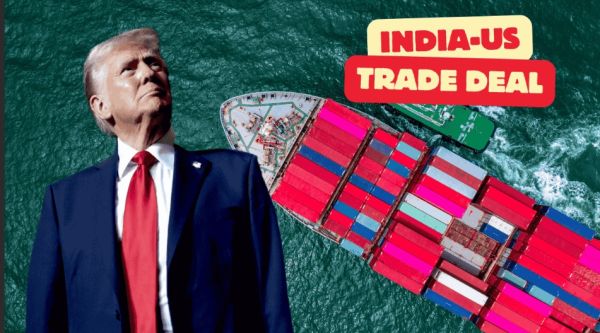
The India-US trade agreement announced by President Donald Trump on February 2, 2026, has sparked debate on whether it is a true victory for New Delhi or a lopsided agreement under geopolitical pressure.
Trump said on Truth Social that after talks with Prime Minister Narendra Modi, the US will immediately reduce mutual tariffs on Indian goods from 25% to 18%, while eliminating an additional 25% punitive duty imposed on India buying Russian oil in 2025 – effectively reducing total tariffs from 50% to 18%. In return, Trump claimed, India has agreed to stop importing Russian crude, switch to American and possibly Venezuelan oil, reduce its tariff and non-tariff barriers on American goods to zero, and buy more than $500 billion of American products (energy, technology, agriculture, coal, defense, aircraft, etc.).
India confirmed tariff relief, with Modi praising the agreement for restoring stability and momentum in relations. Commerce Minister Piyush Goyal called it India’s “best deal ever”, crediting Modi’s good relationship with Trump, while emphasizing full protection for agriculture and dairy – with no US market access given. However, New Delhi has not officially ended Russian oil purchases or confirmed the $500 billion commitment, instead focusing on export profits and supply chain predictability.
Experts give mixed opinions on the imbalance – US 18%, India towards zero:
– Dr. Sumit Kumar (Assistant Professor, International Relations, Manipal University) considers it strategic: Reciprocity is not purely arithmetic. India’s zero-access pledge ensures long-term market certainty amid global uncertainty and protection from future threats, prioritizing shock absorption over symbolic parity.
– Dr Siddharth Shukla (Assistant Professor of Economics, Manipal University) cautions that this is conditional and incomplete – influenced by blocking Russian oil (to put pressure on Moscow over Ukraine), increasing the share of US goods, and possibly India’s Chabahar port investment.
– Akshay Saroha (Assistant Professor, Political Science and IR, IMS Unison University) criticizes this as US “coercion”, which imposes subordination through tariff threats, and undermines fair trade norms under Trump diplomacy. The deal created a buzz in the markets (Sensex/Nifty up, Rupee up), but questions remain over precedent-setting dependency, agricultural weakness and flexibility in future negotiations. Details are still scant, no full joint statement has come yet – analysts say caution should be exercised until implementation is clear about the exact coordination.