AI is expected to add $1.7 Tn to India’s economy by 2030, and the country is on course to transform into a global powerhouse for innovation in artificial intelligence within the next few years. And, at the wheel of this mighty growth engine sits the IndiaAI Mission, a government venture for its Digital India initiative.
With more than INR 10,300 Cr allocated for five years, around 38,000 GPUs (Graphics Processing Units) deployed, and over 6 Mn people employed in the ecosystem, AI is front and centre for the Indian startup and tech economy.
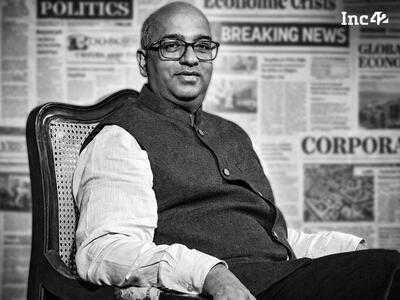
“Of course, the AI revolution is in full swing, and a wider adoption of voice AI will propel it to the next level,” affirmed Abhishek Singh, the CEO of the government-backed AI development body.
Inc42 reached out to Singh for an insight into the AI ecosystem as the IndiaAI Mission entered a decisive phase. After laying down policy frameworks and institutional structures, the mission has moved firmly from design to execution. Compute infrastructure is being deployed at scale, domestic foundation models are under development, datasets are expanding rapidly, and early applications across public services are beginning to take shape and expand.
As the government positions AI as a state-led public infrastructure, the Union Budget 2026 proposed to deploy AI across agriculture, logistics, and social inclusion to enhance efficiency and also suggested a national committee to oversee the evolving landscape. This top-down strategy integrates platforms like Bharat VISTAAR, framing the public infrastructure as the primary architect of India’s emerging digital and social ecosystem.
While the scope of the mission spans models, platforms, and startup enablement, that success may not be judged by infrastructure alone. The real measure lies in adoption and impact, particularly in citizen-facing services such as healthcare, agriculture, and education.
The goal is to see AI-powered systems reach population-scale usage, translating public investment in AI into tangible outcomes for millions of users across the country. And in this regard, Singh’s approach is akin to startup founders. He believes that if the Mission’s services reach less than 10% of the population, this can have a big impact on the Indian economy.
In the interaction with Inc42, IndiaAI Mission’s CEO Singh outlined the key milestones for the next year, explained the role of private capital in building India’s compute backbone, shared his vision for the evaluation of the Indian foundation models, and talked of deepening adoption of AI across the economy.
Here are the edited excerpts from the conversation…
Inc42: The Indian AI ecosystem is moving from experimentation and AI pilots to real execution. What milestones for the next year will be the mission’s accomplishments?
Abhishek Singh: The metrics with regard to the IndiaAI Mission’s success is well defined in the approval that we got, but in real terms, what I feel is that we should be able to achieve what we are aspiring to.
Firstly, we are funding 12 projects for building the Indian foundation model, because we believe there should be a robust Indian large language model or foundation model that can be used for solving our problems.
Then, the next layer is Indian small language models (SLMs) in various sectors – be it for health or material sciences or education.
And then the Indian economy needs lots of AI applications. I would like at least 50 high-impact applications across departments, which should be developed and deployed.
There are certain tangible outcomes but the real benefit will be when the IndiaAI Mission will enable services, especially citizen services like healthcare, agriculture and education.
If our applications and services are being used by at least 100 Mn Indians, then I can say without a doubt that we have made a real positive impact.
Inc42: On the compute side, how many GPUs are currently live and being utilised?
Abhishek Singh: The numbers are in the open. The numbers on the compute portal, the details of all the GPUs that we have got and those which have been deployed – all information is available in the public domain. Out of the 38,000 GPUs, almost 24–25,000 GPUs have been installed and most of them have been deployed.
We have a base of 38,000 GPUs, but I expect to add another 20,000-25,000 units in the next three months. We aim to reach at least 1,00,000 GPUs over the next year.
While demand for NVIDIA H100s remains high and our current inventory is fully committed, we have alternative high-performance compute available, including NVIDIA L40s, AMD Instinct, and AWS-native GPUs. Allocation for these units is handled through our standard ticketing process.
Inc42: How is the government working with the private sector for building AI infrastructure?
Abhishek Singh: We have followed a highly innovative bidding and tendering process designed to incentivise end-usage. The 14 players who have established the infrastructure with 38,000 GPUs are from the private sector. We expect their cumulative investment to exceed INR 25,000 Cr this year.
While the IndiaAI Mission budget is smaller in comparison, it has successfully catalysed this massive private-sector participation. Our approach is to subsidise the end-usage: for foundation model development, we cover 100% of the GPU costs, and for application building, we subsidise up to 40%.
While the government has committed an initial investment in excess of INR 10,000 Cr (over $1 Bn), the broader ecosystem sees a significant momentum. In fact, India is looking to drive at least $100 Bn (INR 8.4 Lakh Cr) in investments into the Indian startup ecosystem.
By incentivising the end-user, we are driving private investment, and we welcome all private sector players to join this mission.
Inc42: How does the government select the sourcing partners for AI tools to support Indian companies?
Abhishek Singh: Government operations depend on specific needs and established procurement systems. Our policy is very clear. We are committed to building indigenous, sovereign AI solutions and products to reduce our dependency on foreign technology.
Whenever a requirement arises, we follow an open bidding process to ensure transparency, and there are no preferred choices. While we aim to support Indian companies and solutions that can solve our specific challenges, all procurement and contracts are governed by the General Financial Rules (GFR). Ultimately, the contract is awarded to the provider who offers a solution best suited to our requirements at the most optimal cost.
Inc42: How does the IndiaAI Mission plan to improve the adoption and quality of datasets on AI Kosh for startups and researchers?
Abhishek Singh: AI Kosh has been built up as a dataset platform. We started building it six months ago.
And now AI Kosh has more than 7,000 datasets, 400 open source models, and lots of tools for anonymisation and privacy preservation. It is like a common data layer that is available to all AI developers and deployers, so that everybody doesn’t need to invest in the same thing.
From 7,000 datasets, we hope to cross 20,000 datasets within a year. That’s the aspirational level we have. We are also developing several tools for safe and trustworthy AI.
Inc42: With Indian foundation models expected soon, how will success and performance be evaluated?
Abhishek Singh: There are globally accepted benchmarks on various performance parameters on which these models are evaluated.
They will be measured on those standards and benchmarks only. And, ultimately, for the community, we will be able to evaluate which is better on what parameter – whether a voice model, a language model or a reasoning model. All of it will come once they are published.
Inc42: What do you think about the IndiaAI Mission in terms of funding and alignment after the Union Budget 2026?
Abhishek Singh: I do not see any challenges to the Budget provisions as far as the IndiaAI Mission is concerned.
Our allocation is around 25% more than what we spent in FY25, and we have assurances that in case we exhaust the current year’s allocation, we will get more funds.
The Union Budget provisions with regard to data centre tax exemption till 2047 and safe harbour provisions will lead to more investments in the data centre and AI ecosystem in India.
Inc42: What’s your message to the AI founders building in India?
Build for the country, build for the impact, build for the scale. What we will build in India will be something that will have a market across the world.
Edited by: Kumar Chatterjee
The post 100 Mn Indians Using Our Services Is Our Current Goal: IndiaAI Mission’s Abhishek Singh appeared first on Inc42 Media.
-
From runway to global spotlight: LAAM Fashion Week 2026 concludes in style

-
Apply these things mixed with ice, your skin will glow…

-
Mom Infuriated By Note Husband Left For Kids Before His Business Trip

-
Your Daily Love Horoscope For Wednesday, February 4, 2026

-
Southeast Asia’s largest economy receives highest number of Chinese tourists in six years