BYLINE: Paul Menser
Newswise — Computing power has always been essential to the successful execution of the U.S. Department of Energy’s (DOE) nuclear energy mission. As the department’s computing capabilities have grown, so has the ability to gain new insights into developing advanced reactors and fuels.
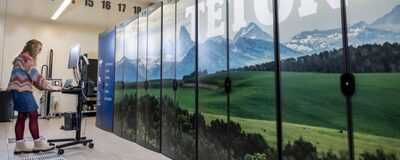
In January, the DOE Office of Nuclear Energy’s Nuclear Science User Facilities (NSUF) program will quadruple its high-performance computing capacity when it activates its newest supercomputer, Teton, at the Idaho National Laboratory’s (INL) Collaborative Computing Center. Four times more powerful than Sawtooth, NSUF’s current flagship computational system, Teton will accelerate researchers’ ability to simulate the complex interactions in a reactor. Multiphysics simulations run on Teton will encapsulate the interconnected feedback mechanisms between fuel performance, neutronics and thermal hydraulics.
Teton was delivered to INL in September 2025 and will be open to NSUF users in January 2026, a record time for such a complex deployment. TOP500, which compiles a list of the world’s most powerful systems, rated Teton’s HPE Cray EX 4000 system as the world’s 85th most powerful supercomputer. Its central processing unit (CPU)-only design is optimized for codes that demand sequential, high-fidelity radiation transport modeling. With 1,024 compute nodes, each with 384 CPU cores and 768 gigabytes of memory, Teton will provide researchers in Idaho and across the United States with the power to tackle the most complex challenges in advanced reactor design and operation.
Teton’s systems are optimized for the complex multi-physics simulations required in developing advanced fast and thermal spectrum reactors, small modular reactors and microreactors. Teton will support a diverse portfolio of nuclear energy research projects critical to national energy security.
“This represents a significant investment in the computational infrastructure needed to accelerate advanced reactor deployment,” said NSUF Director Brenden Heidrich. “Teton will enable researchers to model and simulate next-generation nuclear technologies with unprecedented fidelity, dramatically reducing the time from concept to deployment for critical nuclear energy projects.”
Rigorous selection processThe selection of the HPE Cray EX 4000 system came after a rigorous process, said Brandon Biggs, the Teton supercomputer technical lead within NSUF’s High Performance Computing team. The main consideration was the number of computer cores. Teton uses AMD’s 9005 series of CPUs codenamed “Turin.” Launched in October 2024, Turin came with numerous platform advancements, including a dramatic increase in the number of cores per socket and speeds as high as 5.0 gigahertz.
“This allows us to complete complicated calculations on a single node where before calculations would have to run from node to node,” said Matt Anderson, High Performance Computing manager for INL’s Nuclear Science and Technology directorate.
Teton’s increased computing power will benefit the larger nuclear energy research community.
“NSUF is proud to be able to provide access to this level of performance to our user community,” Heidrich said. “The large number of nodes available in Teton allows our (High Performance Computing) team to support hundreds of users at one time or allocate all of them to a single massive project that was previously beyond our reach.”
Highly specialized capabilities to support nuclear energyINL’s specialized nuclear energy computing systems are in extremely high demand. “We have enough people waiting in the wings to run four times over,” Biggs said.
With the ability to perform 20.8 quadrillion calculations per second, Teton will enable many more researchers to simulate complex reactor physics, advanced materials behavior and fuel cycle processes.
“Modeling and simulation codes are what will benefit the most,” Biggs said. “With Teton – a dedicated CPU system with just under 400,000 cores, computations that take days to turn around, will be more like hours.”
With the speed it is expected to provide, Teton will reduce wait times for researchers, but the demand is not expected to ease. “We expect the queue to continue to fill,” Biggs said.
Consistent with DOE’s Genesis Mission, Teton will support efforts to accelerate nuclear energy deployment using artificial intelligence (AI). From a computational standpoint, its power will make it possible to run the thousands of complex high-fidelity simulations needed to produce reduced order models (ROMs). These reduced order models accelerate reactor deployment by rapidly creating accurate digital twins of real-world systems, enabling fast simulations for design optimization, real-time monitoring, faster R&D for new fuels and quicker analysis of complex physics.
Teton’s advanced capabilities will make increased use of AI-driven agentic workflows, where AI agents talk to each other and make decisions. “It’s not an AI system, but its systems are driven by AI agents,” Anderson said. “We will see more and more of this. Agentic workflows will be running them in a new way.”
Aiding everyday modeling and simulationWith its four-fold increase in power over Sawtooth, Teton will also aid in the everyday modeling and simulations done with the Multiphysics Object-Oriented Simulation Environment (MOOSE) developed at INL.
MOOSE and the nuclear applications built on it (Bison, Grizzly, Marmot, Pronghorn, etc.) are relatively mature tools, said Cody Permann, INL Computational Frameworks Department manager. Teton is likely to have the most value in validating the MOOSE-based modeling and simulation tools widely used by the Nuclear Energy Advanced Modeling and Simulation program, the nuclear industry and the Nuclear Regulatory Commission, he said. With increased computing power, these simulation tools and capabilities are expected to accelerate the deployment of new nuclear energy technologies, advanced reactors and new fuels.
To learn more about the NSUF program at Idaho National Laboratory, visit https://nsuf.inl.gov/. For information on computational resources and accessing Teton computing time, visit https://inl.gov/hpc/.
About Idaho National LaboratoryBattelle Energy Alliance manages INL for the U.S. Department of Energy’s Office of Nuclear Energy. INL is the nation’s center for nuclear energy research and development, and also performs research in each of DOE’s strategic goal areas: energy, national security, science and the environment. For more information, visit www.inl.gov.
https%3A%2F%2Fwww.newswise.com%2Farticles%2Fexpanding-capabilities-new-supercomputer-teton-quadruples-inl-computing-power%2F%3Fsc%3Drsla
The post Expanding Capabilities: New Supercomputer Teton Quadruples INL Computing Power appeared first on CliQ INDIA.
-
Zayn Malik and Louis Tomlinson reunite for Netflix road trip

-
Lips actually turn black after drinking too much tea, know here what is the real reason…

-
4 Scientifically Proven Health Benefits Of Having A Cat

-
Everything Finally Falls Into Place For 3 Zodiac Signs After February 8, 2026

-
5 Cool Hunting Gadgets You Didn’t Know Existed