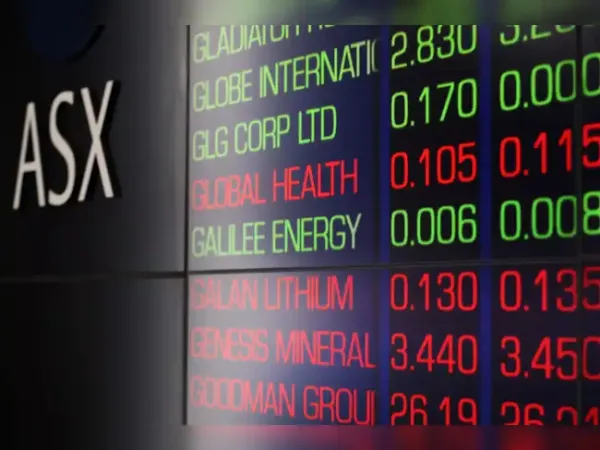
The S&P/ASX 200 recorded its worst performance in 11 weeks as Australian shares logged their biggest daily fall in 10 months (since April 2025) on Friday (February 6, 2026), with miners leading a selloff spanning all sectors. The massive drop occurred as investors pulled out of resource stocks on soft commodity prices amid a broader retreat from equities globally.
The S&P/ASX 200 closed sharply lower Friday, dropping 180.40 points, or 2.03%, to 8,708.80 and setting a new 20-day low. According to the ASX website, the bottom-performing stocks in this index were WEB TRAVEL GROUP LIMITED and DEEP YELLOW LIMITED, down 29.52% and 12.00%, respectively. The index has lost 1.81% for the last five days but is virtually unchanged over the last year to date.
S&P/ASX 200: Top Gainers and Losers
The S&P/ASX 200 recorded mixed movements, with several stocks posting gains while others saw sharp declines. Among the top five gainers, Brambles Limited (BXB) closed at $23.510, rising $0.790, or 3.477 per cent. ResMed Inc. (RMD) finished at $37.920, up $0.460, representing a 1.228 per cent increase.
PEXA Group Limited (PXA) ended the session at $13.740, gaining $0.150, or 1.103 per cent. Aussie Broadband Limited (ABB) edged higher to $4.360, adding $0.010, a rise of 0.229 per cent. QBE Insurance Group Limited (QBE) closed at $20.180, up $0.020, or 0.099 per cent.
On the downside, Web Travel Group Limited (WEB) led the decliners, falling $1.240 to $2.960, a drop of 29.524 per cent. Deep Yellow Limited (DYL) slid to $2.200, down $0.300, or 12.000 per cent. Paladin Energy Ltd (PDN) ended at $11.010, declining $1.350, or 10.923 per cent. Flight Centre Travel Group Limited (FLT) closed at $13.810, shedding $1.580, a fall of 10.267 per cent. IperionX Limited (IPX) finished at $5.780, down $0.590, or 9.263 per cent.
Wall Street closes sharply lower
Overnight, Wall Street indexes closed sharply lower, led by losses in major tech firms due to concerns over their AI outlays. Global equities were also under pressure on Friday.
Caution on Wall Street spilt into Australia, with commodity volatility and concerns over global growth softness weighing on confidence, Jocum said. The S&P ASX volatility index shot up by 21%, the most since the April "Liberation Day" shocks, indicating a sharp rise in investor anxiety and expectations of heightened market volatility.
All sectors ended lower
All 11 sectors ended lower along with the S&P/ASX 200 Index, according to the ASX website. The session's top sector, Health Care, was lower by -1.16%, continuing its -2.39% decline for the last five days.
The selloff was broad-based, with heavyweight resources and financial sectors shedding 2.7% and 1.2%, respectively, while energy, technology and gold stocks fell about 3% each.
Healthcare, consumer staples and consumer discretionary stocks lost between 1% and 3%. A gauge of blue-chip stocks, which includes the top miners and banks, fell 1.5%, the most since mid-November.
The resources index ended at a three-week low, shedding 4.6% for the week – its biggest since late March. While BHP Group fell 3%, rival Rio Tinto jumped 2% to a record high after it abandoned its merger talks with Glencore, although it ended a touch lower.
Rio Tinto's London-listed shares ended more than 2% lower overnight. Jocum said the divergence between the two stocks likely reflects Australian shareholders rewarding management's decision to prioritise valuation discipline.
The S&P/ASX 200 closed sharply lower Friday, dropping 180.40 points, or 2.03%, to 8,708.80 and setting a new 20-day low. According to the ASX website, the bottom-performing stocks in this index were WEB TRAVEL GROUP LIMITED and DEEP YELLOW LIMITED, down 29.52% and 12.00%, respectively. The index has lost 1.81% for the last five days but is virtually unchanged over the last year to date.
S&P/ASX 200: Top Gainers and Losers
The S&P/ASX 200 recorded mixed movements, with several stocks posting gains while others saw sharp declines. Among the top five gainers, Brambles Limited (BXB) closed at $23.510, rising $0.790, or 3.477 per cent. ResMed Inc. (RMD) finished at $37.920, up $0.460, representing a 1.228 per cent increase.
PEXA Group Limited (PXA) ended the session at $13.740, gaining $0.150, or 1.103 per cent. Aussie Broadband Limited (ABB) edged higher to $4.360, adding $0.010, a rise of 0.229 per cent. QBE Insurance Group Limited (QBE) closed at $20.180, up $0.020, or 0.099 per cent.
On the downside, Web Travel Group Limited (WEB) led the decliners, falling $1.240 to $2.960, a drop of 29.524 per cent. Deep Yellow Limited (DYL) slid to $2.200, down $0.300, or 12.000 per cent. Paladin Energy Ltd (PDN) ended at $11.010, declining $1.350, or 10.923 per cent. Flight Centre Travel Group Limited (FLT) closed at $13.810, shedding $1.580, a fall of 10.267 per cent. IperionX Limited (IPX) finished at $5.780, down $0.590, or 9.263 per cent.
Wall Street closes sharply lower
Overnight, Wall Street indexes closed sharply lower, led by losses in major tech firms due to concerns over their AI outlays. Global equities were also under pressure on Friday.
Caution on Wall Street spilt into Australia, with commodity volatility and concerns over global growth softness weighing on confidence, Jocum said. The S&P ASX volatility index shot up by 21%, the most since the April "Liberation Day" shocks, indicating a sharp rise in investor anxiety and expectations of heightened market volatility.
All sectors ended lower
All 11 sectors ended lower along with the S&P/ASX 200 Index, according to the ASX website. The session's top sector, Health Care, was lower by -1.16%, continuing its -2.39% decline for the last five days.
The selloff was broad-based, with heavyweight resources and financial sectors shedding 2.7% and 1.2%, respectively, while energy, technology and gold stocks fell about 3% each.
Healthcare, consumer staples and consumer discretionary stocks lost between 1% and 3%. A gauge of blue-chip stocks, which includes the top miners and banks, fell 1.5%, the most since mid-November.
The resources index ended at a three-week low, shedding 4.6% for the week – its biggest since late March. While BHP Group fell 3%, rival Rio Tinto jumped 2% to a record high after it abandoned its merger talks with Glencore, although it ended a touch lower.
Rio Tinto's London-listed shares ended more than 2% lower overnight. Jocum said the divergence between the two stocks likely reflects Australian shareholders rewarding management's decision to prioritise valuation discipline.