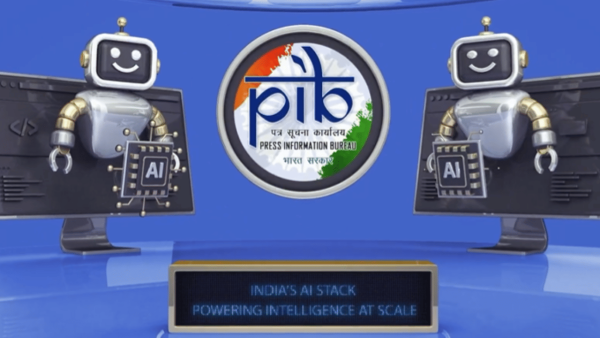
New Delhi: India is preparing the foundation of one of the largest artificial intelligence infrastructures in the world based on the philosophy that AI must benefit all people and not a few. The national vision that the country developed in India AI Stack is to democratise artificial intelligence and make it bring a tangible benefit to the healthcare sector, education, agriculture, governance, finance, and public services.
The core of this strategy is the concept of AI to humanity, whereby technology reinforces public welfare and collective well-being. India is not trying to make AI an elite or experimental instrument but is rather concentrating on population-scale implementation. The idea is as uncomplicated as it is disruptive: ensure AI is trustworthy, costs less, and is integrated into the daily routine to the point where innovation will have a direct effect on how citizens study, work, cultivate, treat, and receive governmental services.
India AI Stack: Powering Intelligence at Scale
Turning Data and Compute into Real-World Impact
The future of technology in India is guided by a simple but powerful idea: the democratisation of #AI. Artificial Intelligence should not remain limited to a few companies,… pic.twitter.com/Q3BnN38BBX
— PIB India (@PIB_India) February 6, 2026
Application layer: Where AI meets citizens
The most visible section of the AI stack is the application layer. It also encompasses end-user devices, i.e., health diagnosis websites, agricultural advising services, chatbots, and language translators. Complex algorithms are transformed into simple and usable services for ordinary people at this point.
In India, AI usage already has an impact. In farming, AI-driven advice software is aiding farmers to make better sowing choices and harvests, and productivity is noted to rise by up to 30 to 50 per cent in the Andhra Pradesh and Maharashtra areas. In the medical field, AI is aiding in the early detection of tuberculosis, cancer and neurological diseases. AI learning is being incorporated into education platforms under the National Education Policy 2020, and e-Courts are utilising AI in translation, scheduling, and administration of cases to enhance access to justice.
AI models: Building sovereign intelligence
The brain of the AI ecosystem is the model layer. These models are learnt based on data to identify patterns and make predictions and drive applications across medical imaging to multilingual chatbots.
Through the IndiaAI Mission, 12 native AI models are under development to meet the needs of India. Projects like BharatGen and IndiaAIKosh are helping the development and distribution of datasets and models that are specific to Indian languages, government services, and government. India is lessening the reliance on international AI ecosystems and promoting trust, transparency, and cultural alignment by concentrating on sovereign and locally pertinent models.
Compute layer: Scaling AI power
AI cannot be run without huge computing capabilities. The compute layer offers the processing muscle that is required to train and execute advanced models.
India is growing low-cost access to high-performance computers with IndiaAI Compute Portal, the subsidised access to tens of thousands of GPUs and TPUs. A secure national cluster of GPUs is also being developed in case of strategic applications. Together with this, the investments through the India Semiconductor Mission and indigenous chip are enhancing the long-term self-reliance in AI hardware.
Data centres and networks: The digital backbone
The basis of AI implementation is data centres and high-speed networks. They store AI systems and transfer data fast and dependably throughout the nation.
India has also deployed 5G in almost every district and is in the process of building more optical fibre networks. The number of data centres is projected to increase drastically by 2030 due to the increase in the demand of AI and cloud. The world leaders in technology are putting big money into the Indian data centre infrastructure, securing the Indian borders with the AI workloads.
Energy layer: Powering sustainable AI
AI infrastructure is power intensive, and therefore consistent power is a necessity at an affordable cost. The fact that India is increasing its electricity capacity and the portion of non-fossil fuel energy is making AI grow without jeopardising sustainability.
As over half of power demand is now provided by non-fossil sources, and as energy storage and nuclear power are invested in, India is making AI development climate-consistent. This will make sure that data centres and supercomputer centres can run round the clock whilst regulating emissions.
These five layers constitute a single AI stack with scale, resiliency, and inclusion. India is reducing the barriers to entry and diffusion of AI innovation by various startups, researchers, and government institutions by leveraging affordable computers, sovereign models, robust infrastructure, and clean energy.
With the growing pace of AI adoption in the world, the Indian strategy is unique because it was orientated towards diffusion, as opposed to concentration. India AI Stack is also not simply a case of technological leadership. It is regarding the fact that intelligence at scale must be translated to real-life impact for millions of citizens.
-
Kyunki posh spice bhi kabhi bahu thi

-
Horoscope Today, 8th February, 2026: Stand Strong, Stay Balanced & Move Freely

-
Domestic and foreign investors to get equal tax benefits on data centres: Union minister Ashwini Vaishnaw
-
Social Security payments February 2026: Who gets paid COLA-boosted Social Security checks this Wednesday, and why some beneficiaries are excluded from the February 11 payment

-
Ride hailing app services partially impacted as drivers go on strike