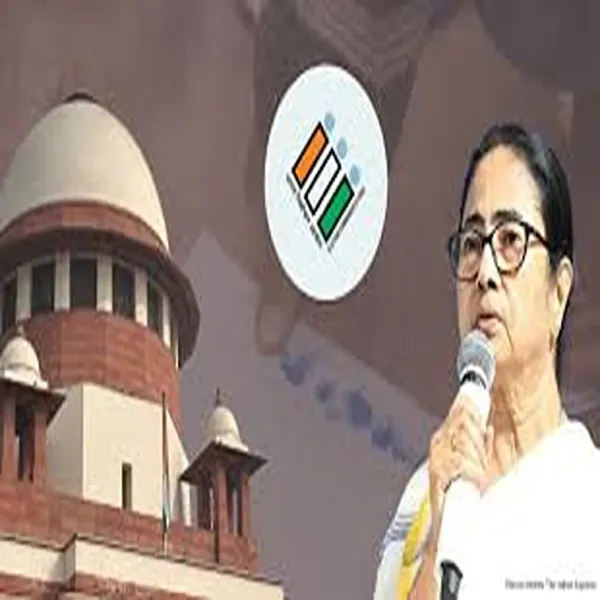
Elections – The Supreme Court is set to take up a petition filed by West Bengal Chief Minister Mamata Banerjee challenging the ongoing Special Intensive Revision of electoral rolls in the state, which is preparing for Assembly elections later this year.
Hearing Scheduled Before Chief Justice–Led Bench
According to the court’s published cause list, a Bench headed by Chief Justice of India Surya Kant, along with Justices Joymalya Bagchi and N.V. Anjaria, will hear the matter on February 9. The petition will be considered alongside similar pleas submitted by Trinamool Congress Members of Parliament Dola Sen and Derek O’Brien.
Banerjee has questioned the legality of the voter roll revision exercise being carried out by the Election Commission of India. In her petition, she has alleged that the process lacks neutrality and could potentially lead to the removal of a significant number of voters, particularly those from marginalised communities.
Concerns Over Deletions and Interim Relief Sought
The Chief Minister has urged the court to issue interim directions preventing the deletion of any voter’s name during the revision process. She has specifically raised concerns about entries being flagged under the category of “logical discrepancy,” arguing that such classifications may disproportionately affect genuine voters.
At an earlier hearing, the Supreme Court had issued notice to the Election Commission and sought its response. The matter was then listed for further consideration this week.
During the previous proceedings, the Bench observed that spelling variations in names, often influenced by regional dialects, are common across the country. The court remarked that such discrepancies alone should not serve as grounds to exclude legitimate voters from the electoral rolls.
Allegations of Disproportionate Impact
Addressing the court, Banerjee contended that certain groups are being more heavily affected by the revision exercise. She pointed to women who adopt new surnames after marriage and individuals who relocate within or outside districts as examples of voters facing difficulties.
The Chief Minister has also claimed that the revision exercise is being selectively implemented in West Bengal ahead of the upcoming elections. She argued that similar large-scale revisions are not underway in some Northeastern states, including Assam. According to her petition, repeated representations made to the Election Commission have not received satisfactory responses.
In response to these submissions during the earlier hearing, the Bench assured that it would seek a practical and fair resolution. The court emphasised that the right of a genuine voter cannot be taken away arbitrarily.
State Government’s Administrative Support
Ahead of the hearing, the West Bengal government informed the Election Commission that it is prepared to provide 8,505 Group-B officers to assist with the remainder of the Special Intensive Revision exercise. The state administration has also recommended that Bengali-speaking officers be deployed to minimise errors linked to language and spelling differences.
Officials have indicated that linguistic familiarity could reduce discrepancies that arise from transliteration or local pronunciation patterns, which often affect voter records.
Election Commission Clarifies Document Rules
In a separate clarification, the Election Commission has specified which documents will be accepted as valid for the revision process. It stated that permanent resident certificates issued by elected public representatives or Block Development Officers will not be considered valid identity proof for the purpose of the ongoing exercise.
The poll body clarified that only certificates issued by District Magistrates, Additional District Magistrates, Sub-Divisional Officers, and, in Kolkata, Collectors, under the legal provisions introduced in 1999, will be accepted.
The ruling Trinamool Congress has objected to this clarification. Banerjee has alleged that the refusal to accept certain documents could result in the exclusion of genuine voters from the electoral rolls.
With the Assembly elections approaching, the outcome of Monday’s hearing is expected to have significant implications for the voter roll revision process in West Bengal. The Supreme Court’s observations may shape how the Election Commission proceeds with the exercise in the coming weeks.
-
World's only underwater roundabout is inside 6.9-mile tunnel between UK and Iceland
-
Modasa Celebrates Khilan Patel's ICC U-19 World Cup Victory with Grand Welcome

-
I asked experts what you should never put in the dishwasher - they named 7 items

-
New EPFO app to enable EPF withdrawals via UPI from April
-
Lindsey Vonn's medical miracle after her body was 'broken beyond repair'