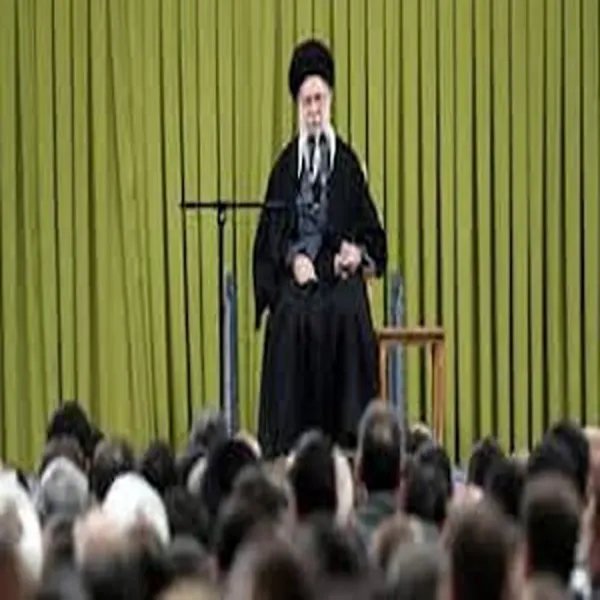
IranTensions – Iran’s Supreme Leader Ayatollah Ali Khamenei did not attend the annual February 8 gathering with air force commanders this year, marking the first time in more than three decades that he has missed the symbolic event. The absence comes at a time of heightened military activity by the United States in the Gulf region, adding to speculation about rising security concerns.
A Break from a Long-Standing Tradition
Since assuming leadership in 1989, Khamenei has consistently presided over the annual meeting, including during the COVID-19 pandemic. The event commemorates February 8, 1979, when a group of air force officers declared their support for Ayatollah Ruhollah Khomeini, a pivotal moment that helped accelerate the fall of the Pahlavi monarchy and paved the way for the establishment of the Islamic Republic.
Over the decades, the anniversary has evolved into a fixed date on Iran’s political calendar. Senior air force officials traditionally gather to renew their allegiance to the country’s clerical leadership, underscoring the military’s loyalty to the ruling establishment.
This year, however, Iran’s Chief of Staff of the Armed Forces, Abdolrahim Mousavi, led the meeting in place of the Supreme Leader, according to reports from Iran International. No official explanation was provided for Khamenei’s absence.
Rising Military Activity in the Region
The development comes against the backdrop of growing strain between Tehran and Washington. In recent weeks, the United States has expanded its military footprint in and around the Gulf, prompting renewed debate over the possibility of direct confrontation.
At the end of January, the US aircraft carrier USS Abraham Lincoln was deployed to the Arabian Sea. Satellite analysis cited by the BBC also indicated that the guided-missile destroyer USS Delbert D Black passed through the Suez Canal en route from the Mediterranean to the Red Sea.
In addition, a dozen F-15 fighter jets, an MQ-9 Reaper drone, and several A-10C Thunderbolt II ground-attack aircraft were reported to have arrived at Muwaffaq Salti Air Base in Jordan. Surveillance and reconnaissance assets, including an MQ-4C Triton drone, an E-11A communications aircraft, P-8 Poseidon maritime patrol aircraft, and E-3G Sentry airborne warning and control systems, have also been observed operating in the region.
The enhanced military presence has fueled speculation about contingency planning amid deteriorating diplomatic ties.
Disputes Over Negotiations
Tensions between the two countries have remained unresolved even after a recent ceasefire linked to the 12-day Iran-Israel conflict in mid-June 2025. While active hostilities subsided, disagreements over future negotiations persist.
Washington has insisted that any renewed talks should address not only Iran’s nuclear program but also its missile capabilities. Tehran, however, has maintained that discussions must be limited strictly to nuclear issues. The widening gap in positions has led to public exchanges of warnings and renewed threats of potential airstrikes.
Iranian officials have cautioned that any direct US military action could trigger a broader regional conflict. They have argued that escalation would not remain contained within national borders but could extend across the Middle East.
Interpreting the Supreme Leader’s Absence
Khamenei’s decision not to appear at the February 8 ceremony has drawn attention precisely because of its historical consistency. Analysts note that the annual gathering carries symbolic weight, reinforcing unity between the armed forces and the country’s highest authority.
While no official reason has been announced, observers suggest that security considerations or pressing national matters may have influenced the decision. The timing, amid visible US military deployments and heightened rhetoric, has inevitably added to public scrutiny.
Despite the uncertainty surrounding the absence, Iranian state institutions have continued to project stability. The armed forces leadership emphasized readiness and national defense during the commemorative event, signaling continuity in military posture.
As diplomatic channels remain strained and regional deployments continue, developments in the Gulf are being closely watched by governments and analysts alike.
-
CTET 2026 Results Likely in March: Answer Key Expected Soon, Here’s the Complete Timeline

-
Supreme Court Pulls Up Banks Over Rising Digital Fraud, Seeks Answers from RBI on Policy Gaps

-
High-Return Trap Costs Dear: Retired Banker Loses ₹1.10 Crore in Sophisticated Online Investment Scam

-
Ferrari Luce EV Interior Designed By Apple iPhone Creator Jony Ive

-
IND Vs PAK Boycott Row: Pakistan's Solidarity For Bangladesh Stance Busted As BCB Requests PCB To Play T20 World Cup 2026 Match On Feb 15