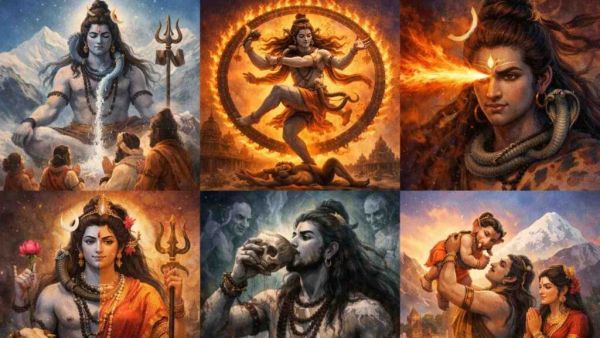
Lord Shiva is called ‘God of Gods’ because he is not bound by any particular framework. He is worshiped not just as a deity, but as the consciousness of the universe that maintains the balance of both creation and destruction. His names are not just for calling but they explain His special qualities and His love for His devotees.
According to mythological beliefs, Shiva’s personality is ‘Advaita’, where beauty and horror meet. He resides in the crematorium and also on the peak of Kailash. This is the reason why Shiva has been accessible and dear to every section of the society, be it king or pauper, deity or demon.
Major names and meanings
Aghori
The meaning of ‘Aghori’ is that which is ‘Ghor’ i.e. not terrible. Shiva is called Aghori because he is free from hatred and attachment. He rubs the ashes of the cremation ground and looks at the cycle of life and death with equal vision. This name reflects his form which does not accept the distinctions of ‘beautiful and ugly’ made by the society.
arbitrary
Shiva is called ‘manmana’ because of his independent nature. He is not bound by any rules, customs or social pressure. He drinks poison as per his wish and performs orgies as per his wish. This name symbolizes his sovereignty where he himself rules.
Bhola and Bholenath
Shiva is called ‘innocent’ because he is far away from deceit and deceit. He becomes happy very quickly. According to mythology, he even granted boons to demons like Bhasmasura after seeing their devotion, without thinking what the consequences would be. He does not see the cleverness of his devotees but sees their emotions.
Shankar
The word ‘Shankar’ is made up of ‘Sham’ and ‘Kar’. ‘Sham’ means welfare and ‘Kar’ means the one who does. That is, one who does good to everyone. This form of Shiva establishes harmony in the universe and spreads the light of knowledge by destroying ignorance.
Neelkanth
The poison released during the churning of the ocean was a symbol of negativity and evil. He neither spat out this poison (so that there would be no destruction outside) nor swallowed it (so that the universe within him remained safe). This story shows that even the most difficult poison can be controlled only with the help of Shiva and Shakti.
Mahakal
‘Kaal’ means both time and death. Shiva is the controller of both. Bhasma Aarti at Mahakal Temple, Ujjain symbolizes that ultimately everything has to turn into ashes (bhasma), only Shiva is eternal. Mahakaal frees his devotees from the fear of untimely death.
Note: The things written in this news are based on religious and local beliefs. We do not confirm this.
-
ICC T20 World Cup 2026 Group D Points table: New Zealand claim top spot after Tim Seifert, Fin Allen record partnership

-
T20 World Cup 2026: Sahibzada Farhan’s power-packed fifty and Usman Tariq’s three-wicket haul lead Pakistan to 32-run win Over USA

-
Shikhar Dhawan Appointed as Brand Ambassador for Delhi Sports Mahakumbh

-
Sulaiman and Maqsood lead the charge as Sharjah hosts action-packed golf double bill

-
Man Utd 'make Harry Maguire U-turn' as Michael Carrick intervenes on contract decision