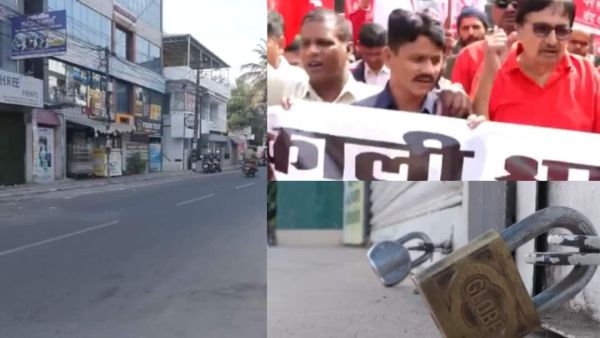
A nationwide strike called by more than ten prominent trade and farmers’ unions unfolded on February 12, with organisers asserting that nearly 30 crore workers were expected to participate. The Bharat Bandh was announced in protest against what unions described as anti-worker, anti-farmer, and pro-corporate policies pursued by the Centre. Processions and rallies were reported from Assam, Tamil Nadu, Kerala, Odisha, and Bihar, underscoring the breadth of the mobilisation. Organisers framed the bandh as a coordinated assertion of workers’ and farmers’ rights, emphasising that their demands centered on employment protections, public sector safeguards, and policy changes.
Security forces were deployed in several regions as demonstrations took place across more than 600 districts. Union leaders warned that banking operations, public transport, and government services could face disruptions due to the scale of participation.
Nationwide Bharat Bandh Observed Today
The response to the bandh varied significantly from state to state. In West Bengal, daily life appeared largely unaffected. Public transport services, including buses and trains, continued without major interruption, while offices and educational institutions remained open.
Tamil Nadu saw union members staging protests in cities such as Coimbatore and Thoothukudi. Demonstrators there called for the rollback of public-private partnership projects, arguing they undermined public sector interests.
In Goa, the strike had a partial effect. Banking and insurance services were impacted, with several offices remaining closed. However, essential services continued to function. Industrial operations in certain pockets were reportedly disrupted.
Odisha’s Trade Union Coordination Centre joined the protest, while reports from Kerala, Assam, Pondicherry, Bihar, and Delhi pointed to broader participation. In the national capital, rallies were held in industrial zones, and traffic volumes were lighter than usual in some areas.
Political Reactions Intensify
The bandh also drew sharp political responses. Samajwadi Party MP Ram Gopal Yadav accused the government of attempting to silence common citizens and reduce them to “bonded labourers.”
Congress leader Rahul Gandhi echoed criticism of the Centre, alleging that workers and farmers were being sidelined in policymaking. He questioned whether Prime Minister Narendra Modi would heed their concerns and linked the unrest to wider debates surrounding India’s trade and energy strategies.
Unions Defend Collective Action
Union representatives maintained that the strike represented a unified stand against new labour codes and privatization initiatives. All India Trade Union Congress General Secretary Amarjeet Kaur said that demonstrations had commenced early in the day across various states.
-
Government job opportunity in Haryana, applications open for 4,227 positions
-
UP Board Exam: UP Board High School and Intermediate exams to begin on February 18, with special emphasis on security and arrangements

-
One mistake and your bank account is wiped out; a new SMS scam poses the biggest threat to phone users. Learn how to avoid it.

-
PF withdrawal will be done in a jiffy: EPFO is bringing a new 'super app', money will come directly into the account through UPI...
-
WhatsApp: 'Digital strike' on WhatsApp, attempt to block it in this country, will the government app work?