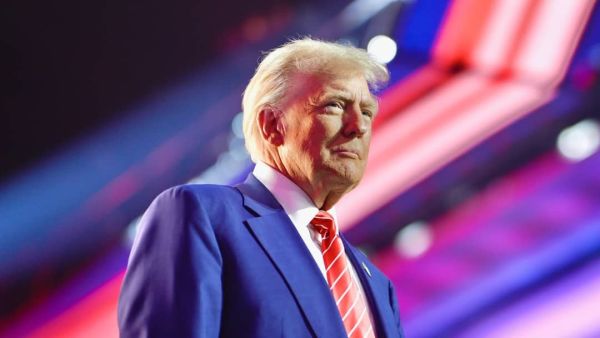
President Donald Trump on Friday publicly indicated his backing for a potential regime change in Iran, framing it as a desirable outcome as geopolitical pressure mounts in the Middle East. His remarks came alongside a major military deployment and ongoing attempts to restart stalled diplomatic discussions over Tehran’s nuclear program.
Trump Calls Regime Change “Best Thing” As U.S. Posture Shifts
At a press appearance in Fort Bragg, Trump was asked directly whether regime change in Iran would be an objective of current U.S. strategy. He responded that it “seems like that would be the best thing that could happen,” though he stopped short of naming any specific alternative leadership, as per a report on Reuters.
The president reiterated his frustration with past diplomatic efforts, describing decades of negotiation as unproductive and emphasising the toll of prolonged conflict on global stability. While Trump suggested diplomacy remains in play, he made clear that a lack of progress could prompt more forceful actions.
Military Buildup: Second Carrier Heads To Region
In support of U.S. interests, the Pentagon announced the dispatch of a second aircraft carrier — the USS Gerald R. Ford — to join the already-deployed USS Abraham Lincoln and accompanying warships in the Middle East. The Ford, the Navy’s newest and largest carrier, had previously been operating in the Caribbean before being rerouted to the region.
Trump used the deployment as a signal of strength, cautioning that if talks with Iran fail, “there’s not much left to target there — it’s mostly dust,” alluding to prior U.S. strikes on Iranian nuclear facilities. Iranian leaders have repeatedly threatened retaliation for U.S. military moves, raising concerns about broader escalation.
Diplomatic Tracks: Geneva Talks & Regional Demands
Despite the heightened rhetoric, diplomatic channels remain active. According to informed sources quoted by Reuters, U.S. envoys Steve Witkoff and Jared Kushner are set to meet Iranian representatives in Geneva this Tuesday, with Oman acting as mediator. On the same trip, they are expected to engage Russian and Ukrainian officials as part of America’s push to advance peace efforts in Eastern Europe.
U.S. officials have signaled they want any revived nuclear negotiation to address not only uranium enrichment but also Iran’s missile program, support for proxy groups across the region, and its human rights record. Tehran has shown willingness to constrain its uranium enrichment for sanctions relief but has rejected making missile development part of the talks.
Israeli Prime Minister Benjamin Netanyahu, visiting Washington this week, echoed U.S. concerns — urging guarantees that any deal would curb Tehran’s missile capabilities and hinder funding to groups such as Hamas and Hezbollah. Iranian leaders continue to insist their nuclear program is peaceful, though before last year’s conflict it had reached 60% uranium enrichment, nearing weapons-grade levels, reported AP.
Secretary of State Marco Rubio has cautioned that ousting Iran’s government would be far more complex than the long-failed effort to remove Nicolás Maduro in Venezuela, highlighting the entrenched power structures in Tehran and the need for careful planning.
-
Petrol Diesel Price Today: Fresh Fuel Rates Released at 6 AM, Check Latest Prices in Your City

-
Vacancy: Over 2,800 IAS, IPS, and IFS posts are vacant; find out how many vacancies are available in each state...

-
Ration Card Rule Changes 2026: e-KYC Mandatory, Cash Support, Free LPG Benefits and Digital Access Expanded
-
Ration Card Will Become Invalid Without e-KYC: Complete Verification Before Deadline to Continue Getting Free Ration

-
8th Pay Commission Salary Update: Will DA at 60% Decide New Fitment Factor and Salary Hike?