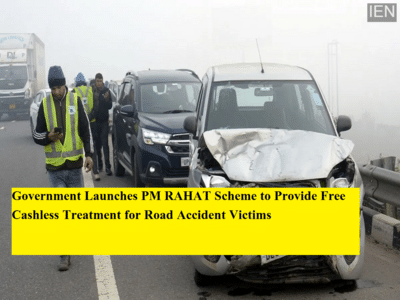
The central government has unveiled a major public welfare initiative aimed at saving lives on Indian roads. Named PM RAHAT (Road Accident Victim Hospitalisation and Assured Treatment), the scheme is designed to ensure that victims of road accidents receive immediate medical attention and cashless treatment of up to ₹1.5 lakh, regardless of their financial background.
The announcement marks a significant step toward reducing preventable deaths caused by delays in medical care after road accidents—an issue that continues to plague India despite improvements in infrastructure and emergency services.
Addressing a Life-Threatening Gap in Emergency CareIndia records one of the highest numbers of road accident fatalities globally. According to government data, a large percentage of these deaths occur not due to the severity of injuries alone, but because victims fail to receive timely medical treatment.
The Ministry of Road Transport and Highways (Ministry of Road Transport and Highways) has emphasized that nearly 50 percent of accident-related deaths could be prevented if victims are admitted to hospitals within the first hour after an accident—commonly referred to as the “Golden Hour.”
PM RAHAT directly targets this critical window by creating a system that prioritizes speed, coordination, and financial protection.
How PM RAHAT WorksUnder the PM RAHAT scheme, every eligible road accident victim will be entitled to cashless medical treatment worth up to ₹1.5 lakh per person for a period of seven days from the date of the accident.
Treatment coverage includes:
-
Up to 24 hours of care for non-serious injuries
-
Up to 48 hours of treatment for critical cases
All expenses will be covered under the scheme, ensuring that victims or their families are not forced to arrange funds during medical emergencies.
Fast Emergency Response Through ERSS 112A key feature of PM RAHAT is its integration with the Emergency Response Support System (ERSS) 112, India’s nationwide emergency helpline.
In the event of an accident:
-
Victims, bystanders, or Good Samaritans can dial 112
-
Emergency services will immediately alert nearby designated hospitals
-
Ambulance support and hospital coordination will be activated without delay
This integration enables faster communication between emergency responders, hospitals, and law enforcement agencies, reducing response time during the most critical moments.
Technology-Driven and Digitally Integrated SystemPM RAHAT is built on a fully digital and technology-backed framework, ensuring transparency, speed, and accountability throughout the treatment and reimbursement process.
The scheme integrates:
-
The Electronic Detailed Accident Report (eDAR) platform of MoRTH
-
The Transaction Management System (TMS 2.0) operated by the National Health Authority
Through this integration, every step—from accident reporting and police verification to hospital admission, treatment approval, claim processing, and final payment—is handled digitally. This minimizes paperwork, reduces delays, and prevents misuse.
Police Verification Through a Unified Digital PlatformTo ensure proper implementation, treatment under PM RAHAT will be subject to police verification, which will also be conducted through the integrated digital system. This approach ensures that genuine accident cases receive benefits quickly while maintaining necessary checks.
Importantly, the system is designed to avoid harassment of Good Samaritans, reinforcing the government’s commitment to encouraging bystanders to help accident victims without fear.
A Governance Signal Focused on Service and CompassionAccording to the Ministry, PM RAHAT was among the first key decisions approved after the administrative transition to “Seva Teerth,” reflecting a governance approach centered on service delivery, empathy, and protection of vulnerable citizens.
Officials described the scheme as a reflection of a people-first policy framework—one that places human life above procedural delays and financial barriers.
Why PM RAHAT Is a Game-ChangerThe launch of PM RAHAT is expected to:
-
Reduce avoidable road accident deaths
-
Ease financial stress on victims’ families
-
Strengthen coordination between emergency services and hospitals
-
Promote quicker hospital admissions during the Golden Hour
If implemented effectively nationwide, the scheme could transform how India responds to road accidents and emergency trauma care.
A Step Toward Safer Roads and Faster CarePM RAHAT is more than just a healthcare scheme—it is a life-saving intervention aimed at addressing one of India’s most persistent public safety challenges. By combining emergency response systems, hospital networks, and digital governance, the government is attempting to ensure that no life is lost due to lack of money or delayed medical attention.
As the scheme rolls out across states, its success will depend on execution, awareness, and coordination—but its intent signals a strong commitment to road safety and citizen welfare.
-
Work fatigue, home responsibilities and balance of emotions

-
Today’s Horoscope: On 15th February, Mahadev will take away the troubles of these zodiac signs! Know how Sunday will be

-
Which temple should be visited according to the date of birth? Numerology says a special shrine for you

-
Mobile Side Effects: Don’t you sleep with a mobile phone next to your pillow? These problems may be beginning

-
Valentine Day Recipe: Prepare heart shaped sandwich for your partner on Valentine’s Day, the face will light up after seeing it
