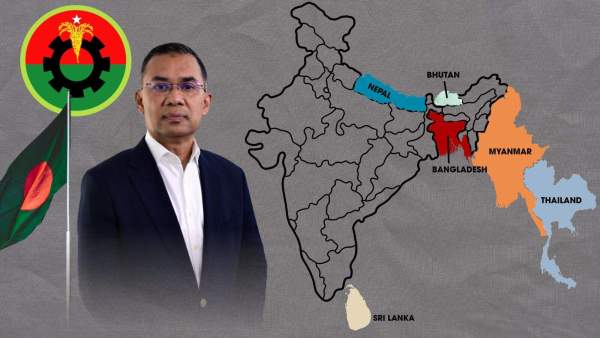
The victory of the Bangladesh Nationalist Party (BNP) should be seen in the light of the recent political developments in most of the seven member countries of the Bay of Bengal Initiative for Multi-Sectoral Technical and Economic Cooperation (BIMSTEC).
India, Nepal, Bhutan, Bangladesh, Sri Lanka, Myanmar and Thailand form this grouping, ostensibly created to reduce the influence of Pakistan (and to some extent Bangladesh) in the sub-continent, especially in regional organisations like South Asian Association of Regional Cooperation (SAARC) and at the same time neutralise the growing impact of China in Bay of Bengal as well as further south in Indian Ocean.
Besides, the outcome of the February 12 election may have its political ramifications in the two election-bound states of Assam and West Bengal in neighbouring India, as well as civil-war-torn Myanmar, which also went to polls in December-January. Incidentally, Thailand also elected its new parliament on February 8 after three governments collapsed in just over two years and Nepal, which also witnessed Bangladesh-like turmoil in September last year, is going for election on March 5.

Sri Lanka, too, saw a widespread upsurge in 2022 to be followed by the surprise victory of Janatha Vimukthi Peramuna (JVP)-led National Peoples Power in the elections held in 2024. JVP is a Marxist-Leninist party that stunned the world by trouncing the established parties of the island nation.
Thailand, which is affected by the social strife in Myanmar, is also locked in conflict with Cambodia over a thousand-year-old Hindu temple dispute on the border. India is naturally concerned about it.
So, from Nepal to Thailand, the entire eastern theatre is in the grip of political transition.
Look East, Act East
However, it is the election outcome in Bangladesh that is likely to give a new shape to the regional geopolitics. If SAARC has become dormant due to power rivalry, BIMSTEC, too, is facing a sort of crisis, largely due to instability within the member countries.
Apart from other factors, road and rail connectivity through member countries, as well as transit facilities for landlocked Nepal and Bhutan in the Bay of Bengal, were among the major objectives of BIMSTEC. India has also built a port in Sittwe in Myanmar’s Rakhine state to cut short the long distance from Kolkata to the Northeastern states, such as Mizoram, Nagaland, Manipur, etc.
The significance of Rakhine can be measured from the fact that China, too, is building a port in Kyaukpyu in the same state. However, the problem is that the separatist Arakan Army fighting against the military junta has occupied a large part of the state. The Arakan Army reportedly enjoys the support of the United States – thus, the fate of both the ports hangs in uncertainty. Arakan is numerically dominated by Buddhists, though it has a significant Rohingya Muslim population too.
The origin of BIMSTEC can be traced back to the 1990s when the then Narasimha Rao government adopted the Look East policy. That was just after the collapse of communism in the Soviet Union and its dismemberment in 1991. But BIMSTEC actually came into existence in 2004. In November 2014, the Narendra Modi government changed Look East into the “Act East” policy.
Significance of Bangladesh
For India, Bangladesh is geographically, economically and politically the most significant factor. The creation of East Pakistan on August 14, 1947, reduced the entire North-East into a landlocked region. Assam, known for its vibrant economy, was hit hard as far off Kolkata was the nearest and only port left for transportation of tea, timber and other forest goods.
The birth of Bangladesh on December 16, 1971, brought a new lease of hope for India, as a friendly regime in Dhaka was bound to give a fillip to sea trade directly up to Guwahati. Dhaka and Chattogram could have become transit ports for India. The river water disputes over the Ganga, Teesta and others were also expected to be solved. But that hope proved short-lived due to the August 15, 1975, coup and massacre of almost the entire family of the Father of the Nation, Sheikh Mujib-ur-Rahman. In most of the last 50 years, Bangladesh has had governments hostile to India.
The partition of India and the subsequent emergence of Bangladesh created the problem of refugees and infiltration. These two issues continue to haunt the politics in the entire region.
The overthrow of the Sheikh Hasina-led Awami League government after massive protests on August 5, 2024, and now the victory of the BNP under Tariq Rahman, son of former president and prime minister General Zia-ur-Rahman and Khaleda Zia, respectively, have brought about a big change in the regional politics.
Back to square one
New Delhi took a sigh of relief as the Jamaat-e-Islami could not win the election. It hopes to make some sort of deal and adjustment with the new regime. But BNP’s past record leaves little room to cheer about.
Though he was killed before SAARC came into being, the organisation was the brainchild of none other than General Zia-ur-Rahman himself, who teamed up with General Zia-ul-Haq of Pakistan to check the domination of India. Be it the BNP or the military government under General Husain Mohammad Ershad, the relationship with India was hardly cordial.
More than four decades later, the scenario in Southeast Asia is more complex.
The growing proximity between Pakistan and Bangladesh, the encircling of India by China, which had acquired Hambantota and Gwadar ports in Sri Lanka and further west in Pakistan, as well as the keen interest of the United States to fish in the troubled waters of the Bay of Bengal, have emerged as a fresh challenge. Washington would never like any domination of either China or India in the entire region. Political instability suits it.
-
AI will choose nail polish according to clothes! The world’s first ‘smart nail’ has arrived.

-
Simple way to block unknown numbers and spam in WhatsApp

-
IND vs PAK mega match: Dark clouds in the sky, big talks from captains in the press conference
-
IND Vs PAK Rising Stars Asia Cup 2026: India-A beats Pakistan-A by 8 wickets, Pak team helpless in front of Vrinda’s fifty

-
Arshdeep Singh’s viral Ronaldo ‘Siuuu’ celebration vs Namibia in Delhi