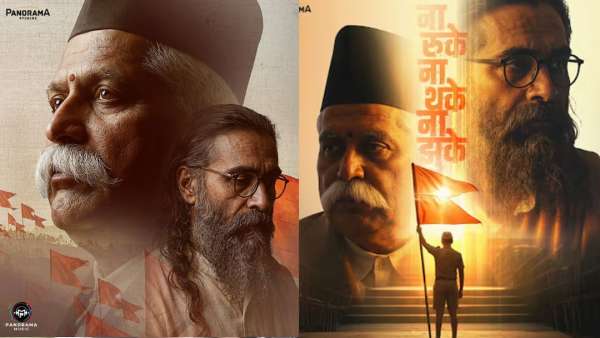
Shatak presents a detailed and ambitious portrayal of 100 years of the Rashtriya Swayamsevak Sangh (RSS), offering viewers an in-depth look at the organisation’s history, controversies, and evolution. The 1-hour-52-minute film attempts to answer several debated questions. These are: Was the RSS involved in Mahatma Gandhi’s assassination? Did it play a role in India’s freedom struggle? What were Gandhi’s relations with the RSS leadership? What role did the organisation play during times of war?
The film claims to present factual accounts from the RSS’s century-long journey, bringing forward lesser-known aspects that may surprise viewers.
Story
The narrative begins in 1925 with the founding of the RSS by Dr Keshav Baliram Hedgewar. The first half focuses on Hedgewar’s early life, the challenges he faced, and the formation of the organisation. It also highlights the role the RSS played during India’s freedom struggle.
The second half shifts to MS Golwalkar (Guruji), examining how he expanded the organisation, why the RSS chose to stay away from direct politics, and how it strengthened its network over the years. The film attempts to encapsulate the entire journey of the RSS within its runtime.
How Is The Film?
Shatak delivers a large volume of information in under two hours. It gets straight to the point from the opening scene, moving year by year through the organisation’s formation and its role in the country.
The storytelling relies heavily on voiceover narration, which helps maintain pace. The film presents several claims and lesser-heard accounts that may surprise viewers. It maintains a balanced tone, avoiding direct attacks on individuals. Figures such as Mahatma Gandhi, Jawaharlal Nehru, and Indira Gandhi appear briefly, but the focus remains on the RSS narrative rather than criticism.
The film adopts a hybrid format, using both AI and human inputs, as claimed by the makers. AI elements are minimally noticeable, mostly appearing like visual effects in war sequences. While the film may feel information-heavy at times, condensing 100 years into under two hours is no small task. Overall, it succeeds in delivering extensive information in an engaging manner.
Writing And Direction
The film is written by Anil Agarwal, Utsav Dan, Rohit Gehlot, and Nitin Sawant, and directed by Aashish Mall. The writing stands out for its strong research and balanced approach. The direction is effective and focused. Produced by Kridhan Mediatech and backed by producer Veer Kapoor, the film also marks an experimental step toward hybrid filmmaking.
Music
The music complements the film’s tone well. Composed by Sunny Inder and Shantanu Shankar, the soundtrack enhances the viewing experience. Songs sung by Shankar Mahadevan, Shaan, and Suresh Wadkar leave a strong impression.
Final Verdict
If you are interested in understanding the history and journey of the RSS, Shatak is worth a watch.
-
Ambani’s new daughter-in-law’s lehenga made without fabric by Mughal technique, 15,000 hours of performance cost 1 crore, eyes will widen

-
Such a home remedy of 7 days… which cured piles of 90 out of 100 patients, got a mysterious recipe from the Mahatma.

-
Broccoli is the queen of vegetables, you will be surprised to know its benefits

-
Vivo V70 Vs Google Pixel 10a: From Display To Processor, Here Is the Detailed Comparison You Must Read Before Buying

-
AI Impact Expo 2026: Hint for Airtel, Jio, Vi? BSNL 5G launch countdown begins… Users will get high speed service in 6 months