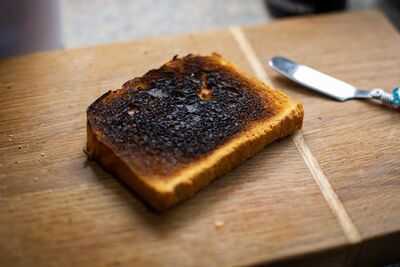
It's a belief that's been so widely spread over the years that it's likely you have heard it too: burnt food can cause cancer. And it's possible that as a result you may have worriedly scraped the burnt bits off your toast or avoided those carrots with burnt ends on your Sunday roast.
But is there any truth in the widely-held belief? Does eating burnt food really increase your risk of getting cancer. First, let's look at how the belief gained widespread traction.
Why do people believe burnt food causes cancer?When certain foods, especially high-starch foods like potatoes and bread, are cooked a substance called acrylamide forms. In cooking it is known as the Maillard reaction and it is often what you might use at home to give food that lovely caramelised look and flavour. Chefs love it.
- 'I'm a cardiologist and there are three things I would never eat or drink'
- 'I drank SIX bottles of wine EVERY DAY - until something horrific happened'
But in April 2002, the Swedish National Food Administration along with researchers at the University of Stockholm raised the alarm regarding the levels of acrylamide found in these foods because there was a belief that acrylamide caused cancer. So when the Swedish teams issued a press release saying "fried, oven-baked and deep-fried potato and cereal products may contain high levels of acrylamide" and that acrylamide was a "probable human carcinogen", there was widespread alarm. They even suggested that "perhaps several hundred of the annual cancer cases in Sweden can be attributed to acrylamide", which would effectively mean that hundreds of thousands of cancers worldwide were being caused by something contained in our most popular foods.
Does acrylamide cause cancer?The US Department of Health and Human Services' National Toxicology Program said in 1991 that "acrylamide is reasonably anticipated to be a human carcinogen based on sufficient evidence of carcinogenicity from studies in experimental animals". There have been several studies since and the European Food Safety Authority said in 2015 that "experts conclude" acrylamide "potentially increases the risk of developing cancer for consumers in all age groups".
However, scientists say that in the decades since the scare raised in Sweden there is still no conclusive evidence that acrylamide in food causes cancer. The key thing is that many findings have come as the results of tests on rodents. And, of course, rodents and humans are very different things. The US Department of Health and Human Services' National Toxicology Program says "a large number of epidemiologic studies in humans have found no consistent evidence that dietary acrylamide exposure is associated with the risk of any type of cancer".
And Fatima Saleh, associate professor of medical laboratory sciences at Beirut Arab University in Lebanon, told the BBC: "After almost 30 years of its classification as a 'probable human carcinogen', there is still inconsistent evidence of its definite carcinogenicity in humans."
However, she added that "if we continue to do further studies on humans, we might have adequate data to change acrylamide's classification to a human carcinogen".
And Neil Iyengar, a medical oncologist at Memorial Sloan Kettering Cancer Center in New York City, told WebMD: "Some studies have suggested that by [overcooking or burning food], you create carcinogens in the food that can potentially harm the body. I would call it a hypothesis right now. I’m not convinced this is truly the case."
That's not to say acrylamide isn't recognised as being a toxic substance. But the key point is whether consuming it in food means you consume enough of it to harm you.
What is acrylamide?The US National Cancer Institute explains that acrylamide is a chemical used "in many industrial processes, such as the production of paper, dyes, and plastics, and in the treatment of drinking water and wastewater, including sewage". It is found in consumer products like caulking, food packaging and some adhesives. But it is also found in some foods and "is produced when vegetables that contain the amino acid asparagine, such as potatoes, are heated to high temperatures in the presence of certain sugars". It is also found in tobacco smoke.
-
Stomach not clear in the morning? Feeling heavy all day? Then mix this substance with curd and eat it, all the dirt in the intestines will be cleaned
-
Holi 2026 in Noida: Ultimate guide to craziest parties and colourful dance events

-
Best tips for working women, how to handle household and office work without tension

-
CBSE Board 12th Psychology exam on 5th March, write answers like this, know the pattern and marking scheme

-
South Korean actor Lim Ju Hwan works part-time at Coupang logistics center