
Listen to this article in summarized format
Loading...
××
Subscribe to

Unlock AI Briefing and Premium Content
New Year Offer 24 Hours Left
Subscribe NowAlready a member? Sign In
What's Included
- Exclusive Stories
- Daily ePaper Access
- Smart Market Tools
- Curated Investment Ideas
- Ad-lite Experience
Subscription

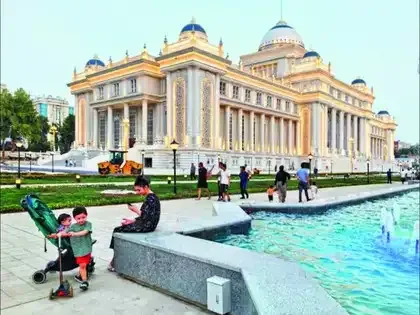
TAJIK MAHAL IN DUSHANBE
When we reached Khujand in northern Tajikistan in the late afternoon, the town was wrapped in a thick grey fog. Once a stopover on the Silk Road, little now hints at that past beyond the meticulously restored fortress at its centre. The rest of the town makes for a rather drab first impression - one that lingers, settles in your bones, and teams up with a winter chill that feels unwelcoming.
Cutting straight through Khujand is Syr Darya, a river heavy with myth and history. Rising in the Tian Shan mountains of Kyrgyzstan, its waters once travelled all the way to the Aral Sea. Formerly the world's third-largest lake, Aral has now almost disappeared - an ecological catastrophe brought about by rivers diverted for Soviet irrigation schemes, with climate change adding the finishing touches.
Tajikistan is perhaps the clearest illustration of how the five Central Asian states - Kazakhstan, Kyrgyzstan, Tajikistan, Turkmenistan and Uzbekistan - were once bundled into the Russian empire and later absorbed into the Soviet Union. They entered that arrangement at different moments and by different routes, but independence left them with a shared puzzle: figuring out what exactly their national identities were supposed to be.
During the 19th c., Russia pushed south into Central Asia as part of the Great Game, jostling Britain's ambitions. After the Russian Revolution and civil war, Moscow decided to tidy things up. In the 1920s, borders were redrawn - not to reflect history, culture or language, but to break up populations, prevent inconvenient alliances, and keep the region manageable from afar. What emerged were 5 Soviet republics: tidy on the map, far messier on the ground.
Strolling along the river in Khujand, our soundtrack was provided by rickety trucks leaning heavily on their horns, drills chewing through concrete, and motorcycles mounting pavements to dodge traffic. There was a sense that Tajikistan's future was being carefully presented as bright, orderly and under control. The ever-smiling face of President Emomali Rahmon, who has ruled since 1994, helped reinforce that message. His portrait appears everywhere: shaking hands with foreign dignitaries, or staring down traffic from towering billboards.
There is something meticulously stage-managed about the whole spectacle. Nowhere is this more apparent than in Dushanbe, where the capital is gripped by a construction frenzy. Vast apartment blocks and office towers rise on all sides, perpetually on the verge of completion.
The disadvantages Tajikistan inherited from Soviet border-making still loom large. Key Persian-speaking cultural centres such as Samarkand and Bukhara ended up inside Uzbekistan rather than Tajikistan. For several years, Tajikistan existed merely as an autonomous region within its neighbour. The result was a weaker economic base and the awkward reality of having much of its historical and cultural heritage sitting across a border that had only recently been invented.
Today, Tajikistan seems keen to make up for lost time. If you thought you had already experienced Central Asia's enthusiasm for monumental architecture in Turkmenistan, think again. Dominating central Dushanbe is Istiklol, or Freedom Tower: a 121-metre marble-clad structure unveiled in 2022 to mark 30 years of independence.
Topped with a gilded crown and a viewing platform, it bears an uncanny resemblance to a karaoke microphone waiting for someone to grab it and belt out a power ballad. At night, it erupts in a riot of colour, determined to drown out Soviet greyness and declare a clean break with the past. Yet from above, as the city spreads out like one vast construction site, that rupture feels less convincing. Everything still looks provisional, adjustable, endlessly remodelled - a landscape shaped by the same logic that once divided it neatly enough to keep it firmly under control.
Cutting straight through Khujand is Syr Darya, a river heavy with myth and history. Rising in the Tian Shan mountains of Kyrgyzstan, its waters once travelled all the way to the Aral Sea. Formerly the world's third-largest lake, Aral has now almost disappeared - an ecological catastrophe brought about by rivers diverted for Soviet irrigation schemes, with climate change adding the finishing touches.
Tajikistan is perhaps the clearest illustration of how the five Central Asian states - Kazakhstan, Kyrgyzstan, Tajikistan, Turkmenistan and Uzbekistan - were once bundled into the Russian empire and later absorbed into the Soviet Union. They entered that arrangement at different moments and by different routes, but independence left them with a shared puzzle: figuring out what exactly their national identities were supposed to be.
During the 19th c., Russia pushed south into Central Asia as part of the Great Game, jostling Britain's ambitions. After the Russian Revolution and civil war, Moscow decided to tidy things up. In the 1920s, borders were redrawn - not to reflect history, culture or language, but to break up populations, prevent inconvenient alliances, and keep the region manageable from afar. What emerged were 5 Soviet republics: tidy on the map, far messier on the ground.
Strolling along the river in Khujand, our soundtrack was provided by rickety trucks leaning heavily on their horns, drills chewing through concrete, and motorcycles mounting pavements to dodge traffic. There was a sense that Tajikistan's future was being carefully presented as bright, orderly and under control. The ever-smiling face of President Emomali Rahmon, who has ruled since 1994, helped reinforce that message. His portrait appears everywhere: shaking hands with foreign dignitaries, or staring down traffic from towering billboards.
There is something meticulously stage-managed about the whole spectacle. Nowhere is this more apparent than in Dushanbe, where the capital is gripped by a construction frenzy. Vast apartment blocks and office towers rise on all sides, perpetually on the verge of completion.
The disadvantages Tajikistan inherited from Soviet border-making still loom large. Key Persian-speaking cultural centres such as Samarkand and Bukhara ended up inside Uzbekistan rather than Tajikistan. For several years, Tajikistan existed merely as an autonomous region within its neighbour. The result was a weaker economic base and the awkward reality of having much of its historical and cultural heritage sitting across a border that had only recently been invented.
Today, Tajikistan seems keen to make up for lost time. If you thought you had already experienced Central Asia's enthusiasm for monumental architecture in Turkmenistan, think again. Dominating central Dushanbe is Istiklol, or Freedom Tower: a 121-metre marble-clad structure unveiled in 2022 to mark 30 years of independence.
Topped with a gilded crown and a viewing platform, it bears an uncanny resemblance to a karaoke microphone waiting for someone to grab it and belt out a power ballad. At night, it erupts in a riot of colour, determined to drown out Soviet greyness and declare a clean break with the past. Yet from above, as the city spreads out like one vast construction site, that rupture feels less convincing. Everything still looks provisional, adjustable, endlessly remodelled - a landscape shaped by the same logic that once divided it neatly enough to keep it firmly under control.
(Disclaimer: The opinions expressed in this column are that of the writer. The facts and opinions expressed here do not reflect the views of www.economictimes.com.)





Michiel Baas
The writer is author of Muscular India: Masculinity, Mobility & the New Middle Class