Grief, that thing with feathers, has a way of rewriting and upending everything. It has a way of settling into the deep recesses of the soul, and the small, daily rituals that suddenly feel unbearable. Grief, for a lost child, carves a silence no words can fill, a hollow where every rustle recalls small feet, every dawn stings with absence. When William Shakespeare’s only son, Hamnet, died at 11 in August 1596, the void left behind must have been immeasurable. Four years later, the playwright wrote Hamleta drama steeped in mourning and metaphysical dread, with its most famous soliloquy arguably becoming the most quoted phrase in English literature: “To be, or not to be.”
Today, it may denote existential crisis, but in the play, the line sums up the dilemma of a man weighing the brute fact of existence against the seductive quiet of oblivion; a mind circling the terror of death, the injustice of life, and the paralysis of soul-crushing, mind-numbing grief. It’s that lingering ache of parental sorrow that forms the emotional engine of Hamnet, directed by Chloé Zhao and adapted from Maggie O’Farrell’s 2020 novel of the same name. Rather than focusing on the Bard, the film turns inward, into the kitchen, the orchard, the marital bed. It reimagines the making, and unmaking, of a family, and the circumstances that might have influenced Shakespeare to come out with one of his famous tragedies.
The burden of loss
Zhao begins the elegiac tale amid the woodlands of 1580s Stratford-upon-Avon, where Agnes Hathaway — Jessie Buckley in a terrific, heartbreakingly beautiful turn as Shakespeare’s wife — stalks as falconer and herbalist. Her path crosses Paul Mescal’s restless young Will; he stumbles upon her gathering roots and reading palms. Theirs is no Elizabethan romance, but a courtship stacked against odds and steeped in urgent passion and a sense of gay abandon and defiance. After she becomes pregnant, it earns her family’s scorn, leading to a hasty marriage and a visceral forest birth for their daughter Susanna (Bodhi Rae Breathnach). Mescal’s Will is a dreamer, dodging his father’s brutality while scribbling verses, and their bond feels palpably real.
With longtime collaborator and Academy Award-winning cinematographer Łukasz Żal (whose credits include Cold War and The Zone of Interest), Zhao makes woodland light and meadow green come alive: in Hamnet’s first hour, the landscape is a thing of elemental beauty that carries an undertow of fragility and forewarning. Shots of emerald glades and sun-dappled leaves are all imbued with the hint of impermanence that later haunts every scene. Zhao and Żal give the opening scenes a painterly but lived-in quality: Hamnet’s bond with his father, and the twins (Hamnet and his sister Judith) tumbling headlong into a brief, bright childhood. That everyday intimacy makes the loss that follows all the more devastating.
Also review: Accused review: Konkona Sen Sharma anchors a stylish thriller on power, hubris and public shaming
Will’s ambitions pull him toward London’s stages, while Agnes’s deep bond with land and lore — a connection she owes to her herbal knowledge and familiarity with the forest — anchors her to home. Watching these two halves of the family slowly moving toward the impending loss is at the heart of Zhao’s strategy: she accumulates ordinary moments that, in retrospect, feel like clues. This approach is consistent with Zhao’s sensibilities in Nomadland and her earlier work. Hamnet invites you to live with these people in their hours of joy and dread, to feel the wind on their necks, the mud under their shoes, and above all, the inconsolable burden of loss.
When the bubonic plague, heralded by grotesque street puppets and ominous coughs, reaches Stratford, life seems to carry on, until it doesn’t. Zhao stages the outbreak with a matter-of-fact chill, as if death were simply another neighbour moving in. It is Judith (Olivia Lynes), who falls ill first. Hamnet, played with astonishing delicacy by Jacobi Jupe, keeps vigil at her bedside, telling her stories about falcons, bargaining in the half-believing way children do as though his love for his sister might be enough to tip the scales. He curls beside her in exhausted devotion. Ultimately, she survives, but he does not. At the tender age of 11, he is gone.
A thoughtful tale of loss and loss
The sequence is almost unbearable in its simplicity. When Agnes finds her son’s body, Buckley lets out a wail that feels torn from somewhere prehistoric. It is the culmination of a shock turning to refusal, and refusal to animal grief. The film earns that moment and takes its time getting there. From that point on, the story turns inward. William returns from London too late. He grieves, but differently. He throws himself back into work, into the theatre, into the making of something that will become Hamlet. Agnes withdraws. “I see nothing now,” she says at one point. Zhao is clear-eyed about what bereavement does to love. It doesn’t always draw people together. Sometimes it makes them strangers.
Buckley, a sheer delight to watch in every scene, literally carries the film. Her Agnes is not a decorative Tudor wife but a woman of instinct and intelligence. Buckley plays her with force but also with stillness; the performance is physical, grounded, often furious. Mescal, by contrast, works in quieter strokes. His Shakespeare is thoughtful, inward, a man who cannot quite bridge the gap between private sorrow and public language. Max Richter’s score is used sparingly, and when it’s done, it has its undertones of ache.
Also read: 2024 Lok Sabha polls: What Shakespeare’s plays can teach us this election season
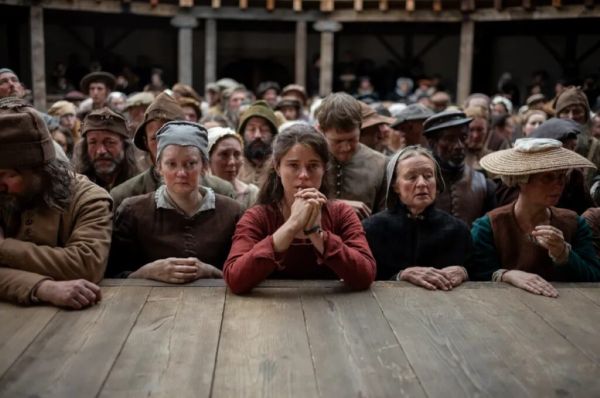
The film’s final act is a cathartic, emotional climax set inside a meticulously reconstructed Globe Theatre, where Agnes confronts the artistic transmutation of her family’s, and specifically her husband’s, shared grief. Having travelled to London, Agnes watches the inaugural performance of Hamletinitially sceptical of her husband’s decision to turn their private tragedy into public spectacle. However, the scene becomes a powerful, unscripted moment of reconciliation; as Shakespeare performs as the Ghost and a young actor portrays the titular prince, Agnes witnesses her husband’s profound, albeit silent, public display of love and grief for their deceased son.
Agnes’s perspective shifts as she watches the audience, along with her, reach out in shared empathy to the young actor on stage, realising her son will live on through this art, allowing her to finally let go of her deep-seated resentment. This setting becomes the stage for the reconciliation of Agnes and Will, where the personal pain of the past is processed through the public, communal experience of art, allowing the film to end with a sense of peace amidst tremendous sorrow.
Hamnet is a precise and thoughtful film about a tested marriage, love and loss, and what survives after both. The story retains its literary flavour while finding a visual language of its own. The film has received eight nominations at the 98th Academy Awards, including Best Picture, Best Director for Zhao, Best Actress for Buckley, Best Adapted Screenplay, Best Original Score, Best Costume Design, Best Production Design, and Best Casting. Whether or not it converts nominations into wins, its achievement is already secure.
-
Remember The Saiyaara-Paglu With An IV Drip? He Was Actually On Dialysis Reveals Ahaan Panday

-
PM Modi Emphasizes Green Energy Investments for Global Market Reach

-
Delhi launches 'Saheli Pink Smart Card' for free women travel across buses, metro, and RRTS

-
Sarah Ferguson's 'stupidity and obsession' blasted as insider reveals extravagant demands

-
Unseen clip: Virat Kohli and son Akaay's new video goes viral
