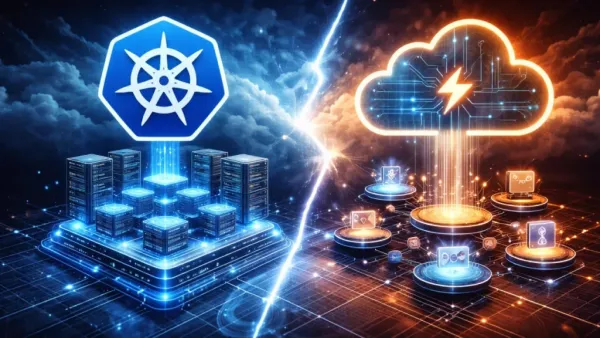
Modern software teams face a fundamental architectural decision early in their growth: whether to build on container orchestration platforms like Kubernetes vs serverless computing models. Both approaches offer users the ability to achieve operational flexibility and system fault tolerance, which leads to different methods of managing their infrastructure resources.
Kubernetes is a container management system that Google developed, and the Cloud Native Computing Foundation now oversees. Serverless platforms from Amazon, Microsoft, and Google provide developers with a complete server-free environment, which enables them to concentrate on their programming work.
The public discussion presents the issue as a competition between two options, yet the actual decision-making process requires identifying which option suits particular needs. Each model performs better in specific situations, while it encounters challenges in different operational environments. The process of determining which option succeeds requires an evaluation of four factors which include operational expenses, system scalability, handling operational tasks and employee performance levels.
What Kubernetes Offers: Control and Consistency
Kubernetes operates as a container orchestration system that handles the operation of distributed software applications. The system manages all activities to scheduling, scaling, networking, and machine cluster resilience.
The system exhibits its main strengths through three features:
- The system enables users to manage all aspects of their infrastructure through precise operational capabilities.
- The system enables users to run their applications on different cloud platforms without any restrictions.
- The system enables users to run applications that require complex operational states with multiple interconnected components.
- The system enables users to create their own networking and storage solutions.
Kubernetes gives organizations using microservices and big distributed systems a way to standardize their operations across different platforms. Developers can deploy the same containerised application in development, staging, and production.
The existence of this control feature creates an operational burden because it increases control. Kubernetes needs specialists who can handle its three main areas of operation, which include setup, performance tracking, and system upkeep.
What Serverless Offers: Abstraction and Speed
The Serverless platform provides two main benefits to users because it simplifies operations and enables faster development processes.
Serverless computing eliminates the requirement for direct server management. Developers create functions and services that activate when specific events occur. The platform takes care of all necessary tasks, including scaling operations, handling system resources, and maintaining backend systems.
The features of the system provide users with three main advantages:
- The system enables fast deployment of new features.
- The system automatically adjusts its capacity according to user demand.
- The system allows organizations to decrease their operational requirements.
- The system charges customers based on their actual usage of the service.
Serverless platforms provide optimal performance for applications that require events to drive their operations, APIs, and systems that experience random changes in user demand.
Small teams can develop systems that can grow to large scales because the system takes care of all necessary infrastructure management tasks.
The trade-off results in decreasing control. Developers need to operate according to the defined restrictions of the platform, while they must accept some degree of dependency on the vendor.
Operational Burden: Who Manages the Infrastructure?
The most important distinction between Kubernetes and serverless systems arises from their different approaches to managing operational tasks.

Kubernetes requires:
- Cluster management
- Monitoring and logging setup
- Security patching
- Resource optimisation
Serverless shifts most of these responsibilities to the cloud provider. Teams focus their efforts on developing code while managing system configurations without operating their system infrastructure.
Kubernetes enables organizations with expert DevOps teams to maintain multiple operational paths. Serverless solutions enable smaller teams to develop faster because they eliminate most operational responsibilities.
Scaling Models: Predictable vs Event-Driven
The two scaling models research predictable patterns while investigating event-based systems.
Kubernetes scales applications based on resource usage and configuration. Teams determine service scaling methods that will match their system usage patterns. This method operates effectively when systems encounter regular and continuous operational demands.
Serverless platforms scale automatically in response to events. Functions can spin up instantly when triggered and shut down when idle:
- Intermittent workloads
- APIs with variable traffic
- Background processing
The serverless system introduces cold start delays, which occur when functions start after a period of inactivity.
Kubernetes vs Serverless: Cold Starts and Performance
The serverless technology has multiple drawbacks most people consider cold starts to be its primary problem. Functions require time to start executing their tasks when they receive their first request after remaining inactive. The user experience will suffer from this issue because it affects applications that need low latency.
Kubernetes-based services normally do not experience cold starts because their containers stay in operation. The system needs to use resources even when it does not perform any work.
The decision between the two options requires organizations to evaluate their expense requirements against their acceptable delay times.

Cost Considerations
The two cost models show major differences between them.
The costs of Kubernetes include the following elements:
- Compute resources
- Storage
- Networking
- Operational overhead
The costs of serverless require organizations to pay according to their actual usage. Teams pay for execution time and resources consumed during function runs.
The serverless model becomes cost-effective when businesses experience minimal or unpredictable customer traffic. The cost of running continuous operations on Kubernetes becomes more affordable when business needs increase.
Cost savings depend on organizations’ ability to analyze their operational activities.
Observability and Debugging
The two platforms use different techniques for conducting monitoring and debugging activities.
Kubernetes provides extensive access to container activities through its log data and metric information. Teams can create their own monitoring systems through the platform’s extensive customization options.
The platform provides basic monitoring functions that enable users to track system performance. The platform supports observability tools, which help users track performance, but users face challenges when they need to debug their distributed functions.
Kubernetes gives teams more operational details, which they can use to evaluate system performance.
Vendor Lock-In
Kubernetes enables users to move their applications between different cloud environments and local data centers. The system allows users to operate their applications through multiple cloud solutions without being tied to one specific vendor.
The serverless model requires organizations to use vendor-specific services as system components. The process of switching between different providers requires organizations to invest a lot of effort into creating new systems.

Organizations that want to maintain multiple operational options should choose between Kubernetes and hybrid solutions.
Team Skills and Organisational Readiness
Team capabilities must determine the selected infrastructure components.
Kubernetes serves teams that possess:
- DevOps proficiency
- Requirements for personalized system setup
- System setup for extensive network distribution
- Serverless technology operates best for teams that possess:
- Minimal hardware capabilities
- Applications driven by specific events
- Quick software development requirements
- More important than technical skills
Hybrid Architectures: The Emerging Norm
Many organisations use both Kubernetes and serverless. For example:
- Core services operate on Kubernetes
- Serverless handles all event-based operations
- APIs access serverless managed endpoints
This hybrid model creates a balance between operational control and execution efficiency.
Organizations face infrastructure choices that go beyond simple two-way decision-making.
Global Perspective: Access and Adoption
Serverless platforms provide developers in regions with poor infrastructure a knowledge base to build scalable services without cluster management requirements.
Enterprises and technology centers are increasingly adopting Kubernetes because it provides them with flexible control options.
Global adoption patterns reflect organisational maturity and resource availability.
Conclusion: Choose Based on Workload, Not Hype
Kubernetes and serverless do not compete against each other in a fight to attain exclusive market dominance. They serve as distinct tools that operate in separate use cases.

Kubernetes provides organizations with better control over their systems while maintaining the ability to move their applications across different environments. Serverless technology enables users to implement their applications with instant operational capabilities and automatic scaling through event triggers.
The best choice depends on workload patterns, team skills, and long-term strategy. Many organizations will implement both methods, which will function as supporting elements instead of acting as competitive systems.
The success of modern infrastructure systems depends more on selecting appropriate technology than using the most advanced available technology.
-
Nvidia CEO hints at end of investments in OpenAI, Anthropic

-
OpenAI looking at contract with NATO, source says

-
Human still in driver's seat: Ford chief AI officer Franziska Bell

-
Brokerages split on future of IT as AI automates nuts and bolts

-
With a little nudge from RBI, banks tap AI for bigger tasks