A United States submarine torpedo strike that destroyed the Iranian warship IRIS Dena off Sri Lanka’s southern coast has jolted India’s strategic community, not just because of the scale of the attack but because of where and when it happened. Barely a fortnight ago, the same Iranian frigate had sailed alongside dozens of global warships during India’s International Fleet Review and the multilateral naval exercise MILAN 2026 at Visakhapatnam. The event, attended by navies from across the world and reviewed by President Droupadi Murmu, was meant to showcase maritime cooperation and naval diplomacy.
Now that very ship lies at the bottom of the Indian Ocean after being struck by a US submarine torpedo near Sri Lanka. The episode signals a stark reality: the widening Iran-US-Israel conflict has spilt into waters that India considers its strategic neighbourhood.
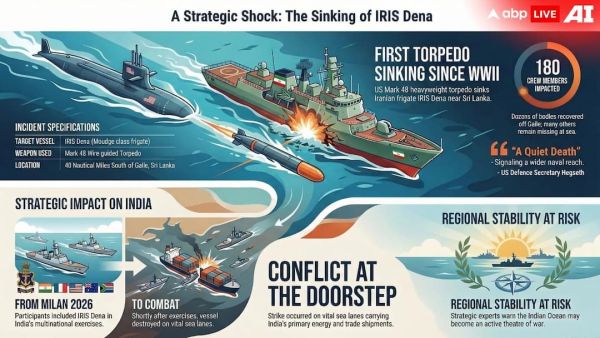
The attack, confirmed by Washington, marks the first acknowledged instance of an American submarine sinking an enemy warship with a torpedo since World War II.
The War Department will not stop until Iran’s Navy is completely and utterly destroyed. pic.twitter.com/9uGsXEXbZZ
— Sean Parnell (@SeanParnellASW) March 4, 2026
Naval Diplomacy To Battlefield Casualty Within Days
The IRIS Dena, a Moudge-class frigate of the Iranian Navy, had been part of the International Fleet Review and the MILAN 2026 naval exercise hosted by India in February. The multinational event saw more than 80 warships from dozens of countries assemble off Visakhapatnam in a show of maritime cooperation.
Contingent from #IRISDena marching in Vishakhapatnam during #Milan-2026 naval exercise on 19th February. IRIS Dena sunk this morning near #Galle, Srilanka by USA submarine, fourth such kill after WW2. War reaches in #IndianOcean . #IranIsraelWar #IranWar #IndianNavy pic.twitter.com/skDCJlbaAp
— Krishna Mohan Mishra (@kmmishratv) March 4, 2026
Just days later, the vessel was sailing back toward Iran through the Indian Ocean when it was struck by a torpedo roughly 40 nautical miles south of Galle, Sri Lanka.
According to reports, the ship sent out a distress call shortly after a powerful explosion rocked the vessel. Within minutes, flooding overwhelmed the frigate, and it disappeared beneath the waves before rescue units could reach the scene.
At the time of the attack, around 180 personnel were believed to be on board. Rescue teams have recovered dozens of bodies while several others remain missing.
The fact that a ship that had just participated in an Indian naval event was destroyed in nearby waters has added an uncomfortable geopolitical dimension to the incident.
Sri Lanka’s Rescue Operation
Sri Lanka quickly mounted a search and rescue mission after receiving the distress signal from the sinking vessel.
Submarine 'SINKS' Iranian warship Dena, hundreds missing in Indian Ocean. pic.twitter.com/v1Lm2OgYG9
— Neelotpal Srivastav (@NS_Neelotpal) March 4, 2026
"Though it was beyond our waters, it is within our search and rescue region. We are the first responders as per the international obligations. We found people floating in the water and rescued them. Later on, we found upon inquiring that they belonged to the Iranian ship. We swiftly transferred them to the Karapitiya Teaching Hospital, where they are undergoing treatment," Sri Lanka Navy spokesman Buddhika Sampath said during a presser.
Rescue teams recovered survivors and transported them to the Karapitiya Teaching Hospital in Galle, where injured sailors are receiving treatment.
Rare Return Of Submarine Warfare
The strike has also revived a form of naval combat rarely seen in modern conflicts. The United States is believed to have used a Mark 48 heavyweight torpedo fired from a stealth submarine, a weapon designed to track targets using acoustic homing before detonating with hundreds of kilogrammes of explosives.
For decades, modern naval warfare has largely been dominated by missiles and air power. The sinking of IRIS Dena shows that submarine-launched torpedoes remain among the most lethal weapons at sea.
The Pentagon confirmed that the Iranian vessel was struck in international waters, underscoring the expanding geographical scope of the conflict.
Why The Attack Matters For India
Now, let's talk about why this matters: The location of the attack is what makes the episode particularly significant for India.
The waters south of Sri Lanka sit along critical sea lanes through which a significant portion of global trade and energy shipments pass. Any escalation of naval conflict in this region has direct implications for maritime security and shipping stability.
More importantly, the symbolism is hard to ignore. A warship that sailed past India’s coast in a naval review attended by the President of India was destroyed within days in the same strategic maritime arc.
For New Delhi, this raises urgent questions. The Indian Ocean is increasingly becoming a theatre where global power rivalry and regional conflicts intersect. If the widening Iran-US confrontation continues to spill into these waters, the Indian Ocean may no longer remain a distant observation post for India but a frontline arena shaping its maritime security calculus.
-
BB 17's Anurag Dhobal cites intercaste marriage as reason for mental harrasment, hints at suicide

-
'Young Sherlock' review: The iconic detective gets a hectic, action-heavy imagined origin story

-
SSC NCC Special Entry: Opportunity to become a Lieutenant in the Army without examination, NCC candidates can apply..

-
Fardeen Khan pens heartfelt 'Sunrise Again' note about life's second chances

-
Govinda Responds to Criticism Over Recent Event Appearances