
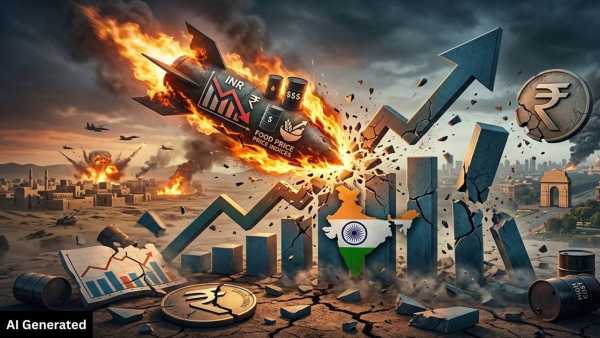
As the crisis in the Middle East is increasing. Similarly, inflation estimates are also increasing in the country. Which can spoil the mathematics of the country's economy in the coming months. Experts believe that due to increasing conflict in the Middle East, crude oil prices may remain high across the world. Due to this, India's inflation for FY 2027 may increase by 10-20 basis points. Following the US-Israel joint strike on Iran on February 28, Iran retaliated against US allies and assets in the region. Due to which Brent crude has increased from $73 to around $85 per barrel. If we talk about Friday, the price of Brent crude crossed $ 94 per barrel during the trading session.
There may be change in inflation
HDFC Bank estimates that if the average crude oil remains at $65 per barrel, then inflation in the financial year 2027 will be 4.3 percent. However, the bank has warned that if the prices increase to $75, an increase of 0.20 percent may be seen in inflation. HDFC Bank's Principal Economist Sakshi Gupta said that if this matter drags on for much longer, the impact could be more than about 0.50 percent. That too when there is no change in excise duty.
Rajni Sinha, Chief Economist of CareAge Ratings, said that if crude oil continuously remains above $ 80 per barrel, then due to indirect effect alone, inflation in FY 2027 may increase by about 0.10 percent from the earlier estimate of 4.3 percent. The sensitivity of the Consumer Price Index (CPI) to fuel prices has increased, the weightage of petrol and diesel in the new CPI series has more than doubled to 4.8 percent from the earlier 2.3 percent. In January, prices of petrol and diesel increased by 0.04 percent and 0.22 percent respectively.
India imports more than 85 percent
Radhika Rao, executive director and senior economist at DBS Bank, said a sharper rise than the central bank's estimates, where the baseline is set at around $70 per barrel, could pose a risk of inflation rising by about 0.30 per cent, even if there is no change in excise duty. India imports more than 85 percent of its crude oil needs, about half of which passes through the Strait of Hormuz. In the first ten months of FY26, about 47 per cent was sourced from suppliers in the Middle East such as Saudi Arabia, UAE, Kuwait and Iraq. Nevertheless, experts expect there to be limited changes in retail fuel prices soon.
Will petrol and diesel become expensive?
Nomura has estimated a lower impact of about 10 basis points on inflation and gross domestic product (GDP) growth. Gaura Sengupta, Chief Economist, IDFC First Bank, believes that the actual impact will be much less as retail petrol and diesel prices are unlikely to increase, which will provide protection to consumers. Sengupta said that this disruption will mainly be due to increase in net crude oil imports and reduction in producer margins.
However, Sinha at CareAge said that if crude prices go above $90 per barrel and retail prices remain the same, then government intervention may be necessary. According to JPMorgan Global Research, higher energy prices will fuel inflation, causing global CPI to increase by more than 1 percent annually in the first half of 2026.
GDP, current account deficit
High crude prices can also affect economic growth. Madan Sabnavis, Chief Economist of Bank of Baroda, said that due to prolonged stress, growth may reduce by 20-30 bps due to supply disruption. According to the sensitivity analysis of the Reserve Bank of India (RBI), a 10 percent increase in crude prices reduces real GDP growth by 0.15 percent.
If oil prices remain high, India's current account deficit (CAD) may also increase. CareEdge estimates that if crude remains above $ 80 per barrel for several months, then the CAD for FY 2027 could increase by 1.3-1.8 percent of GDP.
Nomura expects that if world oil prices average around $65 per barrel over the year, India's CAD could be around 0.9 per cent of GDP in FY26 and 0.8 per cent of GDP next year. It also says that every 10 percent increase in oil prices typically increases CAD GDP by about 0.4 percent.
-
TalkTV star supported as she sports black eye in concerning snap

-
Sarah Ferguson's ridiculous demand for butler forced to wake up at 4.30am

-
Astro: These 4 zodiac signs are the most prone to anger, losing their temper over small things..
-
Maha budget - a mirage of grand dreams amid economic strain, says Shiv Sena(UBT) in Saamana
-
Princess Kate reveals what Prince William is really like with telling 3-word remark