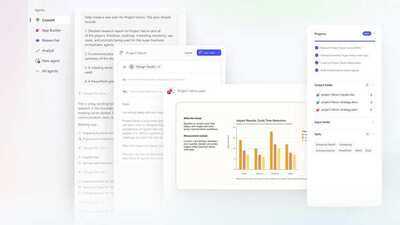
The product runs on Anthropic's Claude model for its core reasoning and uses the same agentic framework—the system that lets an AI model operate software tools within guardrails—as Anthropic's own Claude Cowork. But there's a key architectural difference. While Claude Cowork runs locally on a user's device, Microsoft's version operates in the cloud within a customer's Microsoft 365 tenant. That means it plugs into what Microsoft calls "Work IQ," a layer of intelligence drawn from your Outlook, Teams, Excel, and other 365 data.
"We actually don't work locally, and that's a feature, not a bug," said Jared Spataro, Microsoft's chief marketing officer for AI at Work. He acknowledged Anthropic's offering as "a fantastic tool" but pointed to its limitations in enterprise settings—specifically, the lack of access to cloud-based corporate data and the security concerns that come with local deployment at scale.
Copilot Cowork turns a single request into a full action plan across Microsoft 365Here's how it works in practice. You describe an outcome—say, "prepare me for Monday's client meeting"—and Cowork breaks that down into a plan. It pulls relevant inputs from your email and files, schedules prep time on your calendar, generates a briefing document and a client-ready deck, and drafts a status email with attachments. The whole thing runs in the background with clear checkpoints where you can review progress, approve changes, or pause execution.
Charles Lamanna, Microsoft's president of business apps and agents, said he used Cowork to audit his meeting calendar for the next three months. The AI analysed his email and calendar history, flagged meetings he didn't need to attend, and put its recommendations into a chart. After he reviewed them, Cowork declined the meetings on his behalf—with AI-written notes attached. The 40-minute process saved him and his executive assistant hours of manual triage.
"With chat, you're babysitting every step—this is much more like 'fire and forget' with Cowork to get the job done," Lamanna said.
Microsoft's multi-model approach means Copilot isn't locked to one AI vendorCowork also signals a broader shift in how Microsoft thinks about the AI powering Copilot. The company initially built its entire Copilot stack around OpenAI's models but has now moved to a flexible, multi-model approach. Claude is now available across the full Copilot Chat experience, not just in the Researcher and Excel features where it was previously offered. The idea is to let customers pick the best model for the job regardless of who built it.
"Every 60 days at least, there's a new king of the hill," Spataro said. "There's so much demand for a platform that doesn't feel like I have to skip over to the next vendor."
Copilot Cowork runs inside enterprise security boundaries, not on your local machineA big part of Microsoft's pitch is that Cowork runs within the company's existing security and governance boundaries. Identity management, permissions, and compliance policies all apply by default. Actions and outputs are auditable. And because it runs in a sandboxed cloud environment rather than locally, tasks keep progressing even as you switch devices. Spataro framed this as the enterprise-ready version of what Anthropic demonstrated was possible with Claude Cowork.
"What Anthropic has done is demonstrate the value of these agentic capabilities and show us practically what it could look like," he said. "Microsoft is all about commercialisation."
Copilot Cowork is currently being piloted with select customers as a research preview and will become more broadly available through Microsoft's Frontier programme in late March 2026.
-
Major airline collapses into liquidation as all flights cancelled - in business since 2002

-
'Last thing we need!' Diversity campaigner to lead new 'anti-jobs regulator'

-
Severe Heatwave Hits India Early in March

-
Diego Simeone makes feelings clear on Conor Gallagher and pays Tottenham compliment

-
NEC releases Rs 5.73 crore for key development projects in Mizoram