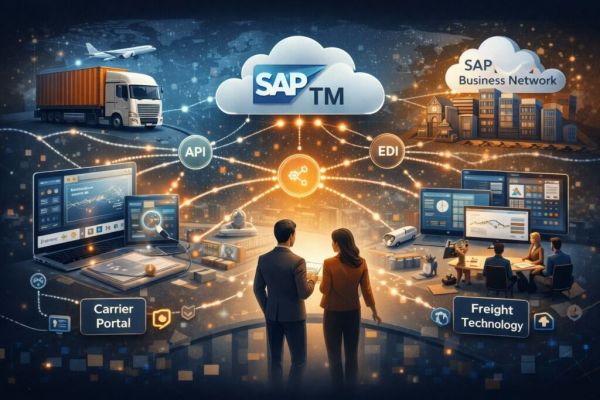
With the rising complexity of global supply chains, the transportation management process has evolved beyond traditional route planning and internal shipment handling. Contemporary logistics presupposes the uninterrupted cooperation between shippers, carriers, freight technology providers, and digital business networks. The ecosystem revolves around TMS, and SAP Transportation Management (SAP TM) stands as a market leader. Its true value is realized when it is seamlessly combined with the right partners and supporting platforms
The basis that allows real time visibility, nimbleness and transport resilience is integration. Through integration of SAP TM, carrier systems, new freight technologies, Business Network ecosystems, organizations can shift toward being responsive in their execution, rather than proactive, data-driven logistics management.
Need for an Integrated Transportation Ecosystem
In the past, transportation operations were heavily dependent on manual coordination, EDI messages that were not individualized and disconnected systems. Transparency was restricted, and reaction time was slowed down by these approaches, even though they were functional. The current logistics landscape demands real-time information on the shipment status, available capacity, and network interruptions. Integrated SAP TM environment will remove information gaps by enabling the passage of information between the external stakeholders and the internal systems. This connection facilitates teamwork, minimized paperwork, and increased speed in decision-making, particularly in large and abbreviated supply chains.
Integrating SAP TM with Carriers
One of the key pillars of execution of transportation is carrier integration. The systems used by carriers can be both legacy TMS tools and current digital portals. SAP TM integration allows to conduct an automated tendering of loads, confirmations of shipment, status reports, and delivery proof without actions of manual follow-up. Shipment information is delivered directly to carrier systems using standardized EDI messages or API based integrations with the carrier systems and information is returned with execution milestones including pickup, in-transit update and delivery confirmation. This does not only increase visibility, it also improves the carrier performance management by providing real-time and accurate analytics and scorecards. Additionally, with evolving business requirements, SAP TM integrates with carrier systems to manage dock appointments and support carrier invoice submission, including dispute handling for any discrepancies
Connecting SAP TM with Freight Technology Platforms
The emergence of freight technology platforms has changed the way capacity is sourced, priced and managed. Digital freight brokers, rate engines, and logistics markets provide dynamic rates, capacity matching, and predictive information, which supplement the planning capabilities of SAP TM. Combined with SAP TM, these platforms will make it possible to discover rates automatically, select carriers intelligently, and source capacity quickly. Commercial routing, mileage, and mapping engines supply geolocation, distance, transit-time, and network data that improve SAP TM planning precision and reduce the need for extensive master data maintenance. From a tracking standpoint, modern visibility platforms now enable real-time shipment monitoring and deliver more accurate ETAs by leveraging AI and machine learning across internal and external shipper and carrier data. This significantly enhances customer satisfaction. Live map visualization further elevates the user experience for both shippers and customers. Connectivity API gives SAP TM the ability to drink real-time data and signals to enhance the accuracy of planning and the speed of execution. This integration also facilitates end-to-end digital processes thus minimizing the use of emails, spreadsheets, and manual negotiation.
Leveraging Business Network Ecosystems
Business Networks will be the next stage of collaboration in logistics. Applications like SAP Business Network for Logistics (BN4L) allow live sharing of multi-party data between shippers, carriers, freight forwarders and service providers. Through the combination of SAP TM and Business Network ecosystems, the organizations would have a common synchronized picture of the transportation events and documents. SAP BN4L reduces the need to integrate SAP TM individually with each carrier and stakeholder by providing out-of-the-box network connections, significantly lowering implementation and maintenance effort. Additionally, advanced capabilities such as dock appointment scheduling and dispute management are available within SAP’s Business Network platform. Shipment milestones, compliance documents, and operational exceptions can be seen by all authorized stakeholders almost instantly. This networked solution lessens the redundancy of information, enhances trust and speeds up cross-organisation cooperation.
Technology Foundations for Integration
Recent SAP TM implementations are commonly constructed around Business technology Platform (BTP) and cloud-based middleware like SAP Integration Suite (CPI) with ability to provide secure, scalable, and adaptable connectivity. These platforms allow transforming data, organizing messaging, and monitoring as well as permitting EDI and API-based models of communication. A hybrid approach to integration can be necessary because there are carriers that still base on old EDI standards and new platforms that are built on real-time APIs. For carriers that do not support EDI, SAP BN4L includes a Fiori-driven portal, enabling manual interactions while maintaining a unified experience with SAP TM and SAP S/4HANA.
Strategic Value and Business Outcomes
A project success-based SAP TM environment provides real business advantages. Organizations enjoy less manual work, better shipment visibility, quick carrier integration, and better shipment exceptions. More to the point, integrated data allows more advanced analytics and predictive insights, which in turn makes it easier to optimize costs and service levels of transport continuously. With the continued development of supply chains, integration is a strategic differentiator as opposed to a technical requirement. By investing in the integration of SAP TM and carriers, freight technology, and business network ecosystems, companies stand in a better position to respond more quickly to disruptions, cooperate, and provide the best customer experiences.
Conclusion
SAP TM should be integrated with carriers, freight technology environments and Business Networks to create an intelligent interconnected transportation ecosystem environment. The adoption of contemporary integration strategies and the development of digital collaboration help organizations to shift transportation management as a transactional activity to a strategic component that leads to resilience, efficiency, and competitive advantage.
-
Why Do Women Feel Guilty for Wanting More in Life? Psychotherapist Explains

-
Summer Survival Guide: 10 Easy Ways To Stay Cool
-
'Aaya Sher' from Nani's 'The Paradise': How a massive slum set and 2.5-acre water village were built instead of CGI

-
7 reasons why Allu Arjun–Deepika Padukone's 1st film has fans thrilled

-
'I'm Game': Dulquer Salmaan starrer likely to wrap shoot by the end of March as team plans final Hyderabad schedule - Reports