Shares of 39 out of the 54 new-age tech companies fell in a range of 0.19% to close to 15%
Including SEDEMAC’s market capitalisation of $697.7 Mn, the total market cap of 55 new-age tech companies under Inc42’s coverage stood at $116.64 Bn at the end of the week
Shares of 13 new-age tech companies – Aequs, WeWork India, MobiKwik, Awfis, Smartworks, Unicommerce, Zappfresh, Wakefit, MapmyIndia, Pine Labs, Meesho, IndiQube – touched fresh lows this week
The Indian equities market continued to suffer amid the ongoing conflict in West Asia, resulting in continued selling pressure on new-age tech stocks as well this week. The total market capitalisation of 54 new-age tech companies slumped over $5 Bn to $115.94 Bn at the end of the week.
Amid this, deeptech company SEDEMAC made a stellar public market debut on Wednesday (February 11), listing at a near 12% premium to the issue price on the BSE. However, the stock fell over 3% during the subsequent trading sessions to end at ₹1,462.8. Including SEDEMAC’s market capitalisation of $697.7 Mn, the total market cap of 55 new-age tech companies under Inc42’s coverage stood at $116.64 Bn at the end of the week.
Contract manufacturer Aequs’ shares plummeted 14.96% to end the week at ₹117.1 and emerge as the biggest loser. The stock fell to a fresh all-time low of ₹113.85 during the intraday trading yesterday.
Besides Aequs, shares of 12 other new-age tech companies – WeWork India, MobiKwik, Awfis, Smartworks, Unicommerce, Zappfresh, Wakefit, MapmyIndia, Pine Labs, Meesho, IndiQube – touched fresh lows this week.
Meanwhile, shares of 15 new-age tech companies gained in a range of 0.09% to nearly 14%. Jewellery brand BlueStone was the biggest gainer, jumping 13.95% to end the week at ₹522.45. Shares of Ather Energy, PhysicsWallah, RateGain, Groww, among others, also ended the week in the green.

With that, here’s a look at some of the key developments at the new-age tech companies this week:
- In further trouble for Fino Payments Bank, its application challenging CID’s ₹11.92 Cr lien (a form of security interest granted over an item of property) in relation to the ongoing investigation of its CEO Rishi Gupta was rejected by a district court in Bengaluru. The company intends to appeal against the order in the Karnataka High Court.
- FirstCry announced the expansion of its quick deliveries offering, Qwik, across select pincodes in Bengaluru, Pune and Hyderabad. Under Qwik, FirstCry delivers apparel and toys for kids to its customers within three hours.
- SBI Mutual Fund sold close to 5 Lakh shares of BlackBuck via open market transactions on Thursday (March 12), raking in ₹28.3 Cr.
- After the NPCI proposed lowering the fees paid to UPI TPAPs and PSPs, Paytm said that the proposed revision would not have a material impact on its overall business. The company’s shares have plunged about 5% since the disclosure.
With that, let’s take a look at what happened in the broader market this week.
West Asia Tensions Singe Indian Equities Market
Bears continued their grip on the Indian equities market this week as the war between US-Israel and Iran continued to rage.
Crude oil prices zoomed past $101 per barrel, raising concerns over India’s fiscal position and inflation outlook.
Besides, domestic macroeconomic data also added pressure. India’s retail inflation rose 3.2% in February 2026, largely driven by higher food prices, while January inflation was revised slightly lower to 2.74%.
Amid the global uncertainty, FIIs remained net sellers across segments, with net equity outflows exceeding ₹35,052 Cr during the week.
“Looking forward, market direction is likely to remain dominated by the Israel and US conflict with Iran and crude trends, given their knock-on effects on inflation, corporate margins, the current account, and RBI policy space. A firm dollar and higher US yields may keep FIIs selective and volatility elevated. Selective value opportunities should persist in fundamentally resilient and domestically anchored themes, while energy‑sensitive pockets may stay pressured if oil remains elevated,” Geojit Investments’ research head Vinod Nair noted.
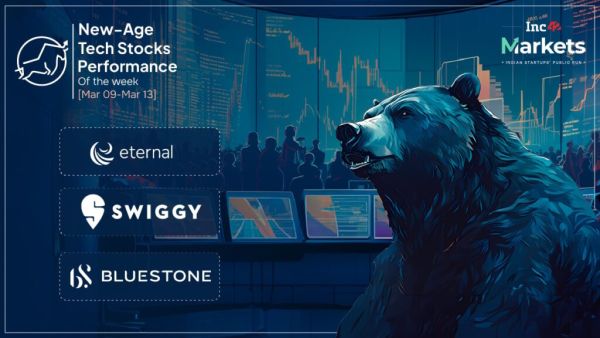
Now, let’s take a look at the performance of BlueStone, Eternal and Swiggy this week.
BlueStone Surges 14%
Amid the grim situation in the broader market, shares of BlueStone rose significantly this week. The stock soared as much as 17% during the intraday trading yesterday. After weeks of being under pressure, the stock ended the week about 3% higher than its listing price in August last year.
The rally stood out because other jewellery stocks either held steady or declined modestly. For instance, shares of Titan Company slipped nearly 4% this week.
Earlier this month, Systematix Group initiated coverage on BlueStone with a buy rating and a price target of ₹644. The brokerage cited BlueStone’s powerful omnichannel flywheel as the reason behind its rating.
“India’s jewellery market is undergoing a decisive shift—from investment-led gold buying toward design-driven, studded, and occasion-based consumption. BlueStone has built its franchise squarely around this transformation, having derived nearly two-thirds of its revenue from diamond-studded jewellery. Unlike commoditised gold retailing, studded jewellery enables brand differentiation, pricing power, and superior gross margin return on inventory (GMROI). Its positioning seems structurally advanced to benefit from increased organised penetration and as younger consumers prioritise ‘jewellery for the wardrobe’ over ‘jewellery for the locker,” the brokerage said.
Swiggy, Eternal Feel The Heat
Shares of foodtech companies Swiggy and Eternal came under selling pressure this week, as investors grew concerned over the impact of the ongoing LPG shortage on food delivery operations.
Shares of Swiggy declined 6.41% to close the week at ₹282.35, while Eternal fell 6.96% to end at ₹216.
The commercial LPG shortage is expected to weigh on near-term operations for food delivery platforms, as supply constraints could disrupt restaurant operations. Industry operators told Inc42 that several kitchens have already begun reducing menu options, and some may be forced to temporarily suspend operations if the situation persists. Platforms were largely unprepared for the sudden disruption and currently lack a clear contingency plan.
Echoing similar concerns, Motilal Oswal Financial Services said the LPG disruption could create a near-term hiccup if the shortage continues through March. Reduced menus, limited cooking hours and temporary kitchen shutdowns could constrain order availability, potentially moderating food delivery order volumes in the fourth quarter.
Despite this, Motilal Oswal maintained its growth outlook, projecting GOV growth of 15.3% and 18% for Eternal in FY26 and FY27, respectively, and around 20.2% and 17.3% for Swiggy, supported by gradual market share gains and continued expansion into new cities.
Edited by Vinaykumar Rai
-
Hungary blocks €90bn Ukraine lifeline over Druzhba pipeline dispute

-
iPhone 17e vs iPhone 16: Two models from the same company… Which iPhone is more powerful at Rs 64,900? Read the difference

-
Before IPL 2026, KKR got a shock of 440 volts, the star player got injured and was out of the entire season!
-
Chelsea vs Newcastle LIVE Score, Premier League: Match updates, lineups, streaming info

-
Got peace and satisfaction by appearing in Akal Takht: CM Mann