
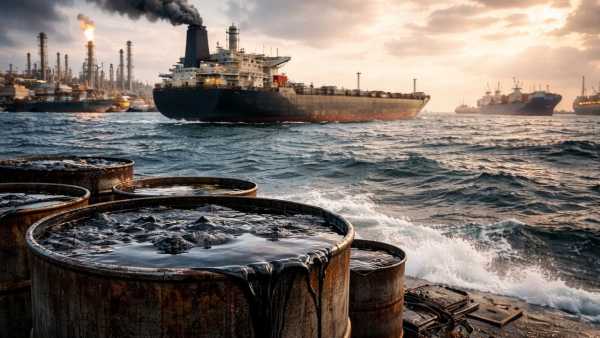
Whenever crude oil prices rise, our concern as a common man is often limited to petrol and diesel becoming expensive. At present, crude oil is trading around $100 per barrel in the international market. Despite the shocks of the Iran war, on the surface this situation does not seem very scary. But, the real crisis is brewing in the lowest part of the refinery, called 'Fuel Oil'. The cheapest and most often overlooked is oil, which comes from the bottom of petroleum distillation towers that heat crude oil. The Iran war has turned the entire picture of this industry upside down. Today this cheap fuel has become so expensive and rare that there is a danger of the wheels of merchant ships all over the world stopping. If this happens, it will have a very serious impact on the global economy.
Why is crude oil 'waste' so important?
What is left after removing expensive things like petrol, diesel and aviation fuel from crude oil is fuel oil. Even though it is called 'bottom of the barrel', the entire business of the modern world runs on it. Giant container ships, considered the axis of globalization, run on this fuel.
Vincent Clerc, chief executive of the world's largest shipping company AP Moller-Maersk, told the French newspaper Le Monde that if nothing is done immediately, there is a risk of fuel reserves at Asia's major ports completely drying up. The situation is such that there is a huge shortage of fuel oil in Singapore and Fujairah of United Arab Emirates, among the top three bunkering (refueling) places of the world. At present the supply is fine at European and American ports, but the crisis is beginning to deepen at many other places included in the top-10.
Old mathematics of crude oil broken
Financial markets always keep an eye on crude oil standards like Brent and West Texas Intermediate (WTI). From policy makers to investors, everyone's eyes are on crude. But the truth is that except the refineries, no one buys crude oil directly. The real world buys refined products, so post-refinery prices matter to us.
Generally, the prices of crude oil and refined products move together. But this traditional mathematics is now broken. Brent crude is at $100, which means that even after adding refining costs, the price of fuel oil should be around this. But in reality it is being sold at a very high price. Fuel oil in Singapore has reached $140 per barrel. At the same time, at major ports like Fujairah, its price has reached up to 160 dollars. Some of its special types, which meet environmental standards, are being sold at an unimaginable price of $ 175 per barrel. This is also well above the historical high levels of 2008 and 2022. Traders are giving these quotes over the phone only for a few minutes...either seal the deal immediately, or forget it.
The closure of the Strait of Hormuz is the real root of the crisis.
The main reason for this dire crisis is the closure of the Strait of Hormuz. This sea route is a major route not only for crude oil but also for fuel oil coming from the refineries of Saudi Arabia, Kuwait and UAE. According to the International Energy Agency, 20 percent of the total fuel oil traded internationally comes from the refineries of these Gulf countries.
Technically speaking, the crude oil of Gulf countries produces more fuel oil on average than other regions. For example, when Saudi Arabia's flagship 'Arab Light' crude oil is refined, up to 50 per cent of it is 'residue' or fuel oil. At the same time, only 33 percent residue is released from America's WTI crude oil after refining. Now that Asian refineries are having to find alternatives like American or Russian oil, naturally the production of fuel oil has reduced significantly.
Danger of new tsunami of inflation
The shipping and oil industries are currently trying to handle the situation by transporting fuel oil to Asia via ships from the US (such as Long Beach and Panama) and Europe (Rotterdam and Gibraltar). The world has also used up its strategic petroleum reserves. In such a situation, now only the natural decrease in demand due to continuously rising prices can balance this crisis.
But, the longer the Strait of Hormuz remains closed, the greater the risk that container ships will not have enough fuel left to complete their journey. This oil coming out from the 'bottom' (lowest part) of the refinery tower has today become the 'top' (biggest) challenge for the global economy.
-
No matter how close you are, don’t forget to share these 7 secrets! Then it’s a scam

-
What Is Dirty Soda? The Bizarre Trend That Everyone Is Trying

-
Special discount available on OnePlus 13 on Flipkart

-
The bat did not even work against Bangladesh, now the career of Babar’s friend will also end?

-
Bangladesh defeated Pakistan by 11 runs in the decisive ODI to win the series 2-1.