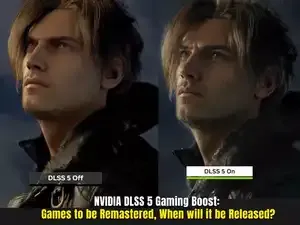
NVIDIA confirmed Tuesday at its GTC conference that it will launch DLSS 5 this fall, introducing a real-time neural rendering model designed to elevate video game graphics to the level of cinematic visual effects. The technology represents the company’s most significant architectural shift since the 2018 debut of real-time ray tracing, moving away from brute-force hardware rendering toward a generative AI approach. By analyzing scene semantics like hair, skin, and fabric, the model generates photoreal pixels that were previously impossible to render in a 16-millisecond game frame. This transition to AI-driven fidelity is expected to coincide with the rollout of the GeForce RTX 50-series architecture, specifically optimized for these new neural shaders.
The game renders a normal frame (but maybe not super detailed on lighting/materials because it's fast). It sends that frame's color data + motion info to the DLSS 5 AI. The AI analyzes it once and adds photoreal upgrades (better light bounce, skin glow, fabric details, etc.) — all anchored to the game's 3D model so it's accurate and stable. You get a much prettier, more realistic image on screen at high resolution (up to 4K), and it runs smoothly because the heavy AI work is done efficiently on RTX GPUs (especially RTX 50-series). Developers can tweak it (intensity, colors, mask areas) so it fits their game's style — like not making faces look too weird.
Check NVIDIA GeForce's video on DLSS 5:
How does NVIDIA's DLSS 5 work?
Neural rendering model (what DLSS 5 uses) is basically a super-smart AI brain trained to understand and improve pictures. It takes the game's basic frame (just colors and movement info from the game engine). The AI "understands" what's in the scene: Is this human skin? Hair? Fabric? Is the light coming from the front, back, or cloudy sky? Then it adds realistic extras like: skin that glows a bit inside (subsurface scattering, like real ears lighting up), fabric with soft shine, hair catching light naturally — all while keeping everything consistent (no flickering between frames) and tied to the game's original 3D world (so it doesn't invent random stuff). It's like the AI is "painting" better lighting and textures on top of the game's picture in real time, making it look way more lifelike than traditional methods.The game renders a normal frame (but maybe not super detailed on lighting/materials because it's fast). It sends that frame's color data + motion info to the DLSS 5 AI. The AI analyzes it once and adds photoreal upgrades (better light bounce, skin glow, fabric details, etc.) — all anchored to the game's 3D model so it's accurate and stable. You get a much prettier, more realistic image on screen at high resolution (up to 4K), and it runs smoothly because the heavy AI work is done efficiently on RTX GPUs (especially RTX 50-series). Developers can tweak it (intensity, colors, mask areas) so it fits their game's style — like not making faces look too weird.
How is DLSS 5 different from traditional Ray Tracing?
While Ray Tracing simulates individual paths of light, it is extremely demanding on hardware. NVIDIA notes that a single photoreal frame in a movie can take hours to render, but a game must do it in milliseconds. DLSS 5 acts as a shortcut; rather than calculating every ray of light, it uses generative AI to predict and draw what those photoreal pixels should look like based on its deep training. Jensen Huang described this as the "GPT moment for graphics," where the AI is no longer just making an image sharper but is actively "reinventing" how the final pixels are created.NVIDIA DLSS 5 and Hollywood level VFX
"Hollywood VFX level" as stated in NVIDIA's press release means the graphics in games will look as realistic and detailed as what you see in big Hollywood movies (like CGI in Marvel films or Pixar animations). In movies, those super-realistic scenes take minutes or hours to render per frame on powerful computers because they use tons of complex calculations for perfect lighting, shadows, skin glow, fabric shine, etc. Games have only about 16 milliseconds per frame to look good and run smoothly (for 60 FPS), so they've always fallen short of that movie-quality look. NVIDIA says DLSS 5 closes that gap using AI, so real-time games can now have lighting, materials, and details that feel "photoreal" like Hollywood VFX without slowing down the game.Check NVIDIA GeForce's video on DLSS 5: