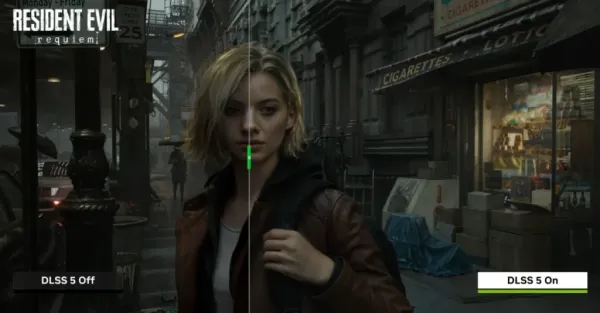
Since DLSS first arrived with Nvidia’s RTX 20-series GPUs in 2018, many gamers have supported the idea. It offered a simple trade: use AI upscaling to boost frame rates or push higher resolutions without heavy performance costs. Over time, the tech improved and became a standard feature in modern PC games.
Now, with the early reveal of DLSS 5, Nvidia is taking a different path. This version moves beyond upscaling and frame generation. It introduces what the company calls a “real-time neural rendering model.” In simple terms, it does not just sharpen or fill in frames. It actively changes lighting, textures, and materials using generative AI.
Nvidia CEO Jensen Huang described it as a mix of “generative AI” and traditional rendering. The goal is to reach film-level realism while still giving developers control over how their games look. Nvidia says DLSS 5 uses in-game data like motion and color to keep changes stable and consistent. This helps the system understand scenes, including faces, lighting conditions, and materials like fabric or skin.
On paper, the idea sounds like a major leap. In practice, early reactions tell a different story.
Why AI “Enhancements” are Clashing with Art Direction
Many players and developers feel the results look off. Faces appear overly smooth and detailed in a way that feels unnatural. Some describe the look as “uncanny,” where characters seem close to real but not quite right. Others say it resembles heavy photo editing rather than natural graphics.
Lighting has also drawn criticism. In several demos, shadows appear weaker or washed out. This creates a flatter image and removes the mood that artists carefully design. For many, this change hurts the original tone of a game.
Developers have been quick to speak up. Mike Bithell, known for Thomas Was Alonesaid the tool feels like it removes art direction rather than supporting it. Jeff Talbot, a senior concept artist at Gunfire Games, argued that the added detail does not improve visuals. Instead, it strips away style and character.
Even stronger reactions came from other parts of the industry. Some critics called the feature an unnecessary AI filter. Others warned that if this becomes standard, future players may not even notice that something feels wrong.
Can DLSS 5 Balance Technical Prowess with Player Trust?
Despite the backlash, some technical analysts see promise. Outlets like Digital Foundry praised the lighting changes as impressive, at least from a technical point of view. Still, even those positive takes note that the current demos rely on extreme hardware setups, including dual GPUs, which are far from common.
Nvidia has responded to the criticism. The company insists DLSS 5 is not a simple filter. It says developers can control how the system behaves, including where effects apply and how strong they appear. Studios can also disable the feature in certain scenes.
Game publishers are taking a cautious tone. Bethesda, one of Nvidia’s early partners, said the current footage shows early work. Its teams plan to adjust the visuals before release. The company also stressed that the feature will remain optional for players.
Still, public opinion has shifted fast. Online, “DLSS 5 On” has already turned into a meme. People use it to describe visuals that look overly polished or unnatural. That kind of reaction can be hard to reverse.
Nvidia still has time before the planned autumn launch. The company may refine the tech and improve its image. But one thing is clear: moving from upscaling to AI-driven visual changes has sparked a debate. For many, the question is no longer what looks more real, but what still feels right.
-
Britain's most hated tax wrings £100m more out of bereaved families

-
Britain's most hated tax wrings £100m more out of bereaved families

-
Mikel Arteta confirms positive Arsenal injury news in double Carabao Cup final update

-
Liverpool issue statement after 'vile' racist abuse of Ibrahima Konate and demand action

-
Karkala: Horrific road accident; biker crushed to death as tyre runs over head