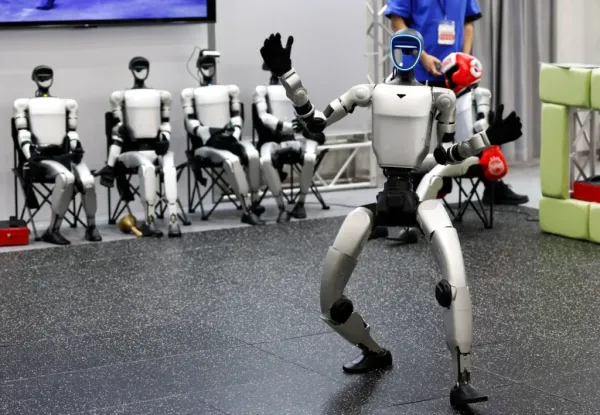
Unitree Robotics has taken a major step toward going public. The company has filed for an IPO on the Shanghai Stock Exchange STAR Market. The move puts a spotlight on how investors value humanoid-robot firms, a sector that is still early but growing fast.
Unitree plans to raise about 4.2 billion yuan, or roughly 600–630 million USD. The exchange accepted its prospectus in late March 2026. CITIC Securities is acting as the main sponsor and underwriter.
The STAR Market often lists high-growth tech firms. It allows companies with strong revenue growth to go public even if their long-term profits remain uncertain. That makes it a natural fit for a robotics firm like Unitree.
Unitree Robotics: Company profile and growth
Founded in 2016 near Hangzhou, Unitree built its name with quadruped robots. These dog-like machines gained attention for their agility and lower cost. Over time, the company shifted toward humanoid robots.
That shift shows in its numbers. In 2025, Unitree reported revenue of 1.708 billion yuan. That marks a rise of about 335% from the year before. Net profit also climbed, with growth between 200% and 270%, depending on how one counts one-off items.
Profit after stripping out non-recurring gains reached around 600 million yuan. That figure grew about 6.7 times year on year. The jump came from strong sales and rising demand for newer products.
Focus on humanoid robots
Unitree now treats humanoid robots as its main growth engine. In the first three quarters of 2025, this segment made up 51.5% of total revenue. Sales from humanoid robots rose about 276% from the same period a year earlier.
The company offers several models at different price points:
- G1 humanoid: a mid-sized robot priced from about 85,000 yuan
- R1 Water: a smaller model priced from 29,900 yuan
- H2 humanoid: a larger and newer system still rolling out
These prices stand out. Many rival humanoid robots from overseas cost between 30,000 and over 100,000 USD. Unitree’s lower pricing aims to speed up adoption.
Sales and market position
Unitree shipped more than 5,500 humanoid robots in 2025. The company claims this makes it the top global seller by volume in this category.
Its prospectus estimates a 32% global market share by shipment volume. That suggests strong demand in China, along with some export growth.
Most of these robots serve practical roles rather than advanced automation. The main use cases include:
- Reception and tour guidance: robots greet visitors in hotels, museums, and offices. This segment makes up 50–70% of humanoid revenue.
- Factory inspection: robots monitor equipment and report issues.
- Light logistics tasks: some models assist with simple handling and movement tasks.
These uses rely on mobility and interaction rather than complex decision-making.
Use of IPO funds
Unitree plans to invest about half of the IPO proceeds in research and development. The focus will be on both hardware and software, often called “embodied AI.” This includes motion control, perception, and human-robot interaction.
The remaining funds will support:
- New product development
- Updates to existing humanoid models
- Expansion of production capacity
The company aims to scale manufacturing to around 190,000 robots per year. That would mark a large jump from current output.
Why does this IPO matter?
This entry is a test for the humanoid robot industry. Investors must consider what to do with these companies that are growing rapidly but are uncertain about long-term demand.
On the one hand, China is helping the robotics industry through government support and investments. The move towards robotics and automation could create long-term demand. The lower price points could also help the industry grow faster.
On the other hand, the current robots are limited in their applications. Most robots are capable of doing simple or semi-structured tasks. The robots that are fully autonomous and can mimic human flexibility are still in development.
This creates uncertainty for investors. They must consider the short-term sales and long-term potential.
Unitree’s IPO comes at a time when robotics and AI are becoming more aligned. Improvements in sensor, chip, and machine learning technologies are making robots more capable. The path to widespread adoption is uneven.
If the IPO attracts strong demand, it may open the door for more robotics firms to list. If it struggles, it could signal caution in the market.
Either way, Unitree stands at a key point. Its growth shows real demand for affordable robots. Its future depends on whether that demand can expand beyond early use cases into wider industry adoption.