
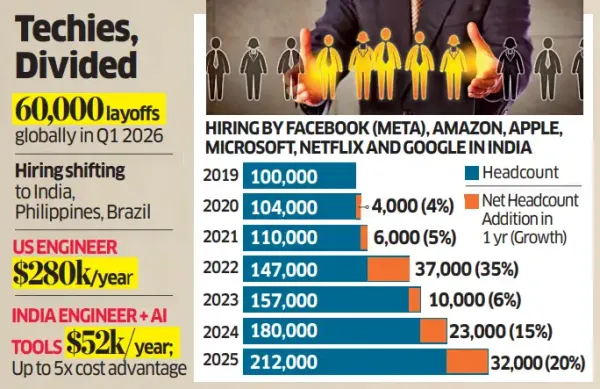
While tech companies are sacking thousands in the US due to AI-led automation and efficiency gains, hiring hasn’t abated in markets such as India, the Philippines and Brazil because of the obvious commercial advantage. A senior engineer in California costs about $280,000 annually. Their equivalent in Bengaluru, along with a paid subscription to AI tools such as Cursor or Claude, costs $52,000 on average. That ‘AI+India/Philippines/Brazil’ equation is working in favour of candidates in these countries.
In the first three months of this year, nearly 60,000 tech workers have been laid off globally, yet markets such as India have remained largely insulated. FAANMG — Facebook/Meta, Amazon, Apple, Netflix, Microsoft and Google — added a net 32,000 employees in India last year.
Double-digit growth
Overall, global tech hiring in India is expected to rise further in 2026, according to staffing firms Xpheno, Michael Page, Adecco and NLB Services.
EY India plans to hire 14,000-15,000, Capgemini aims to create 60,000 new jobs in the country, Google unveiled its new Bengaluru campus, Ananta, and Accenture is planning a new location in Andhra Pradesh for 12,000 seats.
India’s FAANMG headcount has grown in double digits over the last two years, reaching 216,000 at the end of 2025, on the back of a net addition of 31,000, the highest ever, data from Xpheno showed. “We expect the net headcount addition to likely fall between 25,000 to 35,000 jobs this year,” said Kamal Karanth, cofounder of Xpheno.
There’s a clear, measurable and accelerating shift towards offshoring, said Sanketh Chengappa, head of professional staffing at Adecco India. “This is being driven by a combination of factors such as rising H-1B costs, US tech layoffs and restructuring, and increasing demand for 24x7 engineering and global R&D, accelerating GCC expansion,” he said.
AI is enabling offshore teams to modernise processes and deliver higher productivity, with cost-efficient talent pools. “The cost arbitrage will continue to favour India over the next three to five years, and is likely to strengthen further with AI adoption,” Chengappa said. This is because AI tools are boosting productivity without proportional wage inflation, effectively amplifying output per dollar.
Adecco expects overall tech hiring to grow at around 7% annually through FY27.
NLB Services chief executive Sachin Alug concurred. “On average, engineering talent in India can be three to four times more cost-effective than in the US,” he said. “AI tools further amplify this advantage by enabling smaller, highly efficient teams to deliver more output.”
Although AI can already automate up to almost 57% of work activities in theory, most roles still require human judgement and oversight, Alug said.
As the cost of GPU (graphics processing unit) tokens continues to decline, AI will start replacing entry-level coding and testing jobs.
“Currently, the entry barrier to AI remains high due to implementation and training costs, but as with most emerging technologies, this is expected to stabilise in the mid-term,” said Pranshu Upadhyay, regional director and head of India technology practice, Michael Page.
“Even as AI adoption scales and becomes widespread, the demand for basic coding and manual testing may decline, but human intervention will still be critical for solving complex and ambiguous problems. Therefore, the need will reduce, but not disappear,” he said.
In the first three months of this year, nearly 60,000 tech workers have been laid off globally, yet markets such as India have remained largely insulated. FAANMG — Facebook/Meta, Amazon, Apple, Netflix, Microsoft and Google — added a net 32,000 employees in India last year.
Double-digit growth
Overall, global tech hiring in India is expected to rise further in 2026, according to staffing firms Xpheno, Michael Page, Adecco and NLB Services.
EY India plans to hire 14,000-15,000, Capgemini aims to create 60,000 new jobs in the country, Google unveiled its new Bengaluru campus, Ananta, and Accenture is planning a new location in Andhra Pradesh for 12,000 seats.
India’s FAANMG headcount has grown in double digits over the last two years, reaching 216,000 at the end of 2025, on the back of a net addition of 31,000, the highest ever, data from Xpheno showed. “We expect the net headcount addition to likely fall between 25,000 to 35,000 jobs this year,” said Kamal Karanth, cofounder of Xpheno.
There’s a clear, measurable and accelerating shift towards offshoring, said Sanketh Chengappa, head of professional staffing at Adecco India. “This is being driven by a combination of factors such as rising H-1B costs, US tech layoffs and restructuring, and increasing demand for 24x7 engineering and global R&D, accelerating GCC expansion,” he said.
AI is enabling offshore teams to modernise processes and deliver higher productivity, with cost-efficient talent pools. “The cost arbitrage will continue to favour India over the next three to five years, and is likely to strengthen further with AI adoption,” Chengappa said. This is because AI tools are boosting productivity without proportional wage inflation, effectively amplifying output per dollar.
Adecco expects overall tech hiring to grow at around 7% annually through FY27.
NLB Services chief executive Sachin Alug concurred. “On average, engineering talent in India can be three to four times more cost-effective than in the US,” he said. “AI tools further amplify this advantage by enabling smaller, highly efficient teams to deliver more output.”
Although AI can already automate up to almost 57% of work activities in theory, most roles still require human judgement and oversight, Alug said.
As the cost of GPU (graphics processing unit) tokens continues to decline, AI will start replacing entry-level coding and testing jobs.
“Currently, the entry barrier to AI remains high due to implementation and training costs, but as with most emerging technologies, this is expected to stabilise in the mid-term,” said Pranshu Upadhyay, regional director and head of India technology practice, Michael Page.
“Even as AI adoption scales and becomes widespread, the demand for basic coding and manual testing may decline, but human intervention will still be critical for solving complex and ambiguous problems. Therefore, the need will reduce, but not disappear,” he said.