New Delhi: Talks at the 14th ministerial conference of the World Trade Organization (WTO) in Yaounde, Cameroon, continued way beyond the afternoon deadline, with the closing ceremony too delayed for several hours, as negotiators from the US and Brazil continued to argue over issues related to agriculture and moratorium on electronic transmission tariffs.
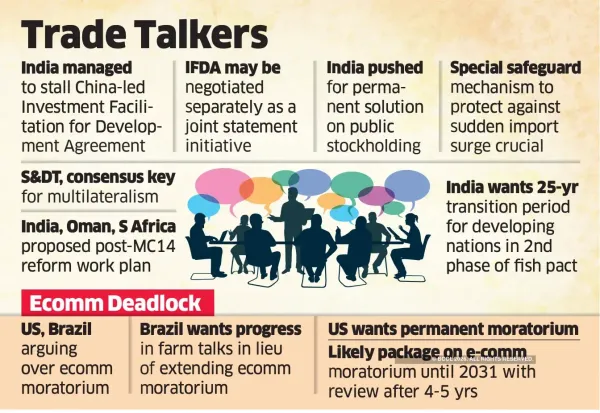
Sources said India managed to stop the China-led Investment Facilitation for Development Agreement (IFDA) from entering the WTO framework through Annex 4 route. It could now be negotiated separately among the participating members like a joint statement initiative.
Also Read: India, Oman, South Africa submit work plan on WTO reforms
New Delhi held its ground on the IFDA, which is endorsed by 128 members, despite being isolated and sought "guardrails" before such plurilaterals make their way into the WTO. Bangladesh, South Africa and Turkiye withdrew their objections to the pact since the MC14 began on March 26.
 "The US and Brazil have been squabbling over agriculture and e-commerce issues," said an official.
Sources said Brazil demanded progress in the agriculture negotiations in lieu of extending the moratorium. The US wants a permanent moratorium to protect its digital services and AI firms from getting taxed in the future.
Also Read: India opposes China-led investment pact in WTO
Since Sunday morning, negotiators were reviewing a package that included a proposal to extend the e-commerce moratorium until June 2031, but requiring a review after four years but reforms and farm issues got linked.
Pressure on India
"An ecommerce moratorium for five years with another five year extension were also discussed. There was great pressure on India," said another source.
Also important for India is the parallel extension of the moratorium on TRIPS non-violation complaints (NVC), a mechanism that developing nations use to shield domestic policies from legal challenges.
Commerce and industry minister Piyush Goyal left from the host country in the afternoon.
Standalone outcomes
Insisting on the need to preserve the development dimension of the Doha Work Programme, India has emphasised the mandated issues of permanent solution on public stockholding (PSH), special safeguard mechanism (SSM), and cotton, followed by outcomes on broader long-term reforms.
India said these issues be taken up "on a standalone basis and shall not be made contingent upon progress in other areas.".
"Special and differential treatment for developing countries is preserved and strengthened...any possible new approach shall be consistent with existing mandates and not dilute or replace them," India said.
New Delhi continued to stress on the need for consensus.
In his talks with WTO director general Ngozi Okonjo-Iweala on Sunday, Goyal acknowledged her continued efforts in building consensus for a successful MC14.
"Emphasised the importance of a balanced and responsive WTO that effectively addresses the needs and aspirations of all members, particularly developing countries and LDCs," he posted on X.
Reform focus
India, Oman and South Africa Sunday proposed a post-MC14 work plan covering issues of decision-making, development and special and differential treatment (S&DT) and level playing field at the WTO.
In the draft Yaounde ministerial declaration on WTO reform, they proposed that consultations on dispute settlement reform, under the auspices of the dispute settlement body (DSB), should continue following MC14 and report to the General Council as per the aforementioned indicative timelines and checkpoints.
Sources said India managed to stop the China-led Investment Facilitation for Development Agreement (IFDA) from entering the WTO framework through Annex 4 route. It could now be negotiated separately among the participating members like a joint statement initiative.
Also Read: India, Oman, South Africa submit work plan on WTO reforms
New Delhi held its ground on the IFDA, which is endorsed by 128 members, despite being isolated and sought "guardrails" before such plurilaterals make their way into the WTO. Bangladesh, South Africa and Turkiye withdrew their objections to the pact since the MC14 began on March 26.
Sources said Brazil demanded progress in the agriculture negotiations in lieu of extending the moratorium. The US wants a permanent moratorium to protect its digital services and AI firms from getting taxed in the future.
Also Read: India opposes China-led investment pact in WTO
Since Sunday morning, negotiators were reviewing a package that included a proposal to extend the e-commerce moratorium until June 2031, but requiring a review after four years but reforms and farm issues got linked.
Pressure on India
"An ecommerce moratorium for five years with another five year extension were also discussed. There was great pressure on India," said another source.
Also important for India is the parallel extension of the moratorium on TRIPS non-violation complaints (NVC), a mechanism that developing nations use to shield domestic policies from legal challenges.
Commerce and industry minister Piyush Goyal left from the host country in the afternoon.
Standalone outcomes
Insisting on the need to preserve the development dimension of the Doha Work Programme, India has emphasised the mandated issues of permanent solution on public stockholding (PSH), special safeguard mechanism (SSM), and cotton, followed by outcomes on broader long-term reforms.
India said these issues be taken up "on a standalone basis and shall not be made contingent upon progress in other areas.".
"Special and differential treatment for developing countries is preserved and strengthened...any possible new approach shall be consistent with existing mandates and not dilute or replace them," India said.
New Delhi continued to stress on the need for consensus.
In his talks with WTO director general Ngozi Okonjo-Iweala on Sunday, Goyal acknowledged her continued efforts in building consensus for a successful MC14.
"Emphasised the importance of a balanced and responsive WTO that effectively addresses the needs and aspirations of all members, particularly developing countries and LDCs," he posted on X.
Reform focus
India, Oman and South Africa Sunday proposed a post-MC14 work plan covering issues of decision-making, development and special and differential treatment (S&DT) and level playing field at the WTO.
In the draft Yaounde ministerial declaration on WTO reform, they proposed that consultations on dispute settlement reform, under the auspices of the dispute settlement body (DSB), should continue following MC14 and report to the General Council as per the aforementioned indicative timelines and checkpoints.