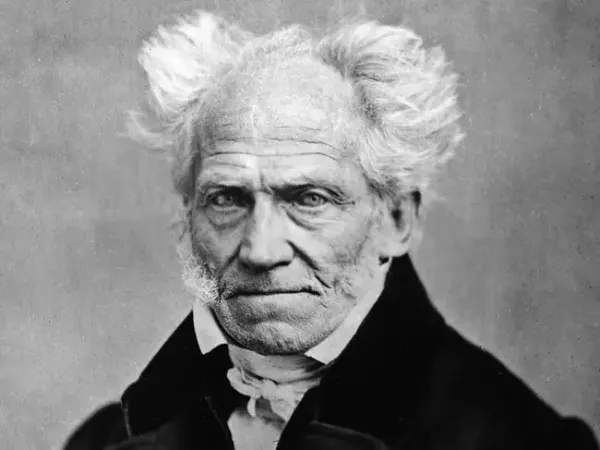
The 'Quote of the day' today is from a phrase often linked with German philosopher Arthur Schopenhauer, someone known for his rather hard and sometimes uncomfortable views on life. The line goes: “Only a philosopher can be happy in marriage, and philosophers do not marry.” It is also commonly seen in a longer form: “Since love is a deception practiced by nature, marriage is the attrition of love and must be disillusioning. Only a philosopher can be happy in marriage and philosophers do not marry.” Over time, this version has been repeated in books and discussions, and it has slowly become one of the more talked-about thoughts on marriage coming from philosophical writing.
To understand the quote, one has to sit with it for a bit because it does not say something simple or comforting. Schopenhauer believed that what people call romantic love is not really as deep or meaningful as it feels in the moment. He argued that love is something created by nature to keep the human race going, not necessarily to make individuals happy. In that sense, what people experience as strong emotional attachment could actually be more biological than emotional, though it doesn’t feel that way when someone is in it.
The second part moves toward marriage, and this is where his thinking becomes even more direct. He saw marriage as something that slowly wears out the excitement that love creates in the beginning. What starts with attraction and emotion, according to him, ends up turning into routine, responsibilities, and sometimes disappointment. So when he says only a philosopher can be happy in marriage, it sounds like he is suggesting that only someone who understands this reality fully, and does not get carried away by illusions, might still manage to stay content. But then he adds that philosophers do not marry, which kind of closes the loop and leaves little room for hope.
What the quote is trying to say
The quote is not just about relationships, it connects with Schopenhauer’s larger way of looking at life. In his major work The World as Will and Representation, he spoke about something he called the “will,” which he described as a blind force driving human actions and desires. This includes love, ambition, and most things people chase in life. According to him, this will does not really care about happiness, it just keeps pushing people forward.So when this idea is applied to marriage, it starts to make a bit more sense why he was so doubtful about it. Love brings two people together, but once that purpose is served, the same force does not guarantee long-term satisfaction. That is where the idea of disillusionment comes in. He also mentioned in his writings that to marry is to “halve one's rights and double one's duties,” which again shows how he saw marriage more as a burden than a source of joy.
The role of Will Durant in shaping the quote
One thing that often gets missed is that the exact line, as it is widely shared today, was not directly written by Schopenhauer. The sharper, more memorable version was framed later by historian Will Durant in his 1926 book The Story of Philosophy. Durant was trying to summarise Schopenhauer’s ideas in a way that readers could quickly understand, and this line ended up becoming the most quoted takeaway.Schopenhauer’s actual writings from the 19th century do carry the same ideas—about love being a kind of deception and marriage leading to a loss of freedom—but they are spread across his works and not written in this exact sentence. So in a way, the quote of the day is both his and not exactly his at the same time, which makes it a bit interesting when people discuss it.
Schopenhauer’s life that reflected his beliefs
Looking at Schopenhauer’s own life, the quote feels less like a random statement and more like something he actually lived by. He never married and chose to spend most of his life alone, focusing on his work and thoughts. He followed a strict routine, read widely, and kept his distance from social and family obligations. For him, this was not a sacrifice but a necessary choice to maintain independence.At the same time, there is a strange contrast when one looks at Will Durant’s life. Durant, who helped popularise this rather bleak line about marriage, had a long and collaborative relationship with his wife Ariel Durant. They worked together for decades and even received major recognition as a team. So while he captured Schopenhauer’s thinking well, his own life told a very different story.
Not the same as Socrates
The 'Quote of the day' is sometimes confused with another famous line linked to Socrates: “By all means, marry. If you get a good wife, you will be happy. If you get a bad one, you will be a philosopher.” While both talk about marriage and philosophy, the tone is very different.Socrates’ statement feels lighter, almost like something said with a bit of humour. Schopenhauer’s idea, on the other hand, comes from a much more serious and somewhat negative view of life. He was not trying to joke, he was stating what he believed to be a hard truth.