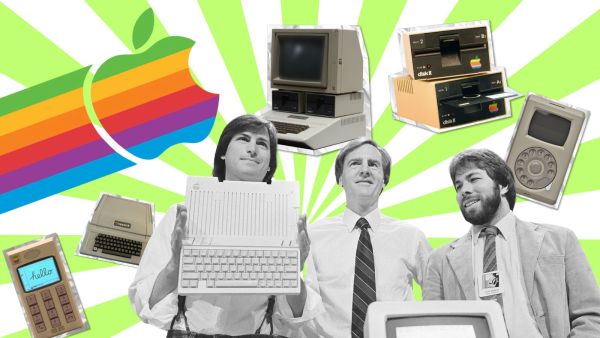
On April 1, 1976, three men signed a piece of paper in a California garage and called their new venture Apple Computer Company. One of them, Ronald Wayne, sold his 10 per cent stake back within two weeks for USD 800. The other two, Steve Jobs and Steve Wozniak, went on to build one of the most valuable companies in history.
Fifty years later, Apple is worth more than USD 3.6 trillion. However, not many know how close it was to shutting down.
The rise, the fall
Wozniak had originally designed the circuit board at the heart of Apple’s first product, the Apple I, simply to share with fellow hobbyists. Jobs saw a business. That tension between the engineer’s instinct to build and the entrepreneur’s instinct to sell would define Apple for decades.

The company went public in 1980 and, for a while, seemed unstoppable. Then came the hubris.
By 1985, Mac sales had stalled and Jobs’s management style, both brilliant and bruising in equal measure, had alienated enough people inside Apple that when he attempted a boardroom move against Chief Executive Officer (CEO) John Sculley, the man he had himself recruited from Pepsi, almost nobody backed him.
The board sided with Sculley. Jobs resigned in September 1985. He was 30.
What followed was a slow unravelling. Apple went through three CEOs, none of whom could find the thread. The product catalogue bloated into an incomprehensible sprawl. Market share fell from nearly 20 per cent in the late 1980s to under five per cent by 1997.
Losses exceeded USD 1 billion in the 18 months before Jobs’s return, according to Fortune. By late 1996, Apple had roughly 90 days of cash left.
BusinessWeek put Apple’s logo on its 1996 cover beside the words “The Fall of an American Icon.” Wired’s 1997 cover showed the Apple logo tangled in barbed wire, with one word below it – “PRAY.”
The comeback
The recovery did not begin with a product. It began with a USD 400 million acquisition.
Apple needed a modern operating system. It bought NeXT, the company Jobs had built after leaving Apple, in February 1997, bringing him back to Cupertino as an “informal adviser.” That description did not last long.
Within months, Jobs had manoeuvred his way back to the top. Interim CEO was the title. However, in practice, he ran everything.
He cut the product line from dozens of models to four, killed the clone licensing programme that had been eating into Apple’s margins and struck a deal, ironically, for Microsoft to invest USD 150 million and keep Office running on Mac. The money bought Apple the time it needed.
Then came the iMac in 1998, the translucent, blue computer designed by Jony Ive, which was unlike anything on the market. It sold 800,000 units in five months. Apple closed that year with a USD 309 million profit, against a loss of over USD 1 billion the year before.
The rest, as they say, is history, with Apple launching the iPod, iTunes, the iPhone, the iPad, the App Store and the M-series chips. Each one reshaped an entire industry.
What Apple means in India
For Indian consumers, Apple’s journey took a particularly significant turn in recent years. Once seen as an aspirational but distant luxury brand, Apple has aggressively pushed into India, opening its first retail stores in Mumbai and Delhi in 2023, expanding manufacturing through partners like Tata and Foxconn and making India a key part of its supply chain diversification away from China.
India is now one of Apple’s fastest-growing markets. As the US smartphone market saturates, Apple has leaned harder into emerging markets, and India, with its expanding middle class, sits at the centre of that strategy, according to Reuters.
Apple’s services business such as the App Store, Apple Music, iCloud and Apple TV+, is also deepening its India footprint.
The road ahead
The Apple that turns 50 faces pressures as real as any it has seen before, just different in character.
Its stock is the second-worst performer among the Magnificent Seven since OpenAI launched ChatGPT in November 2022, according to Reuters. Despite embedding machine learning in its chips since 2017, delays in rolling out meaningful AI features have led analysts to conclude the company was caught off-guard by how fast consumers embraced AI.
Rivals, including OpenAI, are now building AI-native devices designed explicitly to disrupt the smartphone’s dominance.
Annual revenue is expected to approach USD 465 billion this fiscal year. The services layer keeps generating high-margin recurring income. The hardware-software integration remains tighter than anything a competitor offers.
“The company made it fifty years with no one truly competing with its integrated business model,” independent analyst Ben Thompson wrote on Stratechery. “The fate of its next fifty years may rest on the question of just how compelling AI ends up being – and if OpenAI can out-Apple the original.”Half a century on, the most profitable near-death story in corporate history is still being written.
-
Brazilian Model Virat Kohli Dated Before Anushka Sharma

-
Blast Heard Outside BJP Punjab Office In Chandigarh, Crude Bomb Suspected

-
Kannur native accused of sending obscene messages to Kerala Women Commission head, arrested

-
Monty Don says plant he 'hates' is 'repulsively ugly' and 'doesn't work' in garden

-
Sundernagar Nalwar Fair 2026: A Cultural Revolution for Youth Empowerment