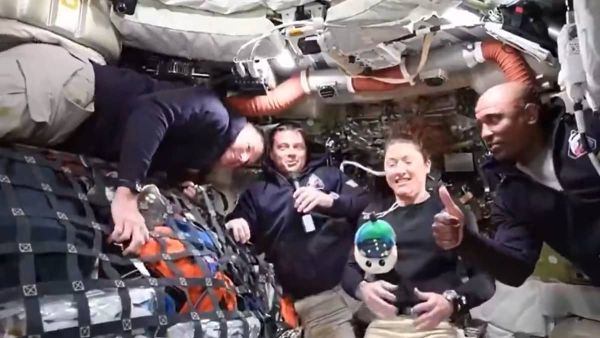
As Artemis II prepares to carry humans back to home from Moon’s neighbourhood, there’s an unexpected name buzzing around the mission logs - a “fifth crew member” who isn’t listed on any official astronaut roster.
Did you send your name aboard Artemis II???
— NASA Artemis (@NASAArtemis) April 8, 2026
If you did, then your name is literally in my pocket!! And every time you see me floating around the Orion spacecraft — that’s where your name is! With ME!
Don’t worry — I’ve kept your names safe as I’ve flown around the Moon ? -Rise pic.twitter.com/4Y8zKqBPhL
The four-person crew - Reid Wiseman, Victor Glover, Christina Koch and Jeremy Hansen have spent days around the Moon aboard NASA’s Orion spacecraft. But somewhere inside that capsule, quietly doing its job, is a small object that signals one of the most important milestones of the journey: the moment they left the Earth’s gravity behind.
Can't get enough of me???? (I don't blame you!)
— NASA Artemis (@NASAArtemis) April 8, 2026
I have my own exhibit at the Fleet Science Center in San Diego April 9, 10, and 11! -Rise pic.twitter.com/vznw6TpmP5
Meet the mission’s most unusual crew member
The mystery “passenger” is Rise - a soft, round, white plush toy that has quickly become the internet’s favourite space traveller. Rise isn’t just there for charm. It serves as the mission’s Zero Gravity Indicator (ZGI) - a simple but crucial tool. When the spacecraft reached microgravity, Rise began to float, giving astronauts a clear, visual confirmation that they’ve entered weightlessness.
COPY, MOON JOY?? I AM MOON JOY!!!! -Rise pic.twitter.com/BM3uYakxoM
— NASA Artemis (@NASAArtemis) April 8, 2026
It’s science, stripped down to its most human-friendly form.
Designed by a child, flown by NASA
What makes Rise stand out is its origin story. Unlike most equipment aboard Orion, it wasn’t engineered in a high-tech lab. It was imagined by Lucas Ye, a young student from California, who submitted the design as part of a global mascot contest. Out of more than 2,600 entries, Rise was chosen not just by judges, but by the astronauts themselves.
This was where my journey began… at @NASAGoddard!
— NASA Artemis (@NASAArtemis) April 8, 2026
The Thermal Blanket Lab is where technicians make clothes — but for spacecraft. Paula Cain not only put me together, but she made me a cool ‘fit as well. ? -Rise pic.twitter.com/QvsEA9czsl
The final plush was stitched together at NASA Goddard Space Flight Center, where technicians who usually build thermal protection systems for spacecraft took on a softer assignment: creating a mascot that could survive space.
A tradition older than the Moon landing
While Rise may feel like a social media-era addition, the idea behind it dates back more than six decades. The tradition began with Yuri Gagarin during his 1961 flight on Vostok 1, when he carried a small doll to indicate zero gravity. Since then, missions have included mascots that blend function with personality.
This was where my journey began… at @NASAGoddard!
— NASA Artemis (@NASAArtemis) April 8, 2026
The Thermal Blanket Lab is where technicians make clothes — but for spacecraft. Paula Cain not only put me together, but she made me a cool ‘fit as well. ? -Rise pic.twitter.com/QvsEA9czsl
Some memorable “crew members” over the years:
- Snoopy, who flew during Apollo 10 and again on Artemis I
- Grogu (popularly called Baby Yoda), aboard a SpaceX Crew Dragon mission
- Shaun the Sheep, who orbited the Moon on Artemis I. Each one carried a mix of symbolism, morale, and a touch of home into the vacuum of space.
More than just a mascot
Rise represents something bigger than a cute addition to the crew. It connects a high-stakes, multi-billion-dollar mission to everyday people, especially young dreamers who may one day build, design, or fly the next generation of spacecraft. In a mission defined by cutting-edge engineering and historic ambition, it’s a reminder that space exploration still leaves room for wonder. And sometimes, the smallest passenger makes the biggest statement.