Setting off on April 1 - and officially becoming the farthest humans from Earth (4,06,788 km away) in history on April 6 - the 4-member Artemis 2 crew is scheduled to splash down in the Pacific Ocean off San Diego tomorrow around 5.23 a.m. IST.
Soaring 6,545 km above the lunar surface at their closest approach, the astronauts looped back to the Moon's vicinity and set sail towards Earth, for the first time in 53 yrs. But unlike Apollo missions (1967-72), Artemis 2 is not a landing mission. It is a vital test flight, with human crew designed to validate Nasa's Space Launch System (SLS) and Orion spacecraft in deep-space conditions.
While Artemis 1 successfully sent an uncrewed Orion around the Moon and back, maths can only tell engineers that much. Artemis 2 is designed to test the human element. For the first time, a crew has relied on Orion's life-support systems, communication modules and manual flight controls in deep space. In the early stages, while still in Earth's orbit, they took manual control of Orion to test its handling and manoeuvrability.
Every breath they took, every drop of recycled water they consumed, all provided invaluable data. If humanity is to establish a sustained presence on the Moon and eventually journey to Mars, we must first prove that our deep-space vessels can keep humans alive, healthy and operational for weeks.
Also Read |Artemis II astronauts describe their lunar voyage as surreal and profound ahead of Earth return
To understand the significance of this mission, we must look at the physics of its journey. Rather than entering a stable lunar orbit - which a Moon landing mission would normally do - Orion was placed on a free-return trajectory. After executing a precise trans-lunar injection burn, the spacecraft was hurled toward the Moon. Then, by utilising our satellite's immense gravitational field, Orion swung around its far side, naturally curving its trajectory back toward Earth without the need for a high-power engine burn to return.
The brilliance of free-return trajectory is its passive safety. If the spacecraft's primary propulsion systems were to fail after the initial trans-lunar injection burn, laws of physics would guide the crew safely back. Climax of this trajectory occurred on April 6, when Orion slipped behind the lunar sphere, plunging the crew into a pre-planned 40-min communications blackout with ground control.
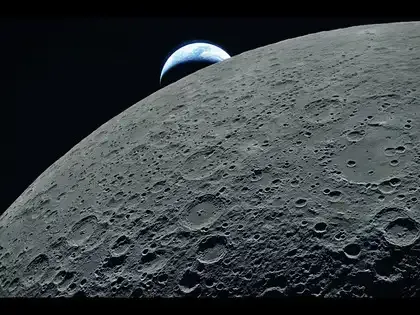
During this period of radio silence, the astronauts were far from idle. They first took a break to enjoy maple cream cookies. Then they took lovely pictures of the lunar surface with unprecedented clarity. They also recorded detailed audio descriptions of the terrain. As they emerged from the blackout, the astronauts witnessed a stunning 'Earthrise' - the first seen by any humans since the final Apollo 17 mission in 1972 - revealing our world as a small bluish crescent set against the dark canvas of deep space.
Soon after, they experienced a total in-space solar eclipse that lasted an hour. From their unique vantage point, the Moon obscured the Sun, revealing fiery tendrils of solar corona while the lunar surface was faintly illuminated by earthshine - reflected light bouncing off our oceans and clouds.
Also Read | Artemis Moon mission: NASA touches the sky during a tough year for science
Orion is packed with advanced avionics, radiation sensors and environmental control systems. The crew is testing how well the spacecraft shields them from cosmic radiation. They are also validating the high-bandwidth communication networks required to transmit scientific data to Earth.
The Moon is increasingly viewed not merely as a destination, but as a stable, pristine platform for studies of the cosmos, and the first stop of future exploratory spaceflights. Since it's geologically inert and its core isn't active, it provides an exceptionally quiet seismic environment. Its far side is also permanently shielded from the cacophony of Earth's radio interference.
In the coming years, missions will exploit this quiet environment. Plans are emerging for instruments like Lunar Surface Electromagnetics Experiment-Night (LuSEE-Night), which will tune into the elusive 21-cm radio frequencies of the universe's primordial 'cosmic dark ages'.
There are also proposals for Laser Interferometer Lunar Antenna (LILA), a network of rover-mounted mirrors designed to use the Moon's tranquillity to detect mid-band gravitational waves. This could act as an early-warning system for detection and follow-up of mergers of black holes and neutron stars, which will teach us a lot about the nature of stars and the universe.
Artemis 2 is a global catalyst that shifts the paradigm of exploration. India is accelerating toward monumental milestones: forthcoming Gaganyaan human spaceflight missions, joint Nisar (Nasa-Isro Synthetic Aperture Radar) satellite and Axiom-4 collaboration. And, of course, plans for India's own moon missions. Progress of the Artemis programme reinvigorates this momentum.
In a landscape increasingly saturated by AI and rapid data generation, true scientific endeavour lies in critical interrogation. Students need to see through the eyes of Artemis 2's crew, who critically analysed albedo - a measure of the reflectivity of a surface, representing the percentage of solar energy reflected back into space compared to the amount absorbed - mapped uncharted terrains, and sent us photos of uncharted moonscapes. Can't we use new adventures like these to bring back excitement and adventure into classrooms?
Artemis 2 is not the destination but the beginning. Humanity is finally readying itself to leave the shores of Earth. Hopefully, this time to stay.
Soaring 6,545 km above the lunar surface at their closest approach, the astronauts looped back to the Moon's vicinity and set sail towards Earth, for the first time in 53 yrs. But unlike Apollo missions (1967-72), Artemis 2 is not a landing mission. It is a vital test flight, with human crew designed to validate Nasa's Space Launch System (SLS) and Orion spacecraft in deep-space conditions.
While Artemis 1 successfully sent an uncrewed Orion around the Moon and back, maths can only tell engineers that much. Artemis 2 is designed to test the human element. For the first time, a crew has relied on Orion's life-support systems, communication modules and manual flight controls in deep space. In the early stages, while still in Earth's orbit, they took manual control of Orion to test its handling and manoeuvrability.
Every breath they took, every drop of recycled water they consumed, all provided invaluable data. If humanity is to establish a sustained presence on the Moon and eventually journey to Mars, we must first prove that our deep-space vessels can keep humans alive, healthy and operational for weeks.
Also Read |Artemis II astronauts describe their lunar voyage as surreal and profound ahead of Earth return
To understand the significance of this mission, we must look at the physics of its journey. Rather than entering a stable lunar orbit - which a Moon landing mission would normally do - Orion was placed on a free-return trajectory. After executing a precise trans-lunar injection burn, the spacecraft was hurled toward the Moon. Then, by utilising our satellite's immense gravitational field, Orion swung around its far side, naturally curving its trajectory back toward Earth without the need for a high-power engine burn to return.
The brilliance of free-return trajectory is its passive safety. If the spacecraft's primary propulsion systems were to fail after the initial trans-lunar injection burn, laws of physics would guide the crew safely back. Climax of this trajectory occurred on April 6, when Orion slipped behind the lunar sphere, plunging the crew into a pre-planned 40-min communications blackout with ground control.
During this period of radio silence, the astronauts were far from idle. They first took a break to enjoy maple cream cookies. Then they took lovely pictures of the lunar surface with unprecedented clarity. They also recorded detailed audio descriptions of the terrain. As they emerged from the blackout, the astronauts witnessed a stunning 'Earthrise' - the first seen by any humans since the final Apollo 17 mission in 1972 - revealing our world as a small bluish crescent set against the dark canvas of deep space.
Soon after, they experienced a total in-space solar eclipse that lasted an hour. From their unique vantage point, the Moon obscured the Sun, revealing fiery tendrils of solar corona while the lunar surface was faintly illuminated by earthshine - reflected light bouncing off our oceans and clouds.
Also Read | Artemis Moon mission: NASA touches the sky during a tough year for science
Orion is packed with advanced avionics, radiation sensors and environmental control systems. The crew is testing how well the spacecraft shields them from cosmic radiation. They are also validating the high-bandwidth communication networks required to transmit scientific data to Earth.
The Moon is increasingly viewed not merely as a destination, but as a stable, pristine platform for studies of the cosmos, and the first stop of future exploratory spaceflights. Since it's geologically inert and its core isn't active, it provides an exceptionally quiet seismic environment. Its far side is also permanently shielded from the cacophony of Earth's radio interference.
In the coming years, missions will exploit this quiet environment. Plans are emerging for instruments like Lunar Surface Electromagnetics Experiment-Night (LuSEE-Night), which will tune into the elusive 21-cm radio frequencies of the universe's primordial 'cosmic dark ages'.
There are also proposals for Laser Interferometer Lunar Antenna (LILA), a network of rover-mounted mirrors designed to use the Moon's tranquillity to detect mid-band gravitational waves. This could act as an early-warning system for detection and follow-up of mergers of black holes and neutron stars, which will teach us a lot about the nature of stars and the universe.
Artemis 2 is a global catalyst that shifts the paradigm of exploration. India is accelerating toward monumental milestones: forthcoming Gaganyaan human spaceflight missions, joint Nisar (Nasa-Isro Synthetic Aperture Radar) satellite and Axiom-4 collaboration. And, of course, plans for India's own moon missions. Progress of the Artemis programme reinvigorates this momentum.
In a landscape increasingly saturated by AI and rapid data generation, true scientific endeavour lies in critical interrogation. Students need to see through the eyes of Artemis 2's crew, who critically analysed albedo - a measure of the reflectivity of a surface, representing the percentage of solar energy reflected back into space compared to the amount absorbed - mapped uncharted terrains, and sent us photos of uncharted moonscapes. Can't we use new adventures like these to bring back excitement and adventure into classrooms?
Artemis 2 is not the destination but the beginning. Humanity is finally readying itself to leave the shores of Earth. Hopefully, this time to stay.
(Disclaimer: The opinions expressed in this column are that of the writer. The facts and opinions expressed here do not reflect the views of www.economictimes.com.)





Somak Raychaudhury
He is vice-chancellor, Ashoka University, Sonipat, Haryana