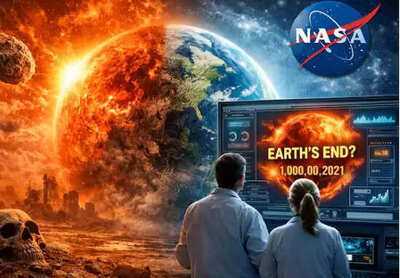
Have you ever pondered the possibility that the Earth we inhabit today could one day become lifeless? A recent scientific study has reignited this concern. It suggests that even predictions akin to those of Nostradamus may pale in comparison, as researchers have utilized supercomputers to forecast the planet's demise.
According to this research, the most significant threat does not stem from an asteroid or warfare, but rather from the sun itself. As the sun's temperature continues to rise, the balance of Earth will increasingly be disrupted. Fortunately, this danger is projected to occur millions of years from now, yet scientists are already observing early warning signs.
Have scientists pinpointed the timeline for Earth's end?
Researchers Kazumi Ozaki and Christopher Reinhard assert that life on Earth is not eternal. They indicate that oxygen, the essential foundation for life, may gradually deplete over time. Previously, it was believed that life could persist on Earth for approximately 2 billion years, but the new study suggests this timeframe has been reduced to around 1 billion years. This indicates that the 'lifeline' of Earth, oxygen, is not guaranteed to last forever.
Has NASA's supercomputer painted a grim picture?
NASA's supercomputer models predict that in the future, the sun's brightness and heat will increase to the extent that Earth's atmosphere will begin to change. As temperatures rise, ocean water will evaporate, and oxygen-producing microorganisms will start to vanish. This will lead to a rapid decline in atmospheric oxygen levels. Scientists believe there will come a time when breathing on Earth will become nearly impossible, resulting in the extinction of most life forms.
Will we see a return to an 'oxygen-depleted' era?
The research indicates that in about 1 billion years, oxygen levels on Earth could drop below 1 percent. This scenario would resemble the period before the 'Great Oxidation Event' when oxygen was scarce. Similar to that time, only a few bacteria may survive in such an environment, while humans, animals, and plants would likely not endure these changes. This is viewed as a natural conclusion to Earth's life cycle.
Is there a way for humanity to prepare?
While this prediction is indeed alarming, it also offers a glimmer of hope. Scientists suggest that this event is still a billion years away, providing humanity ample time. It is possible that by then, humans may have settled on another planet or developed technology to mitigate oxygen shortages. Currently, the most pressing threat lies in existing issues like climate change, which require immediate attention from today's generation.
-
Easy way to recharge yourself by removing stress and fatigue: Yoga Nidra

-
Becoming a mother again? Keep these things in mind before announcing your first child

-
To protect wheat from weevils, just use these 2 things, it will be safe even in big stores.

-
April 19 Horoscope, which zodiac signs will get the blessings of Vishnu on the day of Akshaya Tritiya?

-
How To Make Thai Mango Sticky Rice At Home: An Easy Recipe