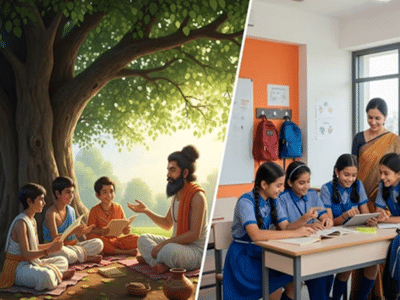
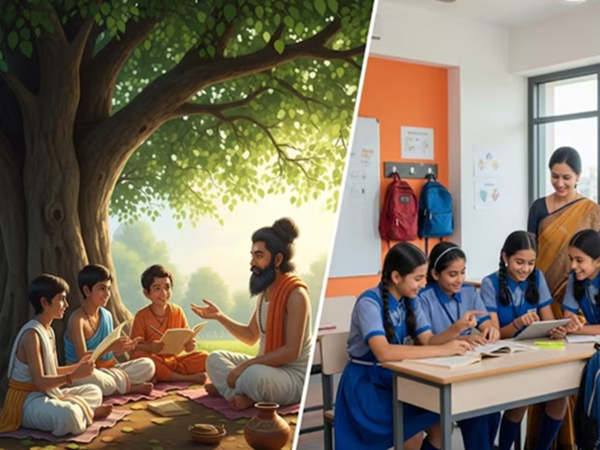
Gurukul Education System, India: India’s ancient and glorious system of education—the ‘Gurukul’—continues to be a subject of discussion even in today's modern era. While the contemporary education system has become confined merely to the acquisition of degrees and jobs, the Gurukul system emphasizes the holistic development of the individual. A Gurukul is not merely a schoolhouse; rather, it is a sanctuary where a disciple becomes an integral part of the Guru's family and learns the true values of life. Here, education is not confined within four walls; instead, it is imparted amidst the lap of nature and in the close presence of the Guru.
In an era where mental stress and a lack of discipline have emerged as global challenges, the significance of the Gurukul system becomes even more profound. Recently, a specific method of study—one that has been an integral part of Gurukuls for centuries—has garnered significant attention. This technique is known as the ‘Walking Method,’ or in ancient terminology, *‘Chakraman’*. This study method not only fosters self-reliance among students but also cultivates a harmonious balance between their intellectual and spiritual faculties. Discover why this centuries-old Indian method continues to be regarded as one of the world's finest educational systems, even in the modern age.
**The Gurukul Method of Study: Experience is the Ultimate Guru**
The foundation of learning within a Gurukul rests upon the principles of *‘Shravan’* (listening), *‘Manan’* (contemplation), and *‘Nididhyasan’* (deep assimilation). Here, students first listen to wisdom as it flows directly from the Guru; they then retreat to solitude to contemplate upon it; and finally, they integrate that knowledge into their daily conduct and character. Education here extends far beyond the mere reading of textbooks; alongside the study of the Vedas and Puranas, students receive practical instruction in subjects such as mathematics, astronomy, logic, and Ayurveda. Disciples rise before sunrise and commence their day with the practice of Yoga and Pranayama, thereby ensuring that both their bodies and minds remain active and alert.
**The Walking Method: The World Acknowledges the Science of the Sages**
Modern research indicates that studying while walking—or the ‘Walking Method’—serves as an infallible technique for enhancing memory retention and alleviating stress. In the ancient Gurukuls, this practice was known as *‘Chakraman’*. **Improved Memory:** Walking increases blood circulation in the brain and activates the hippocampus, making it easier to quickly memorize difficult lessons.
**Stress Relief:** Studying while walking—rather than sitting at a desk—triggers the release of "endorphins" (feel-good hormones), which effectively alleviate exam-related stress.
**Enhanced Focus:** While walking, the mind remains in a heightened state of alertness; consequently, boredom and lethargy do not even come close to the student.
**What Happens in a Gurukul?**
In the Gurukul system, primary emphasis is placed on three key aspects:
**Discipline and *Brahmacharya* (Celibacy/Self-Restraint):** Self-control is accorded the highest priority to ensure a disciplined and orderly life.
**Skill Development:** Here, every student receives practical training in fields aligned with their specific interests—whether it be martial arts (*Shastra Vidya*), agriculture, the arts, or commerce.
**Equality:** Whether a student is the son of a king or the child of a pauper, everyone in a Gurukul partakes of the same food and adheres to the same daily routine.
**How Do Gurukuls Differ from Modern Schools?**
Contemporary educational institutions—or modern schools—primarily prepare students for "competitive examinations," whereas Gurukuls prepare them for "life itself." In modern schools, students are evaluated based on grades and numerical scores, whereas in Gurukuls, priority is given to their character and conduct. In modern schools, education has evolved into a commercial enterprise; in Gurukuls, however, it remains a spiritual discipline (*Sadhana*).
**How Many Gurukuls Are There in India?**
Currently, there are over 5,000 operational Gurukuls across India. Many of these Gurukuls are now integrating traditional Vedic teachings with modern subjects—such as coding and English—to ensure that students can keep pace with the demands of the contemporary world. Educators should learn from the Gurukul model that their role is not merely to function as "knowledge-dispensing machines," but rather to serve as true guides. Students, in turn, should recognize that true education is what renders one calm, humble, and self-confident. Techniques that may appear trivial—such as the "Walking Method"—serve as compelling proof that the science embedded within our cultural roots holds the solution to every challenge facing modern education today.
Disclaimer: This content has been sourced and edited from News18 Hindi. While we have made modifications for clarity and presentation, the original content belongs to its respective authors and website. We do not claim ownership of the content.
-
SDPO Of Odisha's Khandapada Transferred Amid Sexual Harassment Allegations

-
Not a Ford, BMW or Audi - the best car for a road trip announced

-
Nationwide Building Society to make major change in 605 branches - 'affects 1 in 4'

-
The Return of the OG Bloodline: WWE's Strategic Move Post-WrestleMania 42

-
What to Expect from the Highly Anticipated Awarapan 2 Starring Emraan Hashmi?