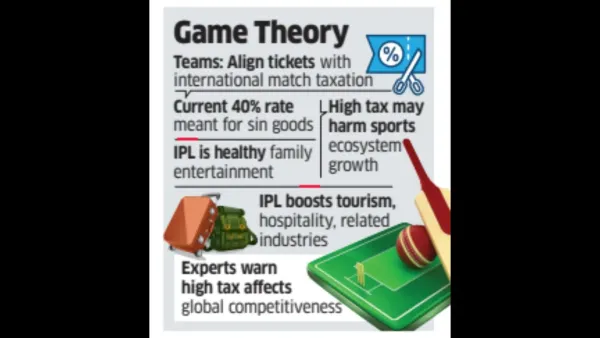
Indian Premier League (IPL) teams have asked the finance ministry to treat the tournament’s cricket fixtures as sporting events and not entertainment, a move that would more than halve goods and services tax (GST) on match tickets to 18% from 40%. This will bring it on a par with tickets for international matches organised by the Board of Control for Cricket in India (BCCI).
A government official confirmed the development, saying that the GST Council will take a call on the matter.Before the GST revamp in September last year, the levy on IPL match tickets was 28%, whereas recognised sporting events were taxed at 18%. The 56th GST Council Meeting, which restructured the indirect tax, introduced a special, de-merit rate of 40%.
The 40% GST is on sin goods & services such as pan masala, betting, gambling, lottery and casinos or luxury items such as vehicles of higher engine capacity and aircraft. IPL tickets are included in this list.
Teams have said 40% slab is designed as a deterrent applied to sin or de-merit goods and services such as tobacco, cigarettes, gambling, betting, casinos, race clubs and other activities carrying negative social externalities. “Sporting events such as IPL constitute a form of healthy family entertainment enjoyed by a wide cross-section of society,” said the representation, adding that treating admission to IPL matches in a manner similar to casinos and gambling is “neither justified nor consistent with policy rationale.”
PREMIUM SERVICES TAXED AT 18%
Under a broader GST framework even premium services consumed predominantly by high-income groups are subject to the standard 18% rate, such as hotel accommodation priced above Rs 7,500 per night or business-class and first-class air travel, they said.
Admission to a wide range of entertainment and recreational events, including cultural and social events, amusement parks, circuses, Indian classical and folk-dance performances, theatre, drama, exhibitions, theme parks, water parks, ballet and other mainstream entertainment activities, is uniformly taxed at 18%.
“Taxing entry to IPL-like sports events at 40%, akin to sin goods and services, negatively impacts the sports ecosystem, which is basic to the growth of the economy and development of sports in the country,” said EY partner Bipin Sapra.
The IPL promotes the development of sporting talent among disadvantaged sections and also generates business for the travel, hotel and food industry and has great tourism potential, the experts said.
“Amongst all the other sporting leagues like soccer, basketball, etc., India is uniquely positioned to have the leadership position in cricket,” said Price Waterhouse & Co Llp partner Pratik Jain. “Charging the highest rate may impact the growth potential as new markets like the US, Saudi etc. are looking to make inroads.”
Experts called for addressing outliers taxed above 18%. “GST rate rationalisation has reduced many rate complexities,” said Deloitte partner MS Mani. “It is now essential that some rate outliers, which are taxed beyond mean rate of 18%, are aligned with the mean rate.”
A government official confirmed the development, saying that the GST Council will take a call on the matter.Before the GST revamp in September last year, the levy on IPL match tickets was 28%, whereas recognised sporting events were taxed at 18%. The 56th GST Council Meeting, which restructured the indirect tax, introduced a special, de-merit rate of 40%.
The 40% GST is on sin goods & services such as pan masala, betting, gambling, lottery and casinos or luxury items such as vehicles of higher engine capacity and aircraft. IPL tickets are included in this list.
Teams have said 40% slab is designed as a deterrent applied to sin or de-merit goods and services such as tobacco, cigarettes, gambling, betting, casinos, race clubs and other activities carrying negative social externalities. “Sporting events such as IPL constitute a form of healthy family entertainment enjoyed by a wide cross-section of society,” said the representation, adding that treating admission to IPL matches in a manner similar to casinos and gambling is “neither justified nor consistent with policy rationale.”
PREMIUM SERVICES TAXED AT 18%
Under a broader GST framework even premium services consumed predominantly by high-income groups are subject to the standard 18% rate, such as hotel accommodation priced above Rs 7,500 per night or business-class and first-class air travel, they said.
Admission to a wide range of entertainment and recreational events, including cultural and social events, amusement parks, circuses, Indian classical and folk-dance performances, theatre, drama, exhibitions, theme parks, water parks, ballet and other mainstream entertainment activities, is uniformly taxed at 18%.
“Taxing entry to IPL-like sports events at 40%, akin to sin goods and services, negatively impacts the sports ecosystem, which is basic to the growth of the economy and development of sports in the country,” said EY partner Bipin Sapra.
The IPL promotes the development of sporting talent among disadvantaged sections and also generates business for the travel, hotel and food industry and has great tourism potential, the experts said.
“Amongst all the other sporting leagues like soccer, basketball, etc., India is uniquely positioned to have the leadership position in cricket,” said Price Waterhouse & Co Llp partner Pratik Jain. “Charging the highest rate may impact the growth potential as new markets like the US, Saudi etc. are looking to make inroads.”
Experts called for addressing outliers taxed above 18%. “GST rate rationalisation has reduced many rate complexities,” said Deloitte partner MS Mani. “It is now essential that some rate outliers, which are taxed beyond mean rate of 18%, are aligned with the mean rate.”
(This story has not been edited by economictimes.com and is auto–generated from a syndicated feed we subscribe to.)