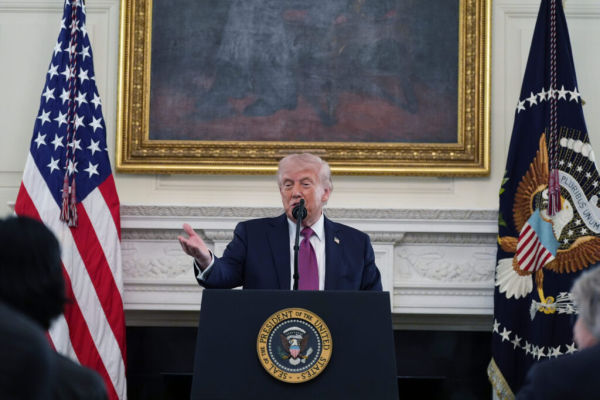
Trump Urges Congress to Pass New College Sports Reform Legislation/ TezzBuzz/ WASHINGTON/ J. Mansour/ Morning Edition/ President Donald Trump renewed his call for Congress to pass federal legislation aimed at controlling college sports, warning that unrestricted athlete transfers and NIL payments are creating financial instability. Speaking at the White House while honoring 2025 NCAA championship teams, Trump said the current system has become a “total and complete mess” after recent court rulings and the House v. NCAA settlement. He urged lawmakers to protect college athletics, women’s sports, and Olympic development programs by giving the NCAA stronger legal authority to enforce new rules.
- Trump wants Congress to pass major college sports reform laws
- He says athlete transfers and NIL pay are hurting college programs
- Trump recently signed an executive order targeting NCAA reforms
- The order limits eligibility to five years and allows one free transfer
- He wants an end to “pay-for-play” systems in college athletics
- Trump says women’s sports and Olympic sports need stronger protections
- He argues courts created confusion through the House v. NCAA settlement
- NCAA leaders are also seeking federal antitrust protection
Trump Pushes Congress to Reform College Sports
President Donald Trump on again urged Congress to step into the growing chaos surrounding college athletics, calling for new legislation to restore order to the NCAA system.
Speaking during a White House ceremony honoring NCAA championship teams from 2025, Trump said college sports are facing serious financial and competitive problems because athletes can now transfer freely and earn major compensation through name, image, and likeness (NIL) deals.
He warned that the system is becoming unsustainable for many athletic departments and threatens the future of Olympic and women’s sports.
Trump said the federal courts have created confusion by weakening NCAA enforcement power and allowing what he sees as an unchecked professional sports model inside college athletics.
Executive Order Targets NIL and Transfer Rules
Earlier this month, Trump signed an executive order aimed at reshaping college athletics while lawmakers debate broader legislation.
The order would limit athlete eligibility to five years and allow undergraduate athletes only one transfer without penalty.
It also seeks to stop what Trump described as “pay-for-play” arrangements, where schools or boosters effectively use NIL money as direct recruiting payments.
The administration says the goal is to restore balance and prevent college sports from becoming a full professional free-agent market.
The executive order also includes protections for women’s sports and Olympic development programs, areas Trump says are especially vulnerable under the current system.
However, legal experts have questioned whether the executive order alone can survive major court challenges.
That is why Trump and NCAA stakeholders are now pushing Congress for permanent legislation.
Why Congress Is Now Central to NCAA Reform
Trump says only Congress can provide the legal clarity the NCAA needs to fully enforce national rules.
He wants lawmakers to pass legislation that would not only codify transfer and eligibility limits, but also give the NCAA an antitrust exemption.
That exemption would protect the NCAA from constant legal challenges when it tries to regulate athlete compensation and movement.
Dozens of athletes have filed lawsuits challenging NCAA eligibility restrictions, often seeking to extend their college careers and continue earning NIL money.
Some athletes now stay in college athletics far longer than previous generations.
Trump argued that creates unfair competition.
He said it makes little sense for athletes straight out of high school to compete against players who are 28 or 29 years old.
For him, the issue is about fairness as much as finances.
House v. NCAA Settlement Changed the Landscape
Trump specifically pointed to the 2025 House v. NCAA settlement as a major turning point.
That legal agreement accelerated the shift toward a more professional financial model inside college sports, allowing athletes to receive greater direct compensation while reducing NCAA restrictions.
While supporters say the changes finally gave athletes fair economic rights, critics argue the system now favors only the richest athletic departments and biggest football programs.
Trump said the settlement deepened instability for schools trying to balance budgets and maintain non-revenue sports.
He believes the court-driven model is damaging the traditional structure of college athletics.
That concern is shared by many university presidents and athletic directors who fear rising costs could force schools to cut programs.
Trump Says Olympic Sports Are at Risk
One of Trump’s biggest concerns is the future of Olympic sports development in the United States.
He argued that college athletics serve as the foundation for Team USA success on the world stage.
He pointed to sports like swimming, volleyball, tennis, golf, rifle, and gymnastics, where college programs function as the main development system for elite athletes.
Without strong NCAA programs, Trump warned, the U.S. could lose its pipeline for future Olympic medalists.
He said these sports do not have the same professional development systems as football or basketball.
That makes college sports even more essential.
White House Honors 2025 NCAA Champions
The national champions honored included:
- Oklahoma State Cowboys men’s golf
- Texas A&M Aggies women’s volleyball
- Wake Forest Demon Deacons men’s tennis
- Georgia Bulldogs women’s tennis
- Youngstown State Penguins women’s bowling
- Florida State Seminoles women’s soccer
- West Virginia Mountaineers mixed rifle
The event was intended to celebrate college athletic achievement, but it also became a platform for Trump’s broader NCAA reform message.
NCAA and Universities Want Federal Protection
Trump is not alone in calling for congressional action.
Many college presidents, athletic directors, and NCAA officials have also asked lawmakers for federal intervention.
Their biggest request is legal protection from antitrust lawsuits that have repeatedly weakened NCAA authority.
Without federal backing, schools say they cannot create consistent national rules around recruiting, transfers, roster limits, or athlete compensation.
The NCAA has struggled to maintain control as court decisions continue reshaping the landscape.
Congress has debated several college sports reform proposals over the past few years, but no major bipartisan legislation has passed.
Trump is now trying to increase pressure on lawmakers to act faster.
Debate Over Athlete Rights Continues
Not everyone agrees with Trump’s approach.
Many athletes and legal advocates argue NIL rights and transfer freedom are long-overdue corrections to a system that generated billions for schools while players had little control.
Supporters of athlete rights say restrictions would unfairly limit earning opportunities and career choices.
They also argue that schools, coaches, and administrators have long profited from the system without similar limits.
The debate now centers on whether reform should prioritize institutional stability or athlete freedom.
Congress may soon be forced to decide where that balance should be.
Future of College Sports May Depend on Washington
Trump’s renewed push shows that college sports are no longer just an NCAA issue—they are now a national political issue.
With billions of dollars at stake and the future of college athletics under pressure, federal legislation may determine what the next era of NCAA competition looks like.
Whether Congress moves quickly or not, the structure of college sports is already changing.
The question is whether Washington will shape that future—or simply react to it.
More on US News
-
Akshay Kumar's Bhooth Bangla Dominates Box Office with Impressive Earnings

-
Kagiso Rabada's Past Disciplinary Record Under Scanner as GT Pacer Allegedly Spotted Smoking

-
Job Opportunity at Bharat Petroleum... Apply by May 17 for Recruitment to Junior Executive and Other Posts..

-
Trump hints 'good news' on Iran talks as ceasefire holds, Tehran pushes back
-
Cricket's Historic Comeback to the Olympics: Venue Construction Begins for LA 2028