Last summer, a Beijing resident identified as Liu received a birthday cake decorated with a nonedible flower after placing an order through a delivery app.
Unhappy with the purchase, he reported the seller to authorities. Investigators later found that the bakery was part of a fraudulent chain claiming nearly 400 outlets. In reality, none of these locations existed, and the business operated entirely using forged licenses.
It caused them to expand the investigation nationwide, and this exposed a shadowy food supply chain.
Sellers charged customers for orders, but passed them to intermediary platforms where producers bid to fulfill them. The lowest bidder typically won, often at the expense of food quality and safety.
More than 67,000 “ghost” vendors who had sold 3.6 million cakes were identified, Xinhua News Agency reported.
|
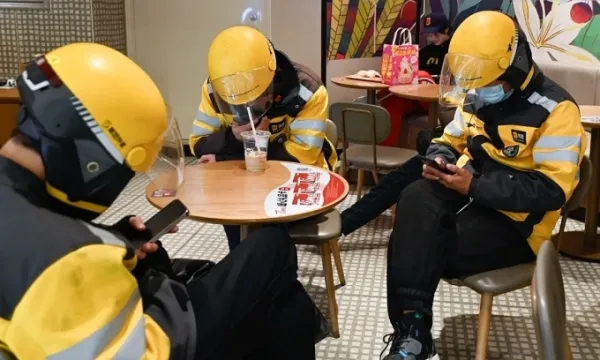
Delivery drivers wait for orders at a shopping mall in Beijing in March 2024. Photo from AFP |
China’s market regulator, the State Administration for Market Regulation, said last week that seven major delivery platforms, including PDD Holdings, Alibaba Group, ByteDance, Douyin, Meituan and JD.com, failed to adequately protect customers and verify vendors’ credentials.
It slapped a combined fine of 3.6 billion yuan on them, or US$528 million, the largest penalty since the amendment of the country’s food security law in 2015, according to Xinhua.
Pinduoduo was hit with the largest fine of 1.5 billion yuan ($221 million) for repeated noncooperation, falsified filings and obstructive behavior.
The company, along with Alibaba and Meituan, said it would accept the penalties and improve its supervision.
 |
|
Colin Huang, the founder of the e-commerce platform Pinduoduo. Photo from Baidu |
The 10-month probe underscores Beijing’s effort to curb cutthroat pricing that has pushed companies into a cycle of slashing delivery costs at the expense of food safety.
In China, this phenomenon is called neijuan or “involution.” It means intense price competition, which has spread across industries in recent years, from electric cars to solar panels.
This has driven down prices and weighed on the economy as consumer spending weakens.
In response, Beijing launched an anti-involution campaign last year.
Last month, the state run Economic Daily called for an end to price wars in the food delivery sector.
“Food and beverage businesses have been forced to sacrifice quality and compress margins, pushing the entire industry into a vicious cycle of losing money just to generate volume,” it wrote.
Flora Chang, an analyst at S&P Global Ratings, told American news outlet CNN that government intervention has begun to curb unhealthy competition, though platforms still compete through other means, including subsidies in different forms.
“That said, the fines are paving the way for platforms to compete more on quality … Overall, this suggests the worst of the unhealthy competition may be behind us for now, although the road to a recovery in profitability remains a distant one.”
-
Modi Govt’s ‘Gift’ To J&K: Vande Bharat Extended To Jammu Tawi, Coaches Increased To 20

-
Quote of the day by Oprah Winfrey: 'The greatest discovery of all time is that a person can change his future by...' - life lesson on how changing your mindset and attitude is the key to success by The Color Purple actress and OWN Tv founder

-
Quote of the Day by Martin Luther King Jr.: 'Darkness cannot drive out darkness; only...'—Inspiring quotes by American civil rights activist and one of the greatest nonviolent leaders in world history

-
Quote of the Day by Demi Moore: “Don’t let your wounds make you become someone you're not”—A powerful lesson on healing, self-identity and inner strength

-
The Neighbourhood fans 'immediately' distracted by same detail in ITV show