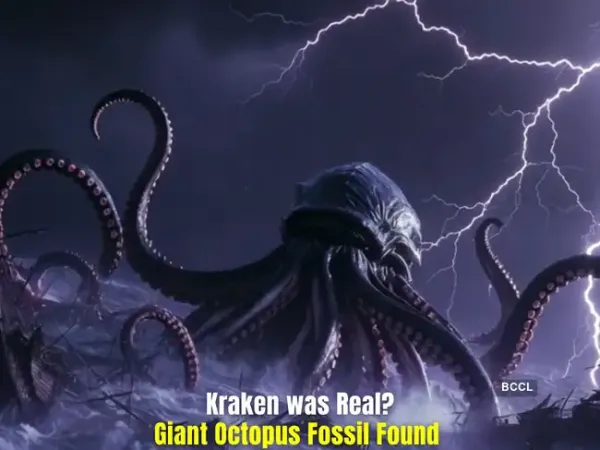
For centuries, sailors told tales of the Kraken, a colossal sea monster capable of dragging entire ships into the depths. Scientists long dismissed these stories as pure myth born from fear and exaggeration. But a groundbreaking study published in the journal Science brings the legend uncomfortably close to reality. Around 100 to 72 million years ago, during the Late Cretaceous period, the oceans were not ruled solely by giant marine reptiles such as mosasaurs and plesiosaurs.
New evidence shows that enormous, intelligent, octopus-like creatures also sat at the top of the food chain. The challenge in studying ancient cephalopods has always been their soft bodies, which rarely fossilise. While dinosaur bones and marine reptile skeletons endure, octopuses typically vanish without trace. Researchers, however, focused on the one hard part that can survive deep time: the chitinous beak.
By examining 27 fossilised beaks, some newly discovered through advanced digital fossil mining techniques and others reclassified, scientists identified a previously underappreciated group of predators belonging to the genus Nanaimoteuthis. The larger species, Nanaimoteuthis haggarti, may have reached lengths of up to 19 metres (about 62 feet), longer than a school bus and possibly the largest invertebrate ever to have lived.
These were no gentle giants drifting in the current. The beaks show heavy wear patterns, chips, scratches, and rounded edges from repeated high-impact use. Such damage points to a diet that included hard-shelled animals, large fish, and quite possibly the bones of other marine reptiles. Modern octopuses are already skilled at dismantling prey; scaled to this enormous size, these ancient cousins would have been formidable hunters.
The creatures also displayed signs of handedness, with asymmetrical wear suggesting they favoured one side of their body, much like humans. This hints at complex neural control and problem-solving ability, traits that make today’s octopuses among the most intelligent invertebrates on Earth. The discovery forces a rethink of Cretaceous marine ecosystems. For decades, textbooks portrayed these ancient seas as domains dominated exclusively by vertebrate giants.
Now it appears that soft-bodied cephalopods were central players, using intelligence, powerful arms, and crushing beaks to shape food webs in ways previously unrecognised.
Questions remain. If these giants were so dominant, why did they disappear? Changing ocean conditions, competition, or gaps in the fossil record may hold clues. Their evolutionary descendants likely gave rise to smaller, more specialised modern species. What is certain is that this find blurs the line between ancient myth and scientific fact.
The oceans have always hidden mysteries. Even today, vast stretches of the deep sea remain unexplored. If a bus-sized, bone-crushing, thinking octopus could rule the planet for millions of years and stay hidden in the rocks until now, one wonders what else the fossil record, and the living ocean, still conceals.
(With TOI inputs)
New evidence shows that enormous, intelligent, octopus-like creatures also sat at the top of the food chain. The challenge in studying ancient cephalopods has always been their soft bodies, which rarely fossilise. While dinosaur bones and marine reptile skeletons endure, octopuses typically vanish without trace. Researchers, however, focused on the one hard part that can survive deep time: the chitinous beak.
By examining 27 fossilised beaks, some newly discovered through advanced digital fossil mining techniques and others reclassified, scientists identified a previously underappreciated group of predators belonging to the genus Nanaimoteuthis. The larger species, Nanaimoteuthis haggarti, may have reached lengths of up to 19 metres (about 62 feet), longer than a school bus and possibly the largest invertebrate ever to have lived.
These were no gentle giants drifting in the current. The beaks show heavy wear patterns, chips, scratches, and rounded edges from repeated high-impact use. Such damage points to a diet that included hard-shelled animals, large fish, and quite possibly the bones of other marine reptiles. Modern octopuses are already skilled at dismantling prey; scaled to this enormous size, these ancient cousins would have been formidable hunters.
The creatures also displayed signs of handedness, with asymmetrical wear suggesting they favoured one side of their body, much like humans. This hints at complex neural control and problem-solving ability, traits that make today’s octopuses among the most intelligent invertebrates on Earth. The discovery forces a rethink of Cretaceous marine ecosystems. For decades, textbooks portrayed these ancient seas as domains dominated exclusively by vertebrate giants.
Now it appears that soft-bodied cephalopods were central players, using intelligence, powerful arms, and crushing beaks to shape food webs in ways previously unrecognised.
Questions remain. If these giants were so dominant, why did they disappear? Changing ocean conditions, competition, or gaps in the fossil record may hold clues. Their evolutionary descendants likely gave rise to smaller, more specialised modern species. What is certain is that this find blurs the line between ancient myth and scientific fact.
The oceans have always hidden mysteries. Even today, vast stretches of the deep sea remain unexplored. If a bus-sized, bone-crushing, thinking octopus could rule the planet for millions of years and stay hidden in the rocks until now, one wonders what else the fossil record, and the living ocean, still conceals.
(With TOI inputs)