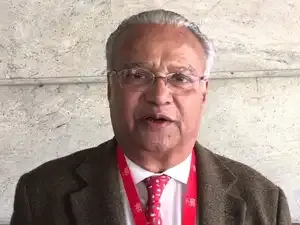
A tariff schedule is a form of foreign policy. A power purchase agreement is an act of statecraft. A chip fabrication plant is a geopolitical asset. The separation between economics and strategy that was taken for granted has collapsed in the 21stCentury, said Pradeep S Mehta, Secretary General of CUTS International, as he launched the second webinar of the organisation’s geoeconomic initiative.
CUTS International recently convened the second webinar of its Geoeconomic Monograph Series, “Global Strategies in the Age of Geoeconomics” (G-SAGE), bringing together leading scholars and policy experts from South Africa, the United Kingdom, India, and Taiwan for a high-level virtual exchange on the defining geoeconomic challenges of 2026.
The event was moderated by Jackline Kagume, lawyer and the programme lead for the Law and Economy Programme at the Institute of Economic Affairs (IEA), Kenya.
In his opening remarks, Mehta framed the urgency of the moment by observing that the multilateral trading system, built over eight decades, is visibly fraying: the WTO Appellate Body remains paralysed, the Most Favoured Nation principle is openly questioned by both the United States and the European Union, and unilateral and weaponised tariff measures have replaced the collegial rule-making of an earlier era.
“The four papers presented at the webinar were precisely that: strategic thinking from regions and economies that have everything to gain from getting geoeconomics right,” Mehta asserted.
Garth le Pere, Professor of International Relations at the University of Pretoria, South Africa, presented his chapter on the African Continental Free Trade Area (AfCFTA), framing it as a collective act of economic statecraft.
“The AfCFTA is Africa’s riposte to decades of collective clientelism, the asymmetric dependencies embedded in Economic Partnership Agreements with the EU, and market-access conditionalities under the US’s AGOA. With 54 signatory states, a combined GDP of $1.3 trillion, and a population of 1.4 billion set to exceed the combined populations of India and China within four decades, the AfCFTA holds the promise of shifting the continent from commodity dependence towards genuine industrialisation and strategic autonomy,” he argued, noting that intra-African exports could rise from 17 per cent today to a projected 52 per cent by 2040.
Hana Al Wakeel, Research Assistant, Firoz Lalji Institute for Africa, London School of Economics and Political Science of the LSE Firoz Lalji Institute for Africa challenged conventional trade orthodoxy by proposing a sequencing logic for Africa’s global engagement.
“Regional integration must come first, strategic openness second, and full reciprocity last. Prematurely entering into fully reciprocal agreements with major trading partners before the AfCFTA is consolidated would produce trade diversion and regulatory fragmentation, undermining the very gains the continent is trying to secure,” they argued, backed by the UN Economic Commission for Africa modelling.
Their call for time-bound protection of strategic sectors,agro-processing, pharmaceuticals, and manufacturing alongside reforms to WTO disciplines on the substantial proportion of trade requirements, was characterised as a developmentally informed approach to globalisation, not a retreat from it.
Professor Kirit Parikh, Chairman of the Integrated Research and Action for Development (IRADe), India, examined how cross-border electricity trade has evolved from a technical question of grid connectivity into a full-fledged instrument of economic statecraft.
“The BBIN framework, Bangladesh, Bhutan, India, and Nepal,presents a structural geoeconomic asset. Nepal’s 83,000 MW and Bhutan’s 41,000 MW of hydropower potential, India’s rapidly expanding renewable capacity, and Bangladesh’s structural power deficit are deeply complementary. Our modelling shows that with accelerated power trade,Nepal’s GDP could be 39 per cent larger by 2045. In November 2024, Nepal made history by exporting electricity to Bangladesh through the Indian grid, the first-ever trilateral power trade in South Asia,” he said, further arguing that 24x7 reliable and affordable power is not merely an infrastructure question but a precondition for digital inclusion, the demographic dividend, and competitiveness in an AI-dominated world.
Dr Kristy Tsun-Tzu Hsu, Director of the Taiwan ASEAN Studies Centre at the Chung-Hua Institution for Economic Research, offered a rigorous stress test of Taiwan’s semiconductor resilience.
“Taiwanese firms account for 76.3 per cent of the global foundry market, and nearly a fifth of all global maritime trade passes through the Taiwan Strait. The concept of the ‘silicon shield’ captures the dual nature of this position: it is simultaneously an economic asset and a geopolitical vulnerability. Four structural challenges: energy dependence, water stress, cybersecurity threats, and a talent shortagedemand urgent attention if this critical node in the global supply chain is to remain resilient,” she argued. Taiwan’s plans to mass-produce 2-nanometre chips, the most advanced in the world, were announced for late 2025.
The G-SAGE series will continue through successive quarterly webinars featuring new regional analyses and thematic deep dives, culminating in the publication of a comprehensive compendium of more than 25 monographs and an international conference in India.
The initiative brings together senior experts and emerging scholars in a mentorship model, analysing countries and regional groupings through six thematic lenses: supply chains and industrial policy; critical and emerging technologies; infrastructure and connectivity corridors; climate transition and energy security; trade and financial governance reforms; and strategic investments and resource security.
“Developing countries and emerging economies cannot afford to be passive observers of these transformations. They must be strategic actors with the analytical tools, policy frameworks, and institutional capacity to navigate geoeconomics on their own terms,” Kagume concluded, affirming the G-SAGE series’ ambition to bridge rigorous scholarship with urgent policy relevance.
CUTS International recently convened the second webinar of its Geoeconomic Monograph Series, “Global Strategies in the Age of Geoeconomics” (G-SAGE), bringing together leading scholars and policy experts from South Africa, the United Kingdom, India, and Taiwan for a high-level virtual exchange on the defining geoeconomic challenges of 2026.
The event was moderated by Jackline Kagume, lawyer and the programme lead for the Law and Economy Programme at the Institute of Economic Affairs (IEA), Kenya.
In his opening remarks, Mehta framed the urgency of the moment by observing that the multilateral trading system, built over eight decades, is visibly fraying: the WTO Appellate Body remains paralysed, the Most Favoured Nation principle is openly questioned by both the United States and the European Union, and unilateral and weaponised tariff measures have replaced the collegial rule-making of an earlier era.
“The four papers presented at the webinar were precisely that: strategic thinking from regions and economies that have everything to gain from getting geoeconomics right,” Mehta asserted.
Garth le Pere, Professor of International Relations at the University of Pretoria, South Africa, presented his chapter on the African Continental Free Trade Area (AfCFTA), framing it as a collective act of economic statecraft.
“The AfCFTA is Africa’s riposte to decades of collective clientelism, the asymmetric dependencies embedded in Economic Partnership Agreements with the EU, and market-access conditionalities under the US’s AGOA. With 54 signatory states, a combined GDP of $1.3 trillion, and a population of 1.4 billion set to exceed the combined populations of India and China within four decades, the AfCFTA holds the promise of shifting the continent from commodity dependence towards genuine industrialisation and strategic autonomy,” he argued, noting that intra-African exports could rise from 17 per cent today to a projected 52 per cent by 2040.
Hana Al Wakeel, Research Assistant, Firoz Lalji Institute for Africa, London School of Economics and Political Science of the LSE Firoz Lalji Institute for Africa challenged conventional trade orthodoxy by proposing a sequencing logic for Africa’s global engagement.
“Regional integration must come first, strategic openness second, and full reciprocity last. Prematurely entering into fully reciprocal agreements with major trading partners before the AfCFTA is consolidated would produce trade diversion and regulatory fragmentation, undermining the very gains the continent is trying to secure,” they argued, backed by the UN Economic Commission for Africa modelling.
Their call for time-bound protection of strategic sectors,agro-processing, pharmaceuticals, and manufacturing alongside reforms to WTO disciplines on the substantial proportion of trade requirements, was characterised as a developmentally informed approach to globalisation, not a retreat from it.
Professor Kirit Parikh, Chairman of the Integrated Research and Action for Development (IRADe), India, examined how cross-border electricity trade has evolved from a technical question of grid connectivity into a full-fledged instrument of economic statecraft.
“The BBIN framework, Bangladesh, Bhutan, India, and Nepal,presents a structural geoeconomic asset. Nepal’s 83,000 MW and Bhutan’s 41,000 MW of hydropower potential, India’s rapidly expanding renewable capacity, and Bangladesh’s structural power deficit are deeply complementary. Our modelling shows that with accelerated power trade,Nepal’s GDP could be 39 per cent larger by 2045. In November 2024, Nepal made history by exporting electricity to Bangladesh through the Indian grid, the first-ever trilateral power trade in South Asia,” he said, further arguing that 24x7 reliable and affordable power is not merely an infrastructure question but a precondition for digital inclusion, the demographic dividend, and competitiveness in an AI-dominated world.
Dr Kristy Tsun-Tzu Hsu, Director of the Taiwan ASEAN Studies Centre at the Chung-Hua Institution for Economic Research, offered a rigorous stress test of Taiwan’s semiconductor resilience.
“Taiwanese firms account for 76.3 per cent of the global foundry market, and nearly a fifth of all global maritime trade passes through the Taiwan Strait. The concept of the ‘silicon shield’ captures the dual nature of this position: it is simultaneously an economic asset and a geopolitical vulnerability. Four structural challenges: energy dependence, water stress, cybersecurity threats, and a talent shortagedemand urgent attention if this critical node in the global supply chain is to remain resilient,” she argued. Taiwan’s plans to mass-produce 2-nanometre chips, the most advanced in the world, were announced for late 2025.
The G-SAGE series will continue through successive quarterly webinars featuring new regional analyses and thematic deep dives, culminating in the publication of a comprehensive compendium of more than 25 monographs and an international conference in India.
The initiative brings together senior experts and emerging scholars in a mentorship model, analysing countries and regional groupings through six thematic lenses: supply chains and industrial policy; critical and emerging technologies; infrastructure and connectivity corridors; climate transition and energy security; trade and financial governance reforms; and strategic investments and resource security.
“Developing countries and emerging economies cannot afford to be passive observers of these transformations. They must be strategic actors with the analytical tools, policy frameworks, and institutional capacity to navigate geoeconomics on their own terms,” Kagume concluded, affirming the G-SAGE series’ ambition to bridge rigorous scholarship with urgent policy relevance.