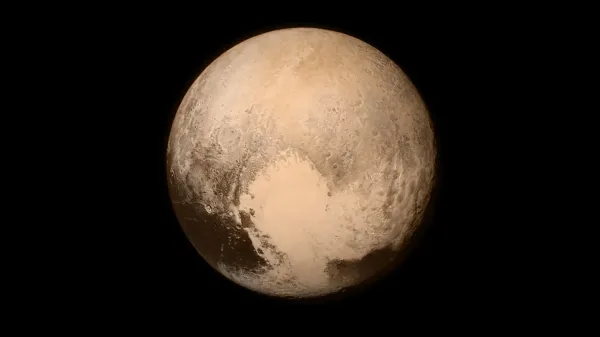
If you grew up memorising the solar system, chances are you learned there were nine planets with Pluto proudly bringing up the rear. Then, almost overnight, textbooks changed. Pluto was out, and the count dropped to eight. Now, years later, that decision is being questioned again.
The trigger this time is Jared Isaacman, who recently told a US Senate hearing that he supports the idea of restoring Pluto’s full planet status. His remarks have reopened one of astronomy’s most emotional and debated topics.
What exactly happened in 2006?
In 2006, the International Astronomical Union (IAU), the global authority that defines celestial classifications, set strict rules for what counts as a planet. According to this definition, a planet must:
- Orbit the Sun
- Be round due to its own gravity
- Clear its orbit of other objects
Pluto ticks the first two boxes but fails the third. It travels through a region called the Kuiper Belt, which is filled with icy bodies of similar size. That meant Pluto was reclassified as a “dwarf planet.”
The move wasn’t just about Pluto. Scientists had started discovering several Pluto-like objects in the outer solar system, raising a bigger question: if Pluto stayed a planet, should all those objects be called planets too?
Why many scientists still disagree
Critics argue the rules are too rigid and not entirely consistent. For instance, even Earth shares its orbit with asteroids, and giant planets like Jupiter influence plenty of surrounding debris. So why single out Pluto?
Some researchers believe the definition should focus more on a planet’s physical features rather than its surroundings.
Pluto’s image problem and its revival
For years, Pluto was thought to be a cold, inactive rock. That perception changed dramatically in 2015 when NASA’s New Horizons flew past it.
The mission revealed a surprisingly active world with glaciers, mountains made of ice, and a massive heart-shaped region called Tombaugh Regio. These discoveries made scientists rethink whether Pluto really belongs in a lesser category.
So, can Pluto become a planet again?
Not so fast. Only the IAU has the authority to officially redefine what a planet is. NASA, even with backing from leaders like Isaacman, cannot change that on its own.
Still, the renewed discussion shows the story isn’t over. As science evolves and new discoveries reshape our understanding of the solar system, Pluto’s status could once again be up for review.
For now, it remains a dwarf planet but clearly, not a forgotten one.
-
Kosovo to hold snap elections in June

-
Bail denied to accused in PFI anti-national activities case

-
Live-in relationship: 34-year-old woman dies by suicide in Bengaluru

-
Dubai honours bus driver who helped blind man safely cross road

-
Gwen Farrell dead: M*A*S*H icon dies as family issue emotional tribute to 'guiding light'