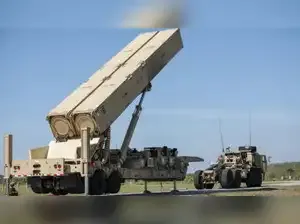
The US Central Command has reportedly sought approval to send the Army’s long-in-development Dark Eagle hypersonic missile to the Middle East, a move aimed at strengthening its ability to strike targets deep inside Iran. If cleared, this would be the first time the system—also known as the Long-Range Hypersonic Weapon (LRHW)—is deployed in an operational setting. The programme has faced multiple delays and is still not officially declared fully operational, even as countries like Russia and China have already fielded comparable weapons.
According to reports, the move to deploy Dark Eagle comes amid concerns that Iran has repositioned some of its ballistic missile launchers beyond the reach of existing US systems such as the Precision Strike Missile, which has a range of just over 300 miles. A final decision on deployment, however, is yet to be made.
What is Dark Eagle?
Dark Eagle is said to be an advanced hypersonic missile but it is still in developement phase and is yet to be used in any battlefield. Designed for long-range, high-precision strikes against heavily defended targets, the ground-launched missile reportedly can travel at speeds exceeding Mach 5 and is thus extremely difficult for current defence systems to detect or intercept. The missile is believed to have a range of roughly 1,700 miles (about 2,700 km), enabling it to hit targets far inside enemy territory. Its intended targets include air defence systems, command centres, and missile launch sites—critical assets in modern warfare. Each missile is estimated to cost around $15 million, and only a limited number are available, suggesting it would be used sparingly and for high-priority targets.
The hostilities began on 28 February following coordinated strikes by the US and Israel against Tehran and other regional targets. Iran responded by striking US bases and Israeli positions, alongside disrupting maritime traffic in the Strait of Hormuz, which caused a sharp spike in global oil prices.
The United States imposed a blockade on Iran's ports two weeks ago, while the Islamic republic has maintained its stranglehold over the strategic Strait of Hormuz since the start of the Middle East war at the end of February.
Washington is now seeking to assemble an international coalition of allied states and shipping firms to coordinate safe passage through Hormuz -- while maintaining its blockade of ships serving Iran, a State Department official told AFP.
Trump threatened Thursday to withdraw US troops from Italy and Spain, extending similar warnings already made against Germany, after lambasting the NATO allies for failing to support US-Israeli operations against Iran, including in the Strait.
According to reports, the move to deploy Dark Eagle comes amid concerns that Iran has repositioned some of its ballistic missile launchers beyond the reach of existing US systems such as the Precision Strike Missile, which has a range of just over 300 miles. A final decision on deployment, however, is yet to be made.
What is Dark Eagle?
Dark Eagle is said to be an advanced hypersonic missile but it is still in developement phase and is yet to be used in any battlefield. Designed for long-range, high-precision strikes against heavily defended targets, the ground-launched missile reportedly can travel at speeds exceeding Mach 5 and is thus extremely difficult for current defence systems to detect or intercept. The missile is believed to have a range of roughly 1,700 miles (about 2,700 km), enabling it to hit targets far inside enemy territory. Its intended targets include air defence systems, command centres, and missile launch sites—critical assets in modern warfare. Each missile is estimated to cost around $15 million, and only a limited number are available, suggesting it would be used sparingly and for high-priority targets.The hostilities began on 28 February following coordinated strikes by the US and Israel against Tehran and other regional targets. Iran responded by striking US bases and Israeli positions, alongside disrupting maritime traffic in the Strait of Hormuz, which caused a sharp spike in global oil prices.
The United States imposed a blockade on Iran's ports two weeks ago, while the Islamic republic has maintained its stranglehold over the strategic Strait of Hormuz since the start of the Middle East war at the end of February.
Washington is now seeking to assemble an international coalition of allied states and shipping firms to coordinate safe passage through Hormuz -- while maintaining its blockade of ships serving Iran, a State Department official told AFP.
Trump threatened Thursday to withdraw US troops from Italy and Spain, extending similar warnings already made against Germany, after lambasting the NATO allies for failing to support US-Israeli operations against Iran, including in the Strait.