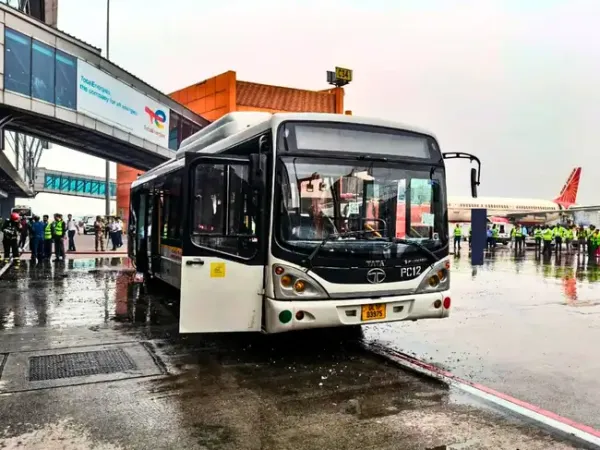
Starting July 2026, transferring between terminals at Delhi’s Indira Gandhi International Airport will become significantly smoother and less exhausting. Passengers moving between Terminal 1 and Terminal 3, or Terminal 1 and Terminal 2, will use dedicated airside buses instead of battling cityside traffic on DTC buses. The change is a major step towards turning Delhi airport into a proper international hub with seamless connections.
For travellers with tight connections, the new system will reduce stress and the risk of missing flights. Families, senior citizens and business travellers will particularly benefit from shorter, smoother transfers without the need to clear security multiple times or drag luggage through traffic.The move is part of Delhi airport’s plan to become a full-fledged hub-and-spoke airport, similar to Dubai, Singapore, or Doha, where seamless transfers are standard.
In this model, passengers from smaller cities or other countries arrive at the hub and easily connect to onward flights. Seamless terminal transfers are essential for this system to work efficiently. The new airside bus service is a practical step towards this goal while the long-planned automated people mover (air train) remains years away.
The Bureau of Civil Aviation Security (BCAS) is finalising safety protocols, with implementation expected by end-June or early July 2026. Passengers will receive clearly marked boarding cards (D for domestic, I for international) at their origin airport to ensure smooth segregation during airside transfers.
(With TOI inputs)
What Is Airside Transfer at Delhi Airport
Airside refers to the restricted area beyond security that includes runways, taxiways and aircraft parking. Currently, passengers moving between T3/T2 and T1 have to exit the secure zone, take a DTC bus through city traffic, and re-enter security — a process that often takes 45 minutes to over an hour.How Airside Transfers Will Work
DIAL will deploy special buses on the airport’s internal periphery (airside). These buses will have speed governors fixed at 20 kmph for safety. A one-way journey is expected to take about 20 minutes. The buses will operate between:- T1 and T3 (for international-to-domestic, domestic-to-international, and domestic-to-domestic transfers)
- T1 and T2 (for domestic-to-domestic transfers)
Why This Change Matters for Passengers
For travellers with tight connections, the new system will reduce stress and the risk of missing flights. Families, senior citizens and business travellers will particularly benefit from shorter, smoother transfers without the need to clear security multiple times or drag luggage through traffic.The move is part of Delhi airport’s plan to become a full-fledged hub-and-spoke airport, similar to Dubai, Singapore, or Doha, where seamless transfers are standard.
In this model, passengers from smaller cities or other countries arrive at the hub and easily connect to onward flights. Seamless terminal transfers are essential for this system to work efficiently. The new airside bus service is a practical step towards this goal while the long-planned automated people mover (air train) remains years away.
Terminal Roles at Delhi Airport
- Terminal 1 will remain purely domestic because of its long, straight design, which makes separating domestic and international passengers very difficult.
- Terminal 2 (built in 1986) will continue as a domestic terminal in its final years. Terminal 3 has been the main integrated terminal (handling both domestic and international flights) since 2010.
- Terminal 4 (to be built later in place of T2) will become the second integrated terminal.
What This Means for You
For transit passengers, the change means less stress, lower risk of missing flights, and a more comfortable experience. International passengers arriving at T1 or T2 will now be able to feed into wide-body flights departing from T3 much more smoothly. The system will also help increase Delhi’s international connectivity in the coming years.The Bureau of Civil Aviation Security (BCAS) is finalising safety protocols, with implementation expected by end-June or early July 2026. Passengers will receive clearly marked boarding cards (D for domestic, I for international) at their origin airport to ensure smooth segregation during airside transfers.
(With TOI inputs)